This extensive publication, complete with hundreds of illustrations by such renowned artists as Carl Larsson, Edvard Munch, Vilhelm Hammershøi, Helene Schjerfbeck, Pekka Halonen, Akseli Gallen-Kallela, Gerhard Munthe, Pietro Krohn, and Frida Hansen, among others, offers an unprecedented study of Japanese influence on the visual arts in the Nordic countries. This unlikely diffusion of Japanese culture, known collectively as Japonisme, became increasingly apparent in England, France, and elsewhere in Europe during the 19th century, although nowhere was the influence seemingly as pervasive as it was throughout the Nordic countries. The book reveals how the widespread interest in Japanese aesthetics helped to establish notions of a fundamental unity between the arts and transformed the region’s visual vocabulary. The adoption of Japanese motifs and styles in Finland, Norway, Sweden, and Denmark gave a necessary cohesion to their existing artistic language, creating a vital balance within and among all of the decorative arts.
Short version for those not particularly interested in the subject: Japonisme in the Nordic countries is pretty much the same as Japonisme everywhere else, which is to say that Japanese-style stuff was suddenly popular and had a significant effect on art, especially in terms of composition and perspective. It is important in understanding the stylistic development of Impressionism and the Aesthetic Movement.
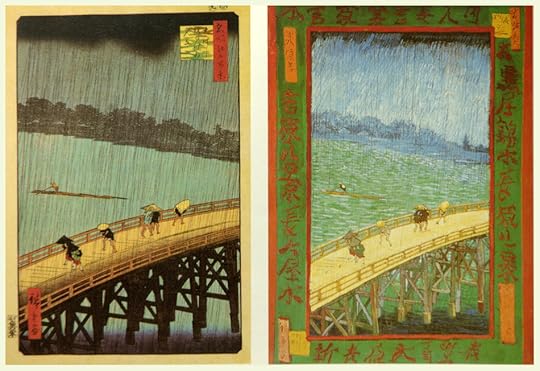
Van Gogh copied a number of Japanese paintings and prints.
Longer version for those interested in art history: Japonisme in the Nordic countries is pretty much the same as Japonisme everywhere else, except of course all the individual artists are different, and usually the specific subject matter likewise. Also, Nordic attitudes toward nature were more different from those in the rest of Europe and so landscapes often had symbolic meaning rather than being primarily decorative. Especially in countries that were not independent, Japonisme sometimes became linked to nationalist or cultural revivalism movements.
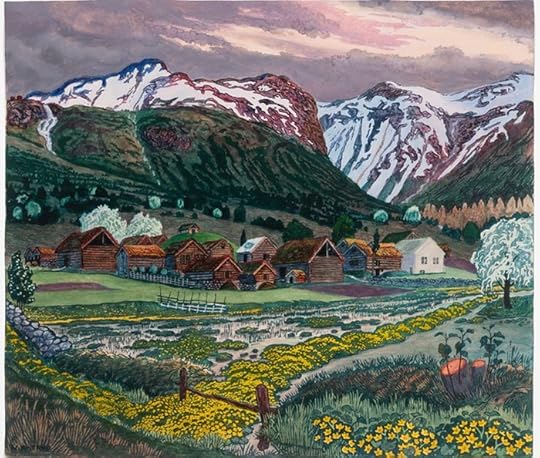
Mount Kolsaas took on the sacred character of the oft-depicted Mt Fuji
It was natural that Nordic Japonisme started out as almost identical to the general European fad: it was introduced by artists who had been studying in France and saw Japanese works displayed at the Exposition, or pieces by other artists who saw the exhibit. The Exposition Universelle was also integral in the shift to the idea that promoting or preserving the distinctive features of one's national culture was an important goal.
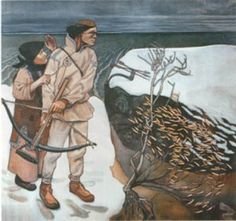
Akseli Gallen-Kallela, the unofficial National Painter of Finnland, was one of those influenced by Japanese art techniques.
Even as someone fairly well-acquainted with art of this period, I found some works I had not been familiar with prior. The reproductions are high quality and I enjoyed them very much. However, this is not a lavish coffee-table art book composed primarily of full-page plates; most images are half or quarter page inserted in text. The accompanying essays are not too abstruse for a lay reader but they are serious research articles rather than basic introductory material (although the introduction itself will probably give you an adequate grounding if you're new to the period). Widar Halen's "Japonisme, National Identity and a New Aesthetic Idiom" and Anna-Maria Bonsdorff's "From Blade of Grass to Sacred Wilderness" are, I think, the essays that would be most interesting to readers who want wider political and cultural contexts.