

What do you think?
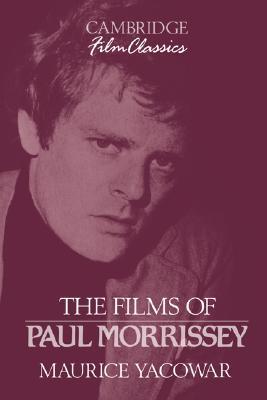
The Films of Paul Morrissey
The Films of Paul Morrissey is the first appraisal of one of the major figures of American independent cinema. An innovator in the narrative cinema that emerged from Andy Warhol's Factory, Morrissey, as established in this study, was also the force who shaped the most important films that have heretofore been attributed to Warhol. The director's experiments in the use of non-professional actors, controversial subject matter, and language are demonstrated through analysis of his most accomplished achievements, including Mixed Blood, 40 Deuce, and Spike of Bensonhurst. The Films of Paul Morrissey furthermore reveals the director's challenge to the moral, social and political values of contemporary liberalism.
160 pages, Paperback
First published May 28, 1993
Ratings & Reviews
Friends & Following
Create a free account to discover what your friends think of this book!
Community Reviews
Displaying 1 - 2 of 2 reviews

November 30, 2016
Paul Morrissey was (and remains) a very harsh, cruel, catholic conservative who used his Hollywood aesthetics of the 'STAR" to appeal to the (also catholic tastes?) of Andy Warhol by pushing the development of Hollywood's golden age (of talkies) thru narrative films based on "stars."
Intentional (but likely not), what I love about the Warhol film timeline is they started out and ended up being a complete imitation of the invention of the Hollywood industry. "Sleep." "Kiss." "Empire" (as in Empire State Building), were all essentially slow moving stills, almost identical to the earliest stages of film shown to a public audience.
In the earliest days of film, simply seeing the most minor of moving images was enough to enthrall an audience. (The latent, (I believe intended) brilliant concept behind this, was if in any given room of a museum, instead of hanging a canvas, if instead you were to "hang" a canvas by projecting a 4 to 24 hour movie of a person sleeping, or the empire state building from dawn to dusk, you had a new form of canvas; perfect for the modern age.)
Warhol started working with theatre of the ridiculous writers like Ronald Tavel who made the brilliant "Warhol" film The life and death of Juanita Castro, but the first, real taste of the Warhol narrative world came with the film Flesh, the first part of the "trilogy" known now as "Flesh" "Trash" and "Heat"; although what's less known is that "Women in Revolt" preceeded "Heat".
In relation to the interviews in this book, Paul Morrissey viewed all these films as lifestyles synonymous with Garbage i.e. "trash". Yet he loved each and every performance of each "star' in these films, as well as the ones that followed: Blood for Dracula, and Flesh for Frankenstein followed, were pure perfection. The films that followed these have their moments, but also show how essential the initial Warhol vibration was needed to complete these camp masterpieces, "flesh" excluded. Please amazon this book and search out the films. Its a wonderful romp thru the mind of one of the most conservative, latter day faux hollywood classicist film makers who used the most decadent of materials (people) to make his and THEIR points. It's beyond comprehension, but makes perfect sense, you'll feel for Paul M at the end: bitter and weird. Harmony Korine without harmony.
; a Warhol coup lifted from Jack Smith, who is attributed the first use of the term superstar. he above anyone else during his peak period (the chaotic late 60's/ early 70's) movies were to ultimately achieve.
Intentional (but likely not), what I love about the Warhol film timeline is they started out and ended up being a complete imitation of the invention of the Hollywood industry. "Sleep." "Kiss." "Empire" (as in Empire State Building), were all essentially slow moving stills, almost identical to the earliest stages of film shown to a public audience.
In the earliest days of film, simply seeing the most minor of moving images was enough to enthrall an audience. (The latent, (I believe intended) brilliant concept behind this, was if in any given room of a museum, instead of hanging a canvas, if instead you were to "hang" a canvas by projecting a 4 to 24 hour movie of a person sleeping, or the empire state building from dawn to dusk, you had a new form of canvas; perfect for the modern age.)
Warhol started working with theatre of the ridiculous writers like Ronald Tavel who made the brilliant "Warhol" film The life and death of Juanita Castro, but the first, real taste of the Warhol narrative world came with the film Flesh, the first part of the "trilogy" known now as "Flesh" "Trash" and "Heat"; although what's less known is that "Women in Revolt" preceeded "Heat".
In relation to the interviews in this book, Paul Morrissey viewed all these films as lifestyles synonymous with Garbage i.e. "trash". Yet he loved each and every performance of each "star' in these films, as well as the ones that followed: Blood for Dracula, and Flesh for Frankenstein followed, were pure perfection. The films that followed these have their moments, but also show how essential the initial Warhol vibration was needed to complete these camp masterpieces, "flesh" excluded. Please amazon this book and search out the films. Its a wonderful romp thru the mind of one of the most conservative, latter day faux hollywood classicist film makers who used the most decadent of materials (people) to make his and THEIR points. It's beyond comprehension, but makes perfect sense, you'll feel for Paul M at the end: bitter and weird. Harmony Korine without harmony.
; a Warhol coup lifted from Jack Smith, who is attributed the first use of the term superstar. he above anyone else during his peak period (the chaotic late 60's/ early 70's) movies were to ultimately achieve.

February 26, 2008
As the projectionist at the Andy Warhol Museum, I've probably projected every Morrissey film there is. & I've watched them indepedent of that. When Morrissey came & talked at the Warhol, someone asked him why he doesn't make movies anymore. He replied "Because I don't like making them." Weird. That sortof sums him up for me. He made some great films w/ some great alternative culture characters - esp drag queens. He seems to appreciate that their personalities are what make the movies. & yet he seems to think of his stars as TRASH. I mean, Holly Woodlawn? Fantastic. What did he pay Woodlawn? $25 a day, no royalties. Something like that. Certainly he cd've given them more. The actors were desperate, Morrissey contemptuously exploited them.
if you think of Morrissey as some sort of champion of the blatantly perverse, forget it. This bk, at least, portrays him as a sortof ultra-right-wing republican whose filmic morals are somewhat less than enlightened. Take "Spike of Bensonhurst" - one might think that the depiction of the Mafia's destroying other neighborhoods w/ their addicitive drug dealing (while keeping their own neighborhood drug-free) might be criticized here as an indication of the Mafia's total racism. But, NO, not according to this bk - Yacowar claims that Morrissey ADMIRES the Mafia as a keeper of law & order & as an example to be followed. As for the drug-users? Apparently they're scum who get what they deserve for being so 'liberal'.
Can Morrissey really be this big of an asshole?! I like his films, even though I think he's a ruthless exploiter, & even I find Yacowar's take on "Spike" a bit hard to swallow. STILL, the arguments are convincing enuf & Morrissey WAS a close associate of Warhol's - who exploited people as much as his greedy little hands cd manage. So, dunno. Morrissey's complex - or maybe he's not - maybe he's just a right-wing airhead gay guy (like Roy Cohn) who just happened to be in the right place at the right time to rip people off & run w/ the money.
if you think of Morrissey as some sort of champion of the blatantly perverse, forget it. This bk, at least, portrays him as a sortof ultra-right-wing republican whose filmic morals are somewhat less than enlightened. Take "Spike of Bensonhurst" - one might think that the depiction of the Mafia's destroying other neighborhoods w/ their addicitive drug dealing (while keeping their own neighborhood drug-free) might be criticized here as an indication of the Mafia's total racism. But, NO, not according to this bk - Yacowar claims that Morrissey ADMIRES the Mafia as a keeper of law & order & as an example to be followed. As for the drug-users? Apparently they're scum who get what they deserve for being so 'liberal'.
Can Morrissey really be this big of an asshole?! I like his films, even though I think he's a ruthless exploiter, & even I find Yacowar's take on "Spike" a bit hard to swallow. STILL, the arguments are convincing enuf & Morrissey WAS a close associate of Warhol's - who exploited people as much as his greedy little hands cd manage. So, dunno. Morrissey's complex - or maybe he's not - maybe he's just a right-wing airhead gay guy (like Roy Cohn) who just happened to be in the right place at the right time to rip people off & run w/ the money.
Displaying 1 - 2 of 2 reviews