1. Edward Burne-Jones was a later member of the Pre-Raphaelite Brotherhood, which had been founded by Dante Gabriel Rossetti with William Holman Hunt and John Everett Millais.
2. Edward Burne-Jones, along with William Morris, was a founding partner of the decorative arts company, “Morris, Marshall, Faulkner & Co.”
3. Edward Burne-Jones was later to be termed “Sir Edward Coley Burne-Jones, 1st Baronet”, after the recommendation by the Prime Minister William Ewart Gladstone. William Morris, his closest friend, was disgusted about Burne-Jones accepting the honorary title, as was his socialist wife Georgiana. Only his son Philip, who had an eye on inheriting the title - and already mixed with the “right” set, including the Prince of Wales - was truly happy about his father’s award.
All these are well-known facts about the artist Edward Burne-Jones. Here is another fact:
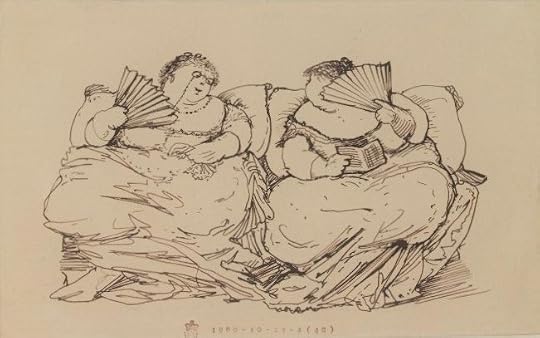
4. Edward Burne-Jones was a skilled caricaturist, with a penchant for amply buxom ladies and portly gentlemen.
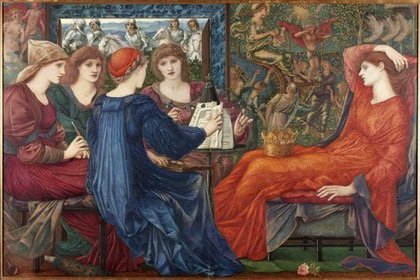
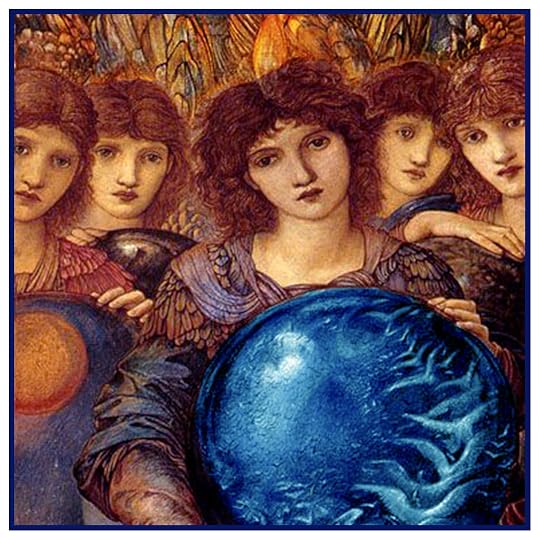
What? Did you have to read that sentence twice? Surely, I hear you say, he was the artist who painted such ethereal, wan maidens, and admired young women with luxuriant red hair, referring to them as “beauties”, as did William Morris?
Laus Veneris - Edward Burne-Jones
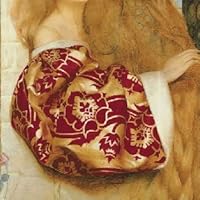
The Angel of Creation (detail) - Edward Burne-Jones
Yes, all this is true. But looking at the drawings in this book, we realise, with surprise, that Edward Burne-Jones could have made his reputation on caricature alone. Often at dinner parties, he would be there in a corner drawing amusing caricatures of those present. The speed and accuracy (much exaggerated, of course, for effect) ensured that he was a popular guest at social occasions. Perhaps it was a welcome relief to him, to be able to indulge this side of his personality when the paintings and murals required were the complete opposite. The ideal Pre-Raphaelite woman was a waif-like creature, her face a beautiful visage, with large, luminescent eyes set in a web of long hair. Most definitely not depicted as his popular series of “Two Fat Women”:
The introduction by John Christian is well worth reading. John Christian is an Art historian with a special interest in Pre-Raphaelites, and Edward Burne-Jones in particular. He puts the caricatures in this book into context.
Edward Burne-Jones used to enjoy writing letters to his children, and including little drawings. Again, for his grandchildren, he would happily sit for hours drawing funny little figures for them to laugh at. For the in-between years, he used to write to the little daughter of Katie Lewis, whose father was the eminent solicitor, Sir George Lewis, and whose mother became a close confidante of Edward Burne-Jones.
Although Katie was tiny - around four - when they first started, Edward Burne-Jones continued writing to her through the 1880s and 90s. Her parents must have suspected that these letters would be of future interest, as they preserved them and they are now in the British Museum. In the letters Edward Burne-Jones signs himself as Mr. Beak, a name given to him by Katie, because of his love of birds:
He talks of “Margaret”, in actuality his daughter, who he pretends bosses him around. Also of “Gertie”, who is Katie’s sister, and therefore fills the same role. The two correspondents are thus joined in a sort of conspiracy. Another convention is that he is always slaving away at his painting, and never allowed any time off, with William Morris as a sort of slave-driver. (There may have actually been a grain of truth in this.)
A selection of the letters was published once before, by the adult Katie, although she kept back any which might have been considered too risque. It is clear to any adult, that the letters were at one and the same time innocent and delightfully appealing to a child, but also sometimes had a double-entendre, specifically directed to her parents (whom he knew would read them).
For instance there is a sequence about a doll, whom he had bought for himself, like Katie’s doll. But he didn’t like her at all, as she had “nasty leather bits” and wasn’t all nice smooth wax all over “like real girls”. He thinks she should be wearing drawers (but keeps crossing this rude word out and putting “underclothes” instead) and so covers her up by binding tape round and round her. But of course Edward Burne-Jones doesn’t like her to look like this so he asks “Elise in Regent Street”, a dressmaker, to make her a nice outfit.
Well this made the doll look beautiful. But unfortunately this went to the doll’s head, and she became very conceited. Edward Burne-Jones soon found that he couldn’t do anything with her at all, as she was so spoilt.
Another series of letters concerns a cat, whom Edward Burne-Jones rescued “when it was raining cats and dogs”. He is to share this pussy with Margaret, but is only allowed the back end. He takes the back end for a walk, but loses it, and is distraught. Margaret makes him go and stand in the corner, where he sobs his heart out, while she holds the front end of the pussy, and covers it up with an apron. Edward Burne-Jones find the back end of the pussy again, and proceeds to wrap it around his neck, like a stole. His drawings show all these things. We then see the back end of the pussy warming itself in front of the fire, before Edward Burne-Jones seems to tire of this story and moves on to a pig he is rearing, who has a lot of little ones. The next drawing shows them all having been made into pies, which “took at a long time to eat … at first i didn’t want to have any but afterwards i didn’t mind.”
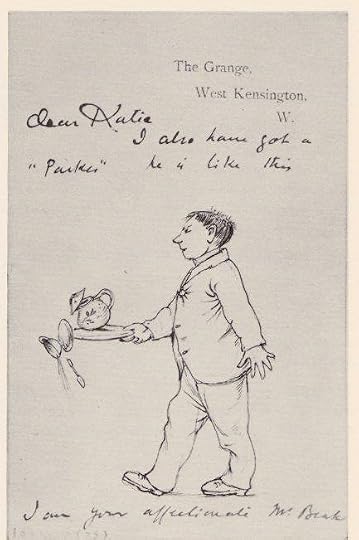
The butler, “Parkes”
We get an idea of the two families’ lives, such as when Edward Burne-Jones asks Katie to guess who had come to dinner? It was Mr. Wilde (Oscar Wilde). Another rather poignant series of drawings show him painting a picture, getting more despondent with it, and eventually trying to climb out of reality, and into his own picture. What is requested, is that Katie should ask her mother to put these in order for him, but the true meaning is rather darker.
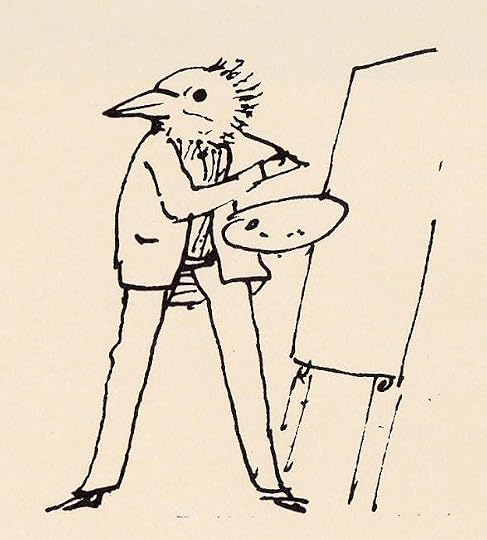
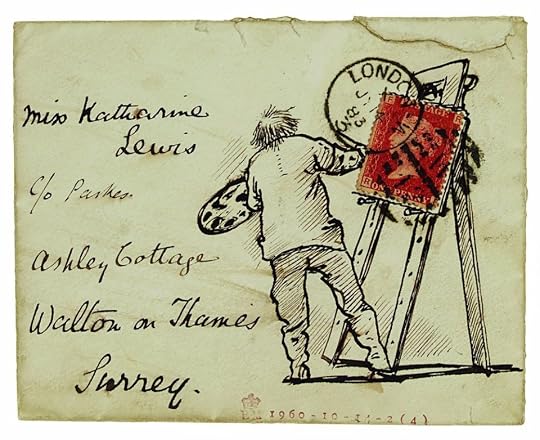
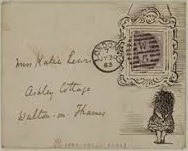
My favourites of all are actually the envelopes. Each is a different little masterpiece, with the stamp usually featuring as a painting on an easel. Often Edward Burne-Jones depicts himself as the rather unkempt artist, or sometimes puts Katie in the picture:
All in all, this is a quick, amusing, whimsical read, with a lot of novelty value, especially for those interested in the Pre-Raphaelite Brotherhood. However, I feel this is still a limited selection, even with the addition of a couple of series such as the ones about the doll and the half cat. Many of the original drawings had clearly been completed in pencil, and at this date they are faded and hard to make out. It would have been better if some kind of computer enhancement had been used, to preserve the lines and fluctuation of Edward Burne-Jones’s original without “restoring” them and possibly changing them in the process. As it is though, a lot of them are too pale.
For these reasons, I shall keep this at a 3 star read. Perhaps hopefully a future edition might merit a four star one.
This book was first published in 1925 when it was edited by William Graham Robertson. This slightly enlarged version is the British Museum 1988 reprint, which draws upon the museum's collection of letters to Katie.
Katie Lewis arrived in Burne-Jones’ life before his own grandchildren were born but after his own children had grown up. She was the young daughter of George Lewis, the eminent solicitor to many celebrities of the day. Lewis, by all accounts, was a mild mannered but extremely astute man, and was called upon by everyone from The Prince of Wales to the relatives of the poisoned Charles Bravo.
The letters Burne-Jones penned to Katie are playful and rather naughty sometimes. He encourages bad habits in Katie by his silly spelling and general foolishness, and instructs her to ask her parents tell her long and complicated stories which Burne-Jones obviously has made up. He was obviously a tease and enjoyed inserting messages to Katie’s parents, George and Elizabeth who he was not only very fond of but also valued her opinion. Toying with the two audiences was no doubt part of his own entertainment. He was someone who was able to maintain life-long relationships and respect and Katie’s own decision to publish the letters and her process of selection when she was older shows how fond she remained of him.
Katie appears to have been a precocious young child and Burne-Jones seems to have enjoyed slightly winding her up and encouraging her highly-strung attitude whilst perhaps diffusing it and pushing it into creativity. He clearly understood children and his letters have a kind of Edward Lear feel to them, which Christian also recognised, and he signed himself Mr. Beak, presumably after his many references and drawings of birds.
The letters really include some wonderful designs. The envelopes are cleverly illustrated with Burne-Jones as he liked to present himself – scrawny, tall and dishevelled - painting at an easel, where the painting is the stamp. Other letters tell silly stories about sharing a cat with Margaret and being told off by her for losing his half. He talks and writes about pigs, fat ladies, cats, dogs, babies, donkeys and dolls (the doll letters are a bit weird and Katie left some of these out due to viewing them as too risque). He describes what he had for breakfast (marmelade [sic] and coffee and toast for breakfast), as well as his dancing lessons where he has learnt a polenska and will soon learn a jigska.
The tone throughout is grandfatherly, playful, and light. They show the delight of an adult who isn't burdened by parental responsibility and can merely indulge the individual. They also dip into other relationships, such as his obvious affection for Margaret, although serious Phil (his son) gets only a passing mention. Oscar Wilde also gets a mention: interestingly, Wilde thought he had lost Lewis as a friend during his trial not knowing that Lewis had refused to represent Queensberry out of loyalty to Wilde. Wilde wrote to Elizabeth about Katie proclaiming that if 'she has ceased to be the modern Nero and is now angelic...I no longer adore her: her fascinating villainy touched my artistic soul'.
The book is mere folly, and a chance to disappear inside Katie's childhood, and perhaps your own for a moment. It won't reveal any great secrets about Burne-Jones or the Pre-Raphaelites, but it will wile away an enjoyable hour and the drawings are gorgeous. The book is a refreshing change to the dense scholarly art criticism Burne-Jones is now subject to which far cry from that Robertson experienced in 1933 when the centenary exhibition opened at the Tate which he said was 'rather sad - a little crow of forlorn old survivals playing their last homage to the beauty and poetry now utterly scorned and rejected'. It may well be because of the multi-layered personality this book reveals that Burne-Jones' reputation continues to be on the assent.