

What do you think?
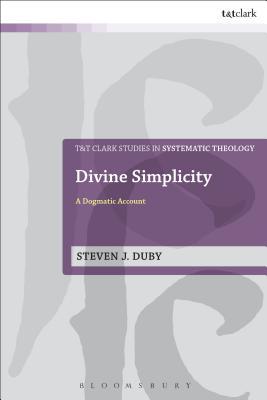
Divine Simplicity: A Dogmatic Account
Steven J. Duby examines the doctrine of divine simplicity. This discussion is centered around the three distinguishing grounding in biblical exegesis, use of Thomas Aquinas and the Reformed Orthodox; and the writings of modern systematic and philosophical theologians.
Duby outlines the general history of the Christian doctrine of divine simplicity and discusses the methodological traits and essential contents of the dogmatic account. He substantiates the claims of the doctrine of divine simplicity by demonstrating that they are implied and required by the scriptural account of God. Duby considers how simplicity is inferred from God's singularity and aseity, as well as how it is inferred from God's immutability and infinity, and the Christian doctrine of creation.
The discussion ends with the response to major objections to simplicity, namely that the doctrine does not pay heed to the plurality of the divine attributes, that it eradicates God's freedom in creating the world and acting toward us; and that it does not cohere with the personal distinctions to be made in the doctrine of the Trinity.
Duby outlines the general history of the Christian doctrine of divine simplicity and discusses the methodological traits and essential contents of the dogmatic account. He substantiates the claims of the doctrine of divine simplicity by demonstrating that they are implied and required by the scriptural account of God. Duby considers how simplicity is inferred from God's singularity and aseity, as well as how it is inferred from God's immutability and infinity, and the Christian doctrine of creation.
The discussion ends with the response to major objections to simplicity, namely that the doctrine does not pay heed to the plurality of the divine attributes, that it eradicates God's freedom in creating the world and acting toward us; and that it does not cohere with the personal distinctions to be made in the doctrine of the Trinity.
- GenresTheology
270 pages, Hardcover
First published December 17, 2015
Ratings & Reviews
Friends & Following
Create a free account to discover what your friends think of this book!
Community Reviews
Displaying 1 - 17 of 17 reviews

March 25, 2024
I really enjoyed this. It was challenging for me at points, (especially the Medieval Latin), but I am glad I stuck with it.
Duby argues that divine simplicity is “an implicate of God’s singularity, aseity, immutability, infinity, and act of creatio ex nihilo.” In building a doctrine of divine simplicity from these more explicit biblical categories, Duby helped me to see clearly both the biblical substrate of the doctrine and the importance of Medieval/Reformation refinements from the likes of Aquinas, Voetius, Turretin, van Mastricht, and others.
Duby helpfully responds to two concerns that are common in my circles. He addresses the concern that “divine simplicity and other similar attributes are [merely] the result of deference to Greek metaphysics” rather than necessary implicates of the biblical data. Further, he explains how the traditional way of describing God does NOT “bifurcate God’s essence and his economic disclosure of his many attributes, evacuating God’s essence of its variegated richness, and undermining or even falsifying God’s revelation.”
Duby also includes lengthy sections responding to common contemporary objections to simplicity from analytic philosophy (Plantinga, Craig, Moreland), and theology (Barth, Pannenberg, Moltmann).
Duby argues that divine simplicity is “an implicate of God’s singularity, aseity, immutability, infinity, and act of creatio ex nihilo.” In building a doctrine of divine simplicity from these more explicit biblical categories, Duby helped me to see clearly both the biblical substrate of the doctrine and the importance of Medieval/Reformation refinements from the likes of Aquinas, Voetius, Turretin, van Mastricht, and others.
Duby helpfully responds to two concerns that are common in my circles. He addresses the concern that “divine simplicity and other similar attributes are [merely] the result of deference to Greek metaphysics” rather than necessary implicates of the biblical data. Further, he explains how the traditional way of describing God does NOT “bifurcate God’s essence and his economic disclosure of his many attributes, evacuating God’s essence of its variegated richness, and undermining or even falsifying God’s revelation.”
Duby also includes lengthy sections responding to common contemporary objections to simplicity from analytic philosophy (Plantinga, Craig, Moreland), and theology (Barth, Pannenberg, Moltmann).

March 12, 2017
Spectacular. Duby retrieves the classical notion of divine simplicity and defends it against contemporary challenges, both from contemporary theology and analytic philosophy. Beyond a clarifying work on what simplicity entails, this book showcases the best integration of history, theology, and exegesis for the sake of dogmatic synthesis. Duby leans heavily on Thomas and post-Reformation theologians (Mastricht, Turretin, Polanus, etc.) to clarify what simplicity is and entails. What is often lost in thinking about theology is that if you get simplicity wrong, there are a whole slew of issues that are effected related to theology proper, trinity, christology, etc.
Highly recommended!
PS: Since it's a specialized monograph, the price tag is obviously high. What better time to explore Interlibrary Loan through your local library!
Highly recommended!
PS: Since it's a specialized monograph, the price tag is obviously high. What better time to explore Interlibrary Loan through your local library!

February 25, 2024
Duby is simply the best there is on the doctrine of God in contemporary theology. Required Reading on Simplicity for anyone interested in or struggling with this blessed doctrine.

April 1, 2019
For starters, this book is *not* for people who are new to the doctrine of Simplicity. This book is for those who are already well acquainted with the doctrine. It is also recommended that the reader have familiarity with Latin phrases, or at least have a copy of Richard Muller’s “Dictionary of Latin and Greek Theological Terms”. An understanding of Greek and Hebrew would also be beneficial, although I was able to catch on to each of his points despite having a very limited understanding of Hebrew (the only words I was able to identify in actual Hebrew script were “Yahweh” and “ruach”). It just required a little extra effort. (I will admit, the farther I got into the book the easier it got to read it, but I don’t know if that’s because of a change on Duby’s part or on my part).
You certainly will work for the knowledge contained within this book. However, it is really rewarding. His survey of patristic approaches to the doctrine, the Medieval debates (Aquinas-Scotus-Ockham), Reformation era re-affirmation of the Thomistic approach, and recent rejection of the doctrine put the modern discussion into perspective. His cartography of Simplicity is exhaustive, consistently and effectively defining all that Simplicity entails. Duby also effectively makes a strong exegetical case for related doctrines (Aseity, Immutability, Creation Ex Nihilo, etc.) and explains how they necessitate Simplicity. He then spends sufficient time engaging the most common objections to Divine Simplicity, not only effectively dispelling any concern but actually rightly raising concern about those who rose the objections to start with (for example, in William Lane Craig and J.P. Moreland’s view of the Trinity).
Even though it wasn’t the main scope of the book, I must also commend Duby and his book for opening my eyes to how connected the attributes of Divine Freedom and Divine Sovereignty are to the rest of those attributes commonly under the label of Classical Theism (I.e. Simplicity, Immutability, Timelessness, etc.). He also does an amazing job at decimating the John Walton/Jon Levenson view that Genesis 1 doesn’t teach material creatio ex nihilo, but instead a functional creation where pre-existent things are merely being given function and form. I was pleasantly surprised to see both of these topics handled (and handled very well) in this book.
I will not recommend this as an introduction to Simplicity. If you want that, read “All That is in God” by Dolezal. But if you are already familiar with the doctrine and and want to read an academic approach to the history, definition, exegesis, and defense relating to the doctrine, I certainly recommend Duby’s book.
You certainly will work for the knowledge contained within this book. However, it is really rewarding. His survey of patristic approaches to the doctrine, the Medieval debates (Aquinas-Scotus-Ockham), Reformation era re-affirmation of the Thomistic approach, and recent rejection of the doctrine put the modern discussion into perspective. His cartography of Simplicity is exhaustive, consistently and effectively defining all that Simplicity entails. Duby also effectively makes a strong exegetical case for related doctrines (Aseity, Immutability, Creation Ex Nihilo, etc.) and explains how they necessitate Simplicity. He then spends sufficient time engaging the most common objections to Divine Simplicity, not only effectively dispelling any concern but actually rightly raising concern about those who rose the objections to start with (for example, in William Lane Craig and J.P. Moreland’s view of the Trinity).
Even though it wasn’t the main scope of the book, I must also commend Duby and his book for opening my eyes to how connected the attributes of Divine Freedom and Divine Sovereignty are to the rest of those attributes commonly under the label of Classical Theism (I.e. Simplicity, Immutability, Timelessness, etc.). He also does an amazing job at decimating the John Walton/Jon Levenson view that Genesis 1 doesn’t teach material creatio ex nihilo, but instead a functional creation where pre-existent things are merely being given function and form. I was pleasantly surprised to see both of these topics handled (and handled very well) in this book.
I will not recommend this as an introduction to Simplicity. If you want that, read “All That is in God” by Dolezal. But if you are already familiar with the doctrine and and want to read an academic approach to the history, definition, exegesis, and defense relating to the doctrine, I certainly recommend Duby’s book.

April 27, 2022
Very comprehensive work on a such a vital topic which has not received enough attention in recent systematic theologies. Those who claim to maintain it, still find issue with the classic articulation of it from the patristics, the medievals and the Reformed orthodox. This rejection is often linked to Thomas Aquinas in whom the doctrine received clear and exact articulation. For some people, there is the connection that if it has to do with Aquinas, then it is wrong. Not only the difficulty of the doctrine but the connection with Aquinas makes it a hard sell in our time.
But in this work, Dr. Steven J. Duby takes on to make an exegetical case for the doctrine of divine simplicity as it has been articulated through the broad catholic tradition. He gives special attention to the Reformed orthodox, especially authors who (to my knowledge) have not been translated into English like Johann Alsted, Bartholomäus Keckermann, Johannes Maccovius, Amandus Polanus, Peter van Mastricht, Gisbertus Voetius. Francis Turretin is also featured a lot in this work who is an excellent Reformed scholastic.
The work is scholarly and thus it makes it a little difficult to dig through for a layman like me. There is a lot of Latin phraseology which is not translated. Often, I could guess what it meant, but sometimes I had to look it up. It is not written for the average layman. Dr. James Dolezal's "All that is in God" is steered more to that side.
This work tries to prove divine simplicity from positive proof from several Christian doctrines about God such as divine singularity (monotheism), divine immutability, divine infinity, and creation ex nihilo. It was very enjoyable to read this work because the author is thorough and very well versed in these discussions and the footnotes are filled with references to all sides. Furthermore, the author does not only seek to focus on divine simplicity, but at the same time provides a dogmatic basis for the doctrines mentioned above which shows the relation between various statements we make about God and their implications. The doctrine of the Trinity also features a lot, especially in the last chapter as there is the object that the Trinity is not compatible with a simple God.
All in all, this is an excellent work and standard which I will have to return it. My only slight criticism would have been to at least parenthetically provide the translation of the various Latin (or Greek) phraseology so that the work would be accessable to a wider audience.
But in this work, Dr. Steven J. Duby takes on to make an exegetical case for the doctrine of divine simplicity as it has been articulated through the broad catholic tradition. He gives special attention to the Reformed orthodox, especially authors who (to my knowledge) have not been translated into English like Johann Alsted, Bartholomäus Keckermann, Johannes Maccovius, Amandus Polanus, Peter van Mastricht, Gisbertus Voetius. Francis Turretin is also featured a lot in this work who is an excellent Reformed scholastic.
The work is scholarly and thus it makes it a little difficult to dig through for a layman like me. There is a lot of Latin phraseology which is not translated. Often, I could guess what it meant, but sometimes I had to look it up. It is not written for the average layman. Dr. James Dolezal's "All that is in God" is steered more to that side.
This work tries to prove divine simplicity from positive proof from several Christian doctrines about God such as divine singularity (monotheism), divine immutability, divine infinity, and creation ex nihilo. It was very enjoyable to read this work because the author is thorough and very well versed in these discussions and the footnotes are filled with references to all sides. Furthermore, the author does not only seek to focus on divine simplicity, but at the same time provides a dogmatic basis for the doctrines mentioned above which shows the relation between various statements we make about God and their implications. The doctrine of the Trinity also features a lot, especially in the last chapter as there is the object that the Trinity is not compatible with a simple God.
All in all, this is an excellent work and standard which I will have to return it. My only slight criticism would have been to at least parenthetically provide the translation of the various Latin (or Greek) phraseology so that the work would be accessable to a wider audience.

December 27, 2025
Divine Simplicity: A Dogmatic Account is a dense and highly academic work, but it is one of the very best treatments of divine simplicity available today. Duby leaves no stone unturned, and the strength of the book lies in its careful exegetical and dogmatic foundations.
Duby follows Thomas Aquinas closely, yet he does so through the lens of the Reformed orthodox—who both appropriated and critically refined Aquinas’s theology. Unlike many modern discussions, this work is deeply grounded in Scripture and clearly situated within Reformation and post-Reformation theology. Alongside James Dolezal’s All That Is in God, this stands as one of the strongest books on the doctrine. Unfortunately, there are still too few Reformed treatments that are willing both to use Aquinas and to critique him carefully.
Another major strength of this book is the scope of its engagement with objections to divine simplicity. Whereas All That Is in God focuses primarily on critiquing Reformed theologians who have modified or weakened the doctrine, Duby takes on the larger and more fundamental critics of simplicity—including contemporary philosophical and theological objections from more prominent philosophers like William Lane Craig and Alvin Plantinga. This broader engagement makes Duby’s work especially valuable for readers who want to see the doctrine defended not only within intramural Reformed debates, but against its most significant modern challengers.
The primary weakness of the book is its academic density. Readers without working knowledge of Latin, Greek, and Hebrew may struggle at points, as Duby often uses untranslated original-language terms and quotations. While this can make parts of the argument difficult to follow, it also makes the book an excellent resource for advanced study and theological research.
Overall, Duby is a superb theologian and one of the most careful voices on divine simplicity today. I hope he eventually writes a more accessible work that retains this depth while serving pastors and teachers more directly
Duby follows Thomas Aquinas closely, yet he does so through the lens of the Reformed orthodox—who both appropriated and critically refined Aquinas’s theology. Unlike many modern discussions, this work is deeply grounded in Scripture and clearly situated within Reformation and post-Reformation theology. Alongside James Dolezal’s All That Is in God, this stands as one of the strongest books on the doctrine. Unfortunately, there are still too few Reformed treatments that are willing both to use Aquinas and to critique him carefully.
Another major strength of this book is the scope of its engagement with objections to divine simplicity. Whereas All That Is in God focuses primarily on critiquing Reformed theologians who have modified or weakened the doctrine, Duby takes on the larger and more fundamental critics of simplicity—including contemporary philosophical and theological objections from more prominent philosophers like William Lane Craig and Alvin Plantinga. This broader engagement makes Duby’s work especially valuable for readers who want to see the doctrine defended not only within intramural Reformed debates, but against its most significant modern challengers.
The primary weakness of the book is its academic density. Readers without working knowledge of Latin, Greek, and Hebrew may struggle at points, as Duby often uses untranslated original-language terms and quotations. While this can make parts of the argument difficult to follow, it also makes the book an excellent resource for advanced study and theological research.
Overall, Duby is a superb theologian and one of the most careful voices on divine simplicity today. I hope he eventually writes a more accessible work that retains this depth while serving pastors and teachers more directly

January 17, 2022
Like Duby's 2019 publication, "God In Himself," this book is brilliant. It is a difficult and rewarding read. If you don't read Latin (like me), you will need to have a dictionary for Latin theological terms nearby.
For my money, the best part of this book is chapter two (56-89). Duby lays out his methodology with admirable clarity. He examines the relationship between dogmatics and exegesis and explores how metaphysics can be used as a conceptual aid in the task of dogmatics. It's really excellent.
This is one of those books to which I will have to return. And I look forward to it.
For my money, the best part of this book is chapter two (56-89). Duby lays out his methodology with admirable clarity. He examines the relationship between dogmatics and exegesis and explores how metaphysics can be used as a conceptual aid in the task of dogmatics. It's really excellent.
This is one of those books to which I will have to return. And I look forward to it.

November 11, 2019
A mind-bending but brilliant read.
Not for the faint hearted.
If you want to dig into what it means to speak meaningfully about Divine Simplicity, and who God is, then this is a really helpful recent 'way in'. Had to dust off some of my old philosophy notes and google a few words!!
Full review to come, I hope.
Heads up - IVP UK is publishing a new book on this by Duby which will be easier to read!!!
Not for the faint hearted.
If you want to dig into what it means to speak meaningfully about Divine Simplicity, and who God is, then this is a really helpful recent 'way in'. Had to dust off some of my old philosophy notes and google a few words!!
Full review to come, I hope.
Heads up - IVP UK is publishing a new book on this by Duby which will be easier to read!!!

May 10, 2021
Absolutely phenomenal. The language in the final chapter of suppositum, supposita, etc. definitely went over my head...kind of hard to find explanations of that online. I wish he explained the modal distinction more directly as well, but that's a minor gripe. All of that being said, I read this book for an exegetical approach to DS and responses to analytic critiques of it, and it lived up to both of those hopes. Highly recommend!

January 4, 2021
Duby's gives the best defense of divine simplicity on the market. He is philosophically robust and exegetically motivated. While he didn't convince this reader of divine simplicity (Duby's moves from exegesis to metaphysics were frequently too quick), I appreciated his scripturally-rooted argumentation.

June 21, 2019
Very technical, brain-stretching reading (I don't presume to claim that I understood it all). Nonetheless, this is a helpful contribution to the Church to defend classical theology, particularly divine simplicity, against contemporary misunderstandings and attempts to jettison the doctrine.

April 20, 2024
A rather philosophical work, but does a stellar job defending classic theism. I was thankful for the exegetical sections, showing the Scriptural basis for our understanding of God's aseity, immutibility, and simplicity.
Liked it a lot.
Liked it a lot.

November 30, 2020
A great read on the topic. What is particularly beneficial in Duby's treatment is his continual concern for Biblical fidelity and exegetical grounding in the doctrine of simplicity.

May 18, 2023
Well argued case for simplicity.

September 21, 2024
Duby carefully defends and promotes the biblical doctrine of divine simplicity. If your Latin is elementary, like mine, you'll want a dictionary close by.

December 20, 2018
This book advances a doctrine of simplicity “tutored by Thomas.” I mostly found it helpful for its replies to 20th century critiques of the doctrine, e.g. strong simplicity leads to nominalism; God’s locked outside of history; simplicity controls the trinity.
November 8, 2016
An excellent scriptural and theological defense of classical theism.
Displaying 1 - 17 of 17 reviews