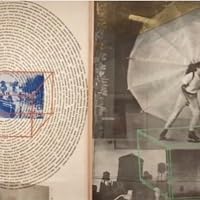
Earth Moves, Bernard Cache's first major work, conceptualizes a series of architectural images as vehicles for two important developments. First, he offers a new understanding of the architectural image itself. Following Gilles Deleuze and Henri Bergson, he develops an account of the image that is nonrepresentational and constructive--images as constituents of a primary image world, of which subjectivity itself is a special kind of image. Second, Cache redefines architecture beyond building proper to include cinematic, pictoral, and other framings. Complementary to this classification, Cache offers what is to date the only Deleuzean architectural development of the fold, a form and concept that has become important over the last few years. For Cache, as for Deleuze, what is significant about the fold is that it provides a way to rethink the relationship between interior and exterior, between past and present, and between architecture and the urban.
Bernard Cache has written my favourite kind of philosophical essay: wildly imaginative, deeply evocative, and borne from a set of very oddly specific practices: that of architecture and furniture design. Not that it stays in those registers mind you - by the book's end, Cache's reflections on bodies and souls, memory and modernism, structuralism and life, all mark the extraordinary flights of inventiveness undertaken in these short 150 pages. Less an essay 'about' any one thing than an effort to reorient 'how' one might approach anything at all, Earth Moves develops a vocabulary of thought drawn from an immersion in design and geography, only to open out onto planes far removed yet subterraneously bound.
Key for Cache is the thought of 'inflection': that subtle but infinitely consequential point at which a curve changes it sign (the mid-point of an 'S' curve, where the concave changes into the convex and vice versa). So important is the inflection for Cache that it is here designated as the "true atom of form", the elementary aesthetic 'bit' out of which all else is generated. A strange claim on the face of it, but one motivated by the inflection’s status as a ‘pure event of curvature’: a point whose properties are ‘intrinsically defined’, insofar as it makes no reference to the space in which it is embedded (unlike, say, the highest or lowest point of a curve, for which the ‘extrinsic’ notion of orientation is required).
If this seems like an oddly technical - if not mathematically abstract - point, the true joy here is in following Cache as, beginning from this tiny atom of form, he elaborates an entire metaphysical and aesthetic itinerary, with engagements among anthropology, philosophy, art theory and more, all in the pursuit of a singular cosmic vision unlike any I’ve come across. Written as a series of vignette-like chapters of 7-10 pages and adorned with Cache's clearly hand-drawn diagrams and schematics for various pieces of furniture, the book is as quirky in its presentation as it is broad in its intellectual eclecticism.
Incidentally, my physical copy happened to be missing its last page, which, in a generous mood, I read as leaving open Cache’s penchant for wide-open, creative fabulation, and not - a rather annoying flub from the MIT Press. Last, important point: this book is barely about folds. I mean yes, Deleuze did call this “essential for any theory of the fold”, and it’s his claim that is plastered all over the book’s dust jacket (“Cache offers …. the only Deleuzian architectural development of the fold”) but there really is almost nothing about the fold in here apart from some incidental mentions. Inflection is the true conceptual hero of this book, and this lovely essay really ought to be remembered for that, after all the wonderful work Cache put into exhibiting all its fascinating entanglements.
"As Deleuze had remarked, Leibniz's mathematics of continuity introduced and expressed a new idea of the object: differential calculus does not describe objects, but their variations and variations of variations. Deleuze even introduced a new term to characterize this two-tiered definition of the object-the "objectile," a function that contains an infinite number of objects. Each different and individual object eventualizes the mathematical algorithm, or objectile, common to all; in Aristotelian terms, an objectile is one form in many events. Deleuze mentions Bernard Cache with regard to the mathematical definition of the objectile adding that it corresponds to a new concept of the technical object, no longer mechanically made and mass-produced but digitally made and based on variations.”
- Mario Carpo, The Alphabet and the Algorithm
“Lynn favors software based on differential calculus; Cache developed an interface based on projective geometry. Both choices are arbitrary: each can be justified but neither is inevitable. In both cases the figural result is unequivocally distinctive: Lynn's differential calculus begets smoothness and continuous surfaces; Cache's projective geometry generates angular intersections of planes in three dimensions. But the shift from mechanical to algorithmic reproduction also prefigures a parallel and equally crucial shift in our visual environment at large. We are leaving behind a universe of forms determined by exactly repeatable, visible imprints and moving toward a new visual environment dominated by exactly transmissible but invisible algorithms.“
I had heard so much about this book that I didn't know what to expect. I was familiar with the MIT architecture writing series and as a matter of fact the books by Rajchman were my favourite during my studies. I mention Rajchman because he refers a lot to Cache. The interesting thing about Earth moves is the schematic/diagramatic way that Cache approaches his subject which is quite difficult to tackle. I was really interested in his way of approaching context and geography though sometimes diagramatically the effort seemed kind of literal when in his writing he was a lot more intricate. I kind of lost the point in the last 3-4 chapters where he refers to the body and psyche where I had this feeling that his ideas were kind of metaphysical and oudated. Anyway...
Good mental workout: felt all mental melty psychelic world collapsy as various thoughts on space, time, bodies, film all fell into one another. I lost interest by the end, didn't read every chapter, but the parts I grooved on I grooved on a lot! Thanks, Gretchen, for recommending this!
this book makes some really interesting connections between ideas. ive borrowed quite a few ideas from it, and continue to see relationships with new things i read or see. and its surprisingly well written.