Want marketing that works? Stop selling and start connecting.
Forget the buzzwords and the hot new tactics. Good marketing is choosing the message and channel that actually lands with audiences. So what do you say, and how do you know it will work? The marketing that wins is rooted in simple principles: Be authentic, speak to a real audience, and make it resonate. The challenge is turning those principles into a narrative strategy that performs in the real world. Because marketing shifts. People shift. Platforms shift. You need a framework built to adapt.
Enter the O.D.D.S. Method: a fail-safe, four-part framework from marketing consultant and entrepreneur Shanise Ling, MBA, that will dramatically simplify and fundamentally change how you go about creating a marketing strategy that works. The O.D.D.S. Method teaches you how to:
• Observe: Start with analysis, then use insights to make meaningful connections. • Distill: Define a clear point of view from which to build a brand that resonates. • Differentiate: Determine and fine-tune the channels and tools that best fit your market. • Scale: Amplify your message strategically.
Blending real-world stories with actionable marketing strategy, Odds Are It’s Marketing is an exploration of what it means to build visibility, credibility, and impact—especially for those who’ve been underestimated, overlooked, or undervalued. To build brands that can’t be ignored, you need clarity, confidence, and purpose. But most of all, you need a great story. What will yours be?
Stop Shouting, Start Listening: How “Odds Are It’s Marketing” Turns Chaos, Data, and Doubt Into a Human Strategy That Actually Scales By Demetris Papadimitropoulos | February 28th, 2026
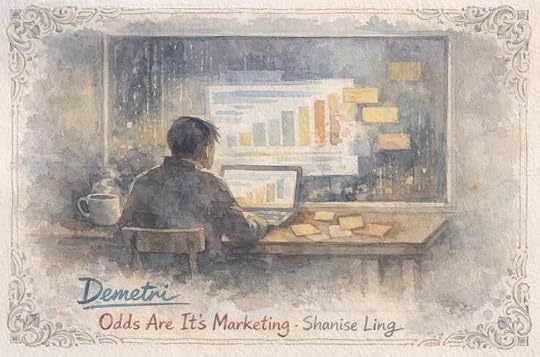
Watercolor Piece by Demetris Papadimitropoulos
In “Odds Are It’s Marketing,” Shanise Ling writes as if she’s still standing in the doorway of that first room where she wasn’t supposed to speak. Not sulking in the threshold, not politely waiting for a chair to be offered, but scanning the room the way a good marketer scans a feed: for micro-reactions, unspoken hierarchies, patterns in what gets amplified and what gets ignored. Her debut is pitched as a practical guide, but it reads like something more consequential than a marketing manual. It is, at heart, an argument about attention as ethics, about strategy as a form of respect, about how to build a brand – and a self – without becoming another loud object in the world.
Ling’s central claim is disarmingly simple: marketing isn’t about shouting the loudest; it’s about listening the closest. That sentence, repeated in various forms, becomes the book’s tuning fork. It helps explain why “Odds Are It’s Marketing” feels so calibrated to our moment, when professional life has become a permanent scroll and “visibility” can be purchased, automated, or faked, yet trust remains stubbornly analog. The book’s four-part framework – Observe, Distill, Differentiate, Scale – is the scaffolding. The deeper architecture is her insistence that in 2026, when a campaign can be built in seconds and optimized while you sleep, the real differentiator is not speed. It is intention.
Ling begins with “Observe,” and she does not mean the bloodless worship of dashboards. She means watching people the way you watch weather. Not simply what they click, but what they linger over. Not only what they say they want, but what they keep doing, again and again, in spite of themselves. Her early chapters are filled with the kind of pragmatic humility that marketing books too often replace with swagger. The learning curve, she says, never really flattens; you just get faster. And she understands, with a kind of earned tenderness, how demoralizing that can feel to the person asked to “go viral” on a budget smaller than a Starbucks order.
One of the book’s strongest moves is to refurbish the old 4 Ps – Product, Price, Place, Promotion – without pretending they can survive unchanged. In Ling’s telling, the digital age doesn’t merely add new channels. It rewrites the terms of engagement. Speed compresses response time into minutes. Transparency turns reviews, behind-the-scenes clips, and employee voices into part of the brand whether you planned for it or not. Saturation means your competition isn’t just your competitors; it’s memes, cat videos, and breaking news. Agency means audiences can block, skip, and unfollow – or advocate, remix, and carry your message further than you could have paid for. Her remix of the Ps is smart because it’s not theoretical. “Place” becomes search results, social feeds, YouTube reviews, a WhatsApp chat where a recommendation moves faster than your ad buy. “Promotion” becomes dialogue and community, not volume. Attention becomes currency, and relevance becomes the exchange rate.
If that were all, “Odds Are It’s Marketing” might sit comfortably alongside the broad tradition of human-centered marketing texts – books like “This Is Marketing,” “Start With Why,” and “Made to Stick,” which also argue, in different keys, for meaning over noise. But Ling’s book is more interesting than an update of familiar doctrines because it insists on applicability. She has a practitioner’s impatience for abstraction. She wants you to test.
Her next move, “Distill,” is where the book begins to sharpen into something like literary criticism: the discipline of reducing a hundred data points into one human truth. Distilling, for Ling, is not simplification as insult. It is simplification as courage. She returns again and again to the idea that branding is not a logo and tagline but the feeling that lingers after the scroll. The book’s best chapters are the ones where she refuses the false security of polish. In nonprofit marketing, she notes, polish without proof doesn’t land; it triggers suspicion. “Where did the budget go?” “Why does this look like an ad?” Authenticity is oxygen, she argues, because trust is the true KPI. That lesson migrates, quietly but insistently, into every other domain the book touches. Service industries, corporate brands, personal brands – all of them are selling not just products but relationships, proof, and the promise that the institution will behave consistently when no one is watching.
“Differentiate,” the book’s third movement, is framed as a refusal to become a replica. Differentiation isn’t a louder logo or a trend-chasing reel; it’s a point of view people can feel and repeat, a “voice with edges,” and the receipts to back it up. Ling’s writing is strongest when she’s insisting on specificity. Who do you serve? What won’t you do? How do you show up? In an era when brands can copy one another within hours, differentiation becomes less about novelty than about coherence. That’s why she’s skeptical of influencer marketing as a follower-count fetish. In certain industries – automotive, manufacturing, finance, B2B services – virality is less persuasive than authority. “Influencers,” she notes, may be experts, thought leaders, or satisfied customers, and influence itself can live in case studies, trade journals, local events. The line she draws between followers and influence is blunt, and correct: a million followers mean nothing without resonance.
Her chapter on cultural awareness makes a similar argument from a different angle. Global marketing isn’t a victory lap, she suggests; it’s walking into a family reunion you weren’t invited to and realizing your gestures mean different things here. Translation isn’t enough. Localization – of language, imagery, and sometimes the product itself – is the minimum. Ling understands that cultural missteps are not merely embarrassing; they can be expensive and corrosive, especially in a marketplace where backlash travels at the speed of a hashtag. Yet she’s also attentive to the possibility of recovery, even redemption, if a brand responds with humility, speed, and genuine learning. It’s a chapter that feels written in the shadow of contemporary brand crises, when companies are called out not just for what they do but for what they reveal about themselves when corrected.
Then there is ethics. In many marketing books, ethics appears as a concluding chapter, a perfunctory “be good.” Ling makes it structural. She distinguishes ethics – how you market, the honesty of your claims, the respect of your tone – from social responsibility – what you stand for, the causes you uplift, the integrity of your alignment. She refuses the comfort of intention. Intent doesn’t erase impact, she insists. Stereotypes, exclusions, lazy shortcuts that feel harmless in a brainstorm can land like grenades in the world. Her personal anecdotes of being reduced to a caricature in corporate spaces are not autobiography for its own sake; they are a warning about the campaign room. If you don’t understand the lived experience you reference, you don’t get “connection.” You get caricature. The critique feels timely not because it name-checks controversies, but because it recognizes the contemporary audience: skeptical, fluent in critique, quick to detect when values are worn like an outfit.
When Ling reaches “Scale,” she offers one of the book’s most bracing reversals: scale is not “doing more.” Scale is “doing what works.” This is where “Odds Are It’s Marketing” becomes an operations book, and a moral one. The practical advice – A/B testing emotional, functional, and urgency-driven messages; sequencing campaigns from awareness to education to action; running ads long enough to learn; repurposing high-performing content across formats; systemizing through automation, documentation, delegation – is the familiar grammar of modern growth. What distinguishes Ling is her insistence on restraint. Growth without alignment becomes chaotic. Unethical scale always catches up. She lists the ways scale turns predatory: targeting demographics you won’t serve well, using AI to over-target vulnerabilities, expanding messaging faster than customer support, burning teams to exhaustion while leadership celebrates metrics, deploying representation as a tactic rather than a truth. It is, in its own way, a critique of the last decade’s marketing mythology, the belief that if something is measurable it is justified.
The AI chapter extends that critique with unusual clarity. Ling treats AI as the second coming of the internet – a seismic shift – and she’s right to frame early adoption as mindset rather than badge. The important distinction she makes is not between humans and machines but between delight and manipulation. Delight happens when personalization feels like service: the playlist that matches your mood, the recommendation that makes you feel seen rather than sold to. Manipulation happens when the same data is used to exploit vulnerabilities: late-night impulse prompts, dynamic pricing pressure engineered to convert anxiety into purchase. AI is neutral, she argues; it amplifies whatever you feed it. If your goal is empathy, AI becomes a tool for listening and service. If your goal is extraction, it becomes manipulation disguised as marketing. In a year when generative content floods feeds and optimization tools can adjust campaigns in real time, this is one of the book’s most necessary arguments: AI doesn’t fix broken marketing. It scales it.
For all its strengths, “Odds Are It’s Marketing” is not a perfect book. Ling’s archetypal examples – Netflix’s pivot, McDonald’s localization, Spotify’s personalization – are widely rehearsed in business writing, and the book occasionally relies on familiar case study shorthand rather than offering sustained, granular reportage. Readers looking for research density, for the muscular empiricism of “How Brands Grow” or the sharper behavioral science of “Influence” and “Predictably Irrational,” may find the evidence base more anecdotal than exhaustive. Ling’s prose, designed to be teachable and motivational, sometimes resolves conflict too cleanly. Real organizational systems can be more stubborn than any framework, and “clarity” is not always enough to overcome power.
But those limitations also reveal the book’s intent. “Odds Are It’s Marketing” is not trying to be a textbook or an academic intervention. It is trying to be a usable compass. Its most compelling chapters – “The Proving Ground” and “Betting on the Odds” – make the subtext explicit: this is a book for those who have had to prove themselves twice as hard, pitch with less, or lead without the title. Ling’s framework is, in that sense, a metaphor for survival. Observe the room. Distill what matters. Differentiate with courage. Scale with integrity. Stop seeking validation and start trusting your instincts. The hardest campaign, she suggests, is often the one for yourself.
That is why the book lands with particular resonance now, in an economy where careers shift in a DM and reputations can be built or broken in comment threads, in a culture where authenticity is demanded and endlessly doubted, in a marketplace where tools can multiply your reach but also your mistakes. Ling’s insistence on “scalable relationships” – LinkedIn as a stage, digital communities as coffee shops, hosting your own space rather than waiting for an invitation – feels less like hustle advice than like an ethics of presence. Networking, she argues, isn’t clout-chasing; it’s human investment. Relationships don’t scale through automation. They grow through authenticity. In a moment when many professionals feel both exposed and invisible, that claim has the force of consolation.
Ultimately, “Odds Are It’s Marketing” succeeds because it refuses the genre’s most common lie: that marketing is a bag of tricks. Ling’s method is not a hack. It is a discipline. It asks you to look longer, think clearer, choose braver, and grow more responsibly. It reminds you that attention is not just a resource to extract but a relationship to honor. That is an old idea dressed for a new era, and it’s why the book earns an 86/100: not because it reinvents marketing, but because it re-centers it on the thing most of our tools can’t automate – the human instinct to feel seen, understood, and valued.
I really wanted to like this book. The premise is promising — a four-part framework (Observe, Distill, Differentiate, Scale) promising to cut through the noise and give marketers a practical, adaptable strategy. Ling writes with energy but lacks genuine warmth. She is obviously an entrepreneur working in marketing, but you cannot feel the passion she has for her craft.
But here's the problem: lukewarm passion doesn't substitute for depth.
Coming in as a working marketer, I kept waiting for the book to go somewhere. It never quite does. The O.D.D.S. Method is a tidy acronym, but any marketing professional who's spent more than a couple of years in the field will recognize it as a repackaging of fundamentals we already live by. Observe your audience. Simplify your message. Differentiate your brand. Scale what works. This isn't a framework — it's a LinkedIn carousel.
The anecdotes are charming but light. Ling describes a pivotal campaign with an industrial company that started using social media, and the results were "real engagement" and "renewed credibility." Great! But what were the metrics? What was the strategy behind the content choices? What failed first, and how did she adjust? These are the questions a marketer needs answered, and the book consistently sidesteps them in favor of a phony inspirational summary.
Chapters on influencer marketing, AI, cultural awareness, and ethics all feel survey-level — topics worthy of their own books are given a chapter or less, with surface observations and no actionable takeaways that go beyond what you'd find in a Google search. The marketing glossary at the back feels like padding.
To be fair: this book likely serves a very specific audience — students, entrepreneurs launching from scratch, or people entering marketing for the first time. For that reader, the approachable tone and clear framework structure could be a genuinely useful entry point. Ling's voice is encouraging without being preachy, and that counts for something.
But if you're a seasoned marketer hoping to sharpen your thinking, challenge your assumptions, or find strategies that actually grapple with the complexity of modern brand-building? You'll finish this book feeling like you attended a motivational seminar when you signed up for a masterclass.
Before I could write full time my day job was sales and marketing. I loved it. Every second of it. This is the first marketing book I've read in a decade that I am actually leaving a review on. I won't leave bad reviews. Everything is subjective. But I won't review it, either.
With that said, welcome to my very first recommendation for marketing books. This book is absolute gold. This is the first book that gives actionable steps to putting together a plan rather than spending two hundred pages telling you the market has changed in fifty different ways.
I read the sample pages first and loved the approach. The rest of the book delivered. The material is well organized and her experience shines. I purchased the Kindle but realized I needed a print copy. Have your highlighter ready. You're gonna be underlining.
If you follow my reviews you know I don't go into exhaustive detail. I either like a book or don't. I LOVED this book. In this wild west shiznizzle of modern marketing this book stands at the top. It is the ONLY marketing book I have ever reviewed and recommended. Ten stars all the way.
Odds Are It's Marketing is a wonderful book that is great for business people such as myself. I found useful and insightful information about the marketing of my own business from this delightful book. It is filled with smart and winning strategies for getting the message out there and receiving a high return on investment with all products and services marketed. I learned a great deal from this book.
A thoughtful and engaging read that offers valuable insights with warmth and honesty. The author presents meaningful ideas in an accessible way, making it both inspiring and practical. A book that leaves you reflecting long after the last page.
I have learned a lot in this book. Some really great insightful information that makes so much sense. I am looking forward to applying it to my real life.
I received a free copy of this book via Booksprout and am voluntarily leaving a review.