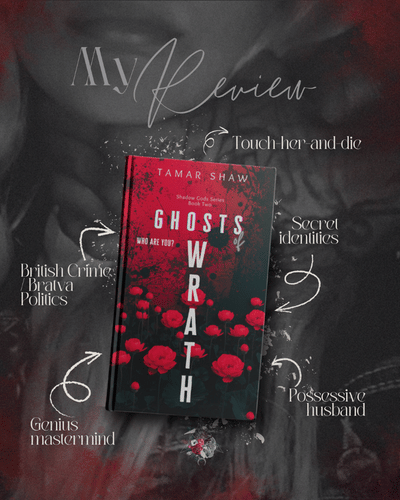
"Architect of Ruin" is not a sequel that plays it safe, it’s a deliberate escalation. Darker, wider, and more politically dangerous, it expands the world without ever loosening its grip on the emotional core that made "Architect of Ruin" unforgettable. This story doesn’t ask whether obsession is healthy, it asks whether it’s necessary - and it absolutely is!
At the heart of the book, Ada and Killian remain inevitability incarnate. Their bond is not softened, diluted, or reframed into something more palatable; it is reinforced through separation, violence, restraint, and reunion. Ada’s trauma is handled with care and consequence, never used as spectacle or reset for drama. She is fragile where it makes sense, strong where it matters, and always emotionally central. Killian, meanwhile, is exactly who "Architect of Ruin" promised he would be: feral, controlled, devastatingly intelligent. His protectiveness is not questioned or corrected; it is validated. He does not rage blindly; he calculates, dismantles, and eliminates. His love is not loud - it is lethal.
Ghosts of Wrath’s strongest achievements is its structural confidence. The introduction of Zorah widens the narrative without destabilising the romance. She is not a rival, not a replacement, not a threat to Ada’s position in the story. She is a parallel (a what-could-have-been) and her presence adds tragedy, scale, and moral weight without stealing focus. The twin reveal is handled with restraint and intelligence, seeded subtly through discomfort, duplication, and instinct long before it is confirmed. When it lands, it doesn’t shock so much as click. It reframes the story rather than hijacking it.
The plot itself is tight, deliberate, and unapologetically brutal. Violence has purpose. Consequences stick. Power structures are exposed and dismantled rather than sensationalised. Killian’s mythos grows not through bravado, but through absence - through the fear his name inspires, the systems that crumble when he looks too closely, and the quiet certainty with which he chooses Ada every single time.
The spice is selective, explicit when it appears, and deeply character-driven. These scenes are not there to entertain casually; they serve intimacy, control, and emotional release. When the characters touch, it matters - because safety has been earned, not assumed.
What ultimately makes this book work is trust. Trust in the reader to handle darkness. Trust in the characters to remain consistent. Trust in the romance to carry weight without constant reassurance. Ghosts of Wrath doesn’t exist to outshine Architect of Ruin - it exists to prove it wasn’t a fluke.
This is a sequel that understands escalation, honours its emotional contract, and refuses to apologise for its ferocity.
Dark romance at its sharpest.
To Tamar Shaw: thank you so much for trusting me with the ARC and for letting me experience this story early. It was a privilege to sit with these characters, feel the weight of their choices, and watch this world burn exactly the way it needed to.