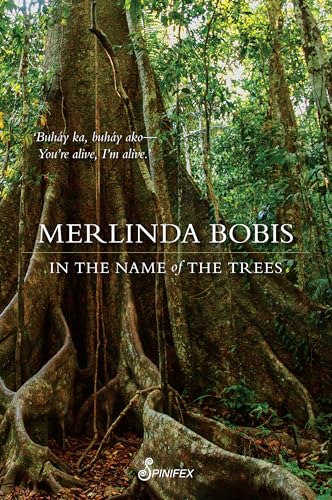
Merlinda Bobis is an award-winning contemporary Philippine-Australian writer who has had 4 novels, 6 poetry books and a collection of short stories published, and 10 dramatic works performed. For her, ‘Writing visits like grace. Its greatest gift is the comfort if not the joy of transformation. In an inspired moment, we almost believe that anguish can be made bearable and injustice can be overturned, because they can be named. And if we’re lucky, joy can even be multiplied a hundredfold, so we may have reserves in the cupboard for the lean times.’
Born in Tabaco in the Philippines province of Albay, Merlinda Bobis attended Bicol University High School then completed her B.A. at Aquinas University in Legazpi City. She holds post-graduate degrees from the University of Santo Tomas and University of Wollongong where she taught Creative Writing for 21 years. She now lives and writes on Ngunnawal land (Canberra, Australia).
Her literary awards include the 2016 Christina Stead Prize for Fiction NSW Premier's Literary Award for her novel 'Locust Girl. A Lovesong'; three Philippine National Books Awards (2016: 'Locust Girl', 2014: 'Fish-Hair Woman', 2000: 'White Turtle'); 2013 MUBA: 'Fish-Hair Woman'; 2000 Steele Rudd Award for the Best Published Collection of Australian Short Stories: 'White Turtle'; 2006 Philippine National Balagtas Award for her poetry and prose (in English, Filipino and Bikol); 1998 Prix Italia, 1998 Australian Writers' Guild Award and 1995 Ian Reed Radio Drama Prize for her play 'Rita's Lullaby'; three Carlos Palanca Memorial Awards in Literature Poetry Category (2016: Second prize, 1989: Second, 1987: First). Her poetry collection, 'Accidents of Composition' was Highly Commended for the 2018 ACT Book of the Year.
Doesn’t quite reach the heights I expect it to, but nonetheless a beautifully told interwoven tale of women, trees, and history. There’s also a gentle, almost lulling, quality to Bobis' writing that makes me feel like I’m reading about home, even if I’m not from Bicol though I’d love to make that trip soon.
This book is a homecoming, hitting even closer to home with the smattering of Bikolnon across its pages and the familiar landscapes of Bikol, my mother’s land.
The land knows, it remembers--across oceans and continents--buhay siya; at dahil buhay siya, buhay tayo.
We may want earnestly to forget our roots, our stories, to fit a narrative that we think will be good for us, hindi lang tungkol sa sarili nating nakaraan, pero ng nakaraan ng ating mga ninuno.
We might want to rewrite our past just so that were able to bear our present burdens much lighter-- or forget entirely the ways of all the people that came before us, of their bravery and their choices that allowed our existence, just so we can fit into the narrative of our colonizers, who they want us to be for their benefit.
To which we really did. Most of us have forgotten our old ways of healing--the last "mananambal", our Cebuano word in Mindanao for "parabulong", in my city is dead with no descendants who understand the power of nature's healing. We do not care so much for our nature as we're all supposed to do, because we're so confined in our colonizer's way of living, where we slave under capital-driven institutions--all seeking gain, gain, gain.
Post-war, and in the aftermath of navigating our personal lives, we've lost so much of our original tales; we do not know the real Filipino self, and we do not know how to heal from all that.
The answer can be found in the name of the trees. Sa ngalan ng ating mga puno. This wonderful book showed me that healing is intrinsic. Four generations of strong women named after four strong Filipino trees, Banaba, Narra, Pili, and Dao, weakened by an accident forever changing their lives, can only truly heal if you start with the rot left inside, and that in our healing, and even in our way of living, we should look up to the trees, because there's so much they can teach us.
The nature of a tree truly is its philosophy. It's seed, then root, the trunk, then the branch, then the leaf, and the flower, then fruit, and then seed, and then root again. Without an ending. Even if we cut it. Always alive. Always remembering.
The only way we ever heal is if we remember. In remembering is acknowledging, in acknowledging we understand, in understanding we learn, and in learning we heal.
‘In the name of the trees, I retrieve you from hurt and sickness.’
This story is woven around four generations of Filipina women. Each of the women is named after a hardwood tree: Banaba, Narra, Pili and Dao. Each has a story, and each story gradually unfolds. The novel opens in Canberra, with seventeen-year-old Dao in bed watching her mother Pili and grandmother Narra argue just out of earshot. They seem to be planning a ritual. Dao, we learn, is partially paralysed following a car accident in which her father was killed. Narra tries to heal her granddaughter: there are rituals, stories, connections to the village of Iláwod where the story really begins. Language is both an enabler and a barrier to communication. Dao knows some Bikol, while Narra has little English. And I think, as I read, how important language is when describing experience and feeling. When Spanish is spoken, I am reminded of Spanish colonisation of the Philippines.
‘We don’t have men in our household. No father, brother, uncle, except in stories. And they’re all dead.'
I drift. The stories are intertwined not separate, and Banaba’s story holds my attention completely. Until I shift, through the experiences of Narra and Pili, through the definitions of the trees for which they are named. The stories Narra tells Dao are part history, part connection to country and culture, and part reconstruction of a painful past. Every time Bikol is used I struggle to understand. I recognise some Spanish but am only comfortable with English. A gentle reminder that language carries its own secrets.
I came to the end of the story well aware that I have not understood it all but thinking that this awareness is very much a part of the message.
A novel to revisit.
‘But trees remember. They do not lie. Knowing is resistance.’
I started this book in 2025 and finished it today, so I’m not quite sure if it counts as my first book of 2026.
I like the story, but I’m still unsure how I feel about the writing style. The book is only 163 pages, yet it is very heavy on description. It beautifully captures the Bikolano language, the scenery of Bikol, and the people, which really helps you visualize the setting and understand the connection between the trees and the characters. At the same time, while reading, I often felt lost because it seemed to just keep describing and describing. Some parts felt unnecessary, and I only fully understood the plot near the end of the book. I honestly think the story could have been clearer if a few sections were omitted.
That said, I’m not saying the book isn’t good, it is! I liked the story itself. More than anything, it’s a reminder that love is shown in many different ways, and that some stories are kept hidden because people believe silence will protect them. But sometimes, letting the story go and telling the truth is what truly sets us free and brings peace.
Overall, I appreciate the story and its message, even if the writing style didn’t fully work for me.
I don’t often gravitate towards local books so I'm making it a goal to read more of it this year. And Merlinda Bobis did not disappoint, her writing brought a sense of comfort and familiarity just by knowing that in this story I somehow belong. In the Name of the Trees follow the interwoven lives of 4 generations, all named after a tree: Banaba, Narra, Pili, and Dao. Each character perfectly embody their name’s origin and each is a reflection of Filipinos. From Banaba`s reslience and strong-willed character, Narra’s people-pleasing tendencies where the tree’s hardwood and strong ability is shown in different form, Pili’s attempt to run and forget her roots—hiding her truth even from the people she loves, and to Dao’s attempt to mend the cracks in their family, albeit unaware that it's about to reach its breaking point
I love how Merlinda wrote the complex family dynamics of Filipinos— how we find different languages to show love and affection. From our mother cooking our favorite meals after a disagreement to hiding secrets in attempt to absolve one another from pain. The story perfectly weaved our culture and how unknowingly Filipinos still carry the marks of our tragic history and how colonialism shape our decisions and choices.
Ms. Merlin has a way with words and with knowing how to connect with her readers like a mother reading a book to her sleepy child. Safe, comforting, intimate, and inevitably leaves you with a sense of longing after you close a chapter. A personification of a warm hug after a long day. You feel the pain of the characters as if it were your own. She knows how to craft an extraordinary experience out of ordinary subjects. This has become one of my sentimental favorites. It has unexpectedly made my banaba flower tattoo more magical, spiritual, and personal to me.
Four generations of women named after trees refuse to be cut down: Banaba, Narra, Pili, and Dao. The story explores their roots, their healing prowess, and their love for storytelling.
I love this book! I love how it explores not just their cultural heritage, philippine history, their family tree (pun intended), and also different languages in the Philippines (especially Bicolano— my mother’s birthplace; that’s why I was able to understand most of the discussions here)