What do you think?
Rate this book


1 pages, Paperback
First published January 1, 1976


Bobby Blunder was going to be world champion one day. There was no doubt about that, you only had to ask him! Unlike Max Euwe, Bobby wasn't going to wait fifteen years for his dream to come true; Bobby Blunder was in a hurry.March 18, 2016
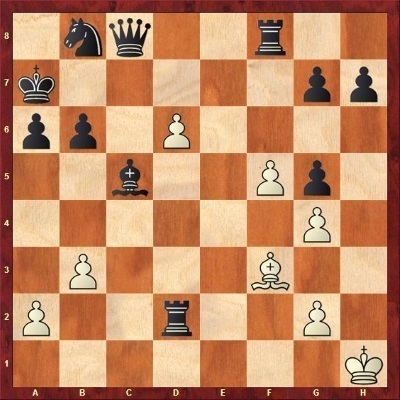
Mr Woodpusher came into the clubroom and headed straight for the corner where he could see Bobby busily writing his thirtieth move on his scoresheet. Bobby was playing the final game in a club tournament, and needed to win to take first place. A quick glance at the board told Mr Woodpusher that the game was almost over. Bobby's opponent, an elderly gentleman, had lost almost all of his pieces and Bobby was getting ready for the kill. (Bobby has the Black pieces)
As soon as he saw his teacher Bobby got up.
'I'm winning it easily,' he said. 'He ought to resign; it's not sporting to play on in such a hopeless position.'
'You be careful,' Mr Woodpusher told him. 'The game isn't over until the last move has been made. You sit yourself down and think about what you're doing; there will be plenty of time for talking after you've won.'
Bobby slouched back in his seat. There were times, he thought, when Mr Woodpusher seemed to have little faith in him. The elderly gentleman puffed on his pipe and stared at the board. Time slowly passed. Bobby yawned, gazed vacantly around the room, fiddled with his pen, and tried to look thoroughly bored. The elderly gentleman wasn't a bit put out: he just puffed on his pipe (of course, smoking at the board is not allowed in tournaments nowadays) and carried on thinking. At length he stirred, stopped puffing and thinking, and moved:
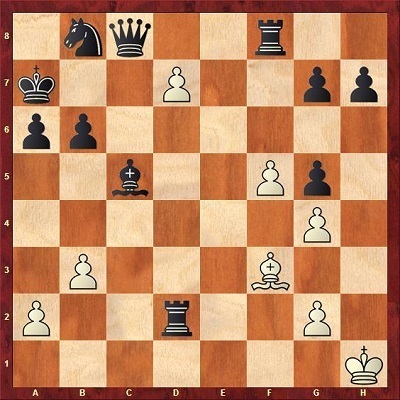
31. d6-d7
'At last!' thought Bobby. 'I've only got to get my rook onto the h-file and it's checkmate. If I move my rook to f6 now, he can take my queen with his pawn and get a queen back himself...but that doesn't matter because I can then put my rook on h6 and it's checkmate!...in fact it doesn't matter what he does...he can't stop me mating him...besides, it'll look good to sacrifice my queen...'
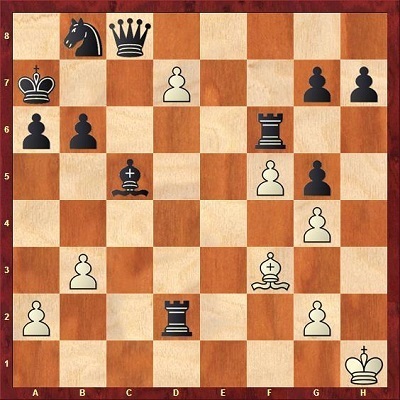
31...Rf8-f6
Bobby wasn't bored any more; he was going to checkmate next move. The elderly gentleman looked puzzled.
'Poor old chap,' Bobby thought, 'he's done his best. The cup will look good at home...we'll keep it in the living room...on top of the television would be a good place...Mum will keep it clean...and she can show it off to all the visitors...Mr Woodpusher will be pleased as well...he's been a great help, but I wish he'd have more faith in me...sometimes he seems to think I'm stupid...what shall I spend the prize money on?...I think I'll...'
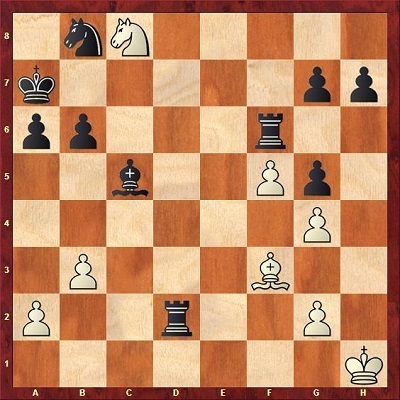
32. d7xc8=N#
Bobby was rudely awoken from his dreams as his opponent smiled and held out his hand.
'I'm very sorry, but that seems to be checkmate,' the elderly gentleman said apologetically, clambering to his feet. 'Bad luck young man, a pity after you had played so well!'
Bobby stared blankly at the position in front of him. He was stunned. Everything had blown up in his face.
His queen sacrifice.
His checkmate.
The game.
The tournament.
All that he had worked so hard to achieve throughout the season. Everything had been wasted, all because of one silly move and that wretched white knight. He slumped back in his seat, peered up at Mr Woodpusher through watery eyes, and felt suddenly rather sick.
There was much that Mr Woodpusher wanted to say, but this was not the time or the place to say it; Bobby had had quite enough for one evening. Even so there was one point he had to make right now. He smiled kindly at Bobby, slowly shook his head, and sat down opposite the youngster.
'Chess is like boxing,' he said. 'A boxer can knock his opponent all round the ring for half an hour, leaving him bruised and bleeding, and still get caught by one silly punch. Then he finds himself flat on his back, unable to get up, and all the good work he has done earlier counts for nothing. Chess is just the same. It doesn't matter how easily you seem to be winning; as long as your opponent has one little pawn left he can still beat you. A chess game is usually lost by the player who makes the last important mistake. It doesn't matter how well you have played for the first 30 moves, it doesn't matter how much better than your opponent you have proved yourself to be; if you make a silly mistake on move 31 then you have had it. At all times, even when the position is very simple, you must concentrate, think hard, and make absolutely certain. Never be in a hurry; always check that your king is safe; and remember that a game is never over before the last move has been made. Until then you can still lose.'