Have you ever seen the Bible used to hurt someone—or has it been used to harm you? Have you sometimes gotten the feeling that people were misapplying verses but been unable to explain how? Do you wish you could better understand what may look like contradictions in the text?
If so, you're not alone. But thankfully, better ways to read and understand the Bible are within your grasp. That's because this user-friendly introduction to biblical interpretation teaches how you can interpret Scripture, both for yourself and for those you love.
Everyone who reads the Bible interprets it, often unconsciously. Learning and practicing key principles of interpretation, however, can empower you to better understand, and to engage more comfortably and responsibly in this process. Using the metaphor of cooking, in which delicious and nourishing meals are created from the ingredients at hand, Serving Up Scripture explains how you, the chef (or interpreter) can whip up solid meals (make trustworthy and insightful interpretations) from the main ingredients (chapters and verses) in your Bible. Just as a cook learns to prepare the same basic ingredients in different ways depending on the context of the meal, you'll learn to ask different questions of the text in order to illuminate aspects of the story or passage you're seeking to understand.
Biblical illiteracy is a major issue in Mainline Protestantism and probably Roman Catholicism. It's probably true even in evangelical churches, despite affirmations of biblical inerrancy. While it is true that until maybe the seventeenth or eighteenth centuries, the likelihood that people had Bibles in their homes, which they could read for themselves, Bibles are easy to find, at least in places like the United States. In fact, there is a plethora of translations that fit just about every level of education and training. You can even read it from your phone through a Bible app or Bible Gateway. So, why is it that people aren't reading the Bible? Besides the fact that we gather less for Sunday School and Bible studies, there is this sense that the Bible is not only ancient but alien. What people need, it would seem, is some guidance about how to read and interpret this familiar but strange book.
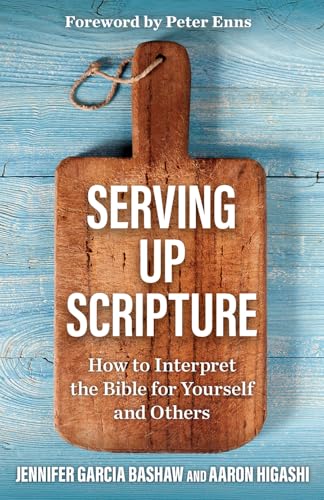
There are, in fact, quite a few resources that can help people encounter Scripture for themselves. Among the most recent offerings is the book "Serving Up Scripture: How to Interpret the Bible for Yourself and Others." Authored by Jennifer Garcia Bashaw, a professor at Campbell University with a PhD in New Testament from Fuller Theological Seminary, along with Aaron Higashi, who is a public Bible scholar with a PhD in biblical interpretation from Chicago Theological Seminary, the book uses the imagery of cooking to draw us into the Bible. They hope that this book can help guide people to read the Bible better. I believe they do an excellent job of helping people do exactly that, especially people who have been hurt by the way the Bible has been used. The metaphor of cooking is designed to take the edge off the conversation, helping people understand the role that the interpreter and the ingredients play in the course of engaging with Scripture.
The authors divide the book into four parts. The first section, Part I, is titled "Setting the Table. Here, Bashaw and Higashi discuss what it means to interpret the Bible (Chapter 1), the role that the interpreter (metaphorically the chef) plays in this process (Chapter 2), and finally, how one engages in "Navigating Biases" (Chapter 3). That third chapter is very helpful because it is important that we not only are aware of our biases but name them.
Moving to Part II, they discuss "The Main Ingredients." Here, the authors provide an introduction of sorts to the Books of the Bible, with chapters on "The Bible in General" (chapter 4), "The Pentateuch" (chapter 5); "The Prophets" (chapter 6); "The Writings" (Chapter 7); "The Gospel and Acts" (Chapter 8); "New Testament and Revelation" (Chapter 9); and finally "The History of Biblical Interpretation," (Chapter 10). You will notice that they use the Jewish organization of the Hebrew Bible/Old Testament, with its three parts - Pentateuch, Prophets, and Writings. This is a different organizing principle than most Bibles printed with Christians in mind. Although the book is geared to Progressive and Post-evangelical Christians, I did find it interesting that when it came to the Pastoral Epistles (1 and 2 Timothy, Titus), the authors spoke of Paul as the author. In any case, this is a helpful introduction to the books found in the bible and the history of their interpretation.
Now that we have the chef identified and the ingredients, it's time for "Preparing the Ingredients" (Part III). Here, the authors focus on the key interpretive Questions. These include "Historical Questions" (Chapter 11). The kinds of questions dealt with here include when and where a text was written, as well as when and where the story was set. These are two different sets of questions. Then there is the question of why it was written as well as why it was preserved. They write that "Historical Questions help us to overcome our own biases and refocus on the issues that would be near and dear to the hearts of the people who originally wrote and read the biblical texts" (p. 178). The next chapter focuses on "Literary Questions" (Chapter 12). The questions involve determining genre and literary devices, as well as the way language is used. They speak of exploring both the big picture and then zooming in on specific elements. In this chapter, the goal is to remind us that the Bible is like other books that also require interpretation. The first two sets of questions are expected, but then we move to the third set, "Ideological Questions" (Chapter 13). Here, the focus is on social identity, both as it is presented in the text and as it defines the person doing the reading/interpreting. In this chapter, they speak of some of the various forms that social identity takes concerning the text, including Feminist hermeneutics, Liberation Theology, Womanist Theology, Mujerista theology, and Asian Theology. Other forms could be added, but this gives a sense of the possibilities. Finally, there are the "Theological Questions" (Chapter 14). They speak of the Theological questions as dessert; the final set of questions that follow after the other questions are addressed. They note that these are important questions that were often suppressed by practitioners of the historical-critical method. They want to note that it's not an either/or scenario. The focus here is on the "why" questions!
Part IV is titled "Feeding People." In the concluding chapters, the authors note that the purpose of cooking is to eat the food. Thus, here the question concerns the purpose of interpreting the Bible. In answering these questions, the focus is on two categories of people: "Interpreting for Yourself" (Chapter 15) and "Interpreting for Others" (Chapter 16). When it comes to interpreting for ourselves, the authors acknowledge the value of engaging with scripture for ourselves. But there is also value in doing it for and with others. The focus of that chapter isn't just on preachers and teachers, but all who gather and share their insights.
Since this is a book written for a "lay" audience, the authors helpfully provide a set of discussion questions that could be used in small groups. I would recommend that the book be utilized in that way. There are two appendices, one that offers a Social Location Inventory, while Appendix 2 offers "Resources for Further Study."
Believing as I do that Christians need to have a strong biblical foundation, it is good to know there is a guide to engaging with and interpreting the Scriptures that is geared for a lay audience, that is interesting to read, and accessible.
This is the book I wish I had been given when I first wanted to study the Bible seriously.
Serving Up Scripture by Dr. Jennifer Garcia Bashaw and Dr. Aaron Higashi doesn’t tell you what to think about the Bible-it teaches you how to read it with care, humility, and responsibility.
I was raised to believe there was one correct way to interpret Scripture, and that anything outside that narrow frame was unfaithful. What this book offers instead is an invitation: to slow down, to notice context and genre, to understand how interpretation actually works, and to engage the Bible honestly-in community, not fear.
This isn’t just for Christians, but if you call yourself a Christian, I believe this kind of biblical literacy matters. The Bible has been used to heal and to harm, to liberate and to control. Learning how to read it well-what it is saying, what it isn’t, and how meaning is shaped-is not optional if we’re going to handle it with integrity.
What I appreciate most is that this book doesn’t trade one rigid framework for another. It resists black-and-white thinking. It honors scholarship without dismissing faith. And it trusts readers enough to invite them into the work themselves.
For anyone who loves Scripture, is wrestling with it, or has been wounded by how it’s been used-this book is important reading.
I wish I had had this instead of my MacArthur Study Bible when I started studying the Bible. It's honest, readable, and fun. I love the metaphor of cooking because I've come to think of Scripture as bread that can nourish our faith rather than a stone that rules our faith. My favorite section of this book is about feeding people. It talks about the Bible as nourishment for your own faith walk and about how you might feed others. I like that this book takes seriously that the Bible is still important even if how you view it is starting to change. Lovely. Highly recommend. Oh! There are also discussion questions for each chapter!
This book has been so refreshing to read! I was raised in a conservative Christian household where questioning a church leader’s interpretation of the Bible was practically heresy. So, reading this book has not only helped me understand how to properly read scripture but, it’s also encouraged me to question what I already thought I knew about what the Bible says. I feel that reading this book has actually allowed me to feel closer to God and allows me to understand scripture in a brand new way!
This is a really helpful book for anyone wanting to get to know Scripture better. Even though it talks about scholarly things it does it in a way for everyday people. If you've been taught that there's only one right way to read the Bible, this book can open up a whole new world like Jasmine on that magic carpet.