Bette A. - also known as Bette Adriaanse - is a writer and an artist from Amsterdam. Her novels include ‘What’s Mine’ and ‘Rus Like Everyone Else’. With artist Brian Eno she wrote the non-fiction book ‘What Art Does’. Her short story collection ‘Slow Stories’ is forthcoming with Unnamed Press. Bette writes in English and in Dutch. Bette is also a visual artist, a teacher and the co-founder of the TRQSE Foundation, an international network for artists and scientists, who work together on projects with a social purpose.
A Book of Fables for the Algorithm Age: My Review of “Slow Stories,” Where Prediction, Performance, and Possession Become Their Own Kinds of Violence By Demetris Papadimitropoulos | February 5th, 2026
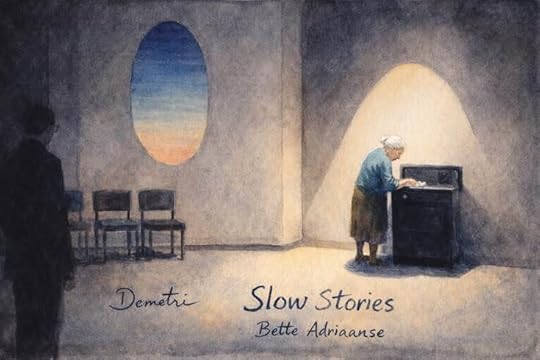
Watercolor Piece by Demetris Papadimitropoulos
“Slow Stories” arrives disguised as a slim fable-book – the kind you imagine could be read in a single sitting – but it behaves less like a bedtime moral tale than like a cabinet of pressure instruments. Each story is a small sealed chamber. You step inside, the door clicks, the air changes, and suddenly you can feel what contemporary life does to the nervous system: its compulsions toward performance, consumption, prediction, surveillance, and self-explanation. Bette Adriaanse writes with the clean, bright blade of parable and the bruised afterglow of confession. The tone is often lucid, sometimes wickedly funny, and always a little aghast at the human talent for turning even tenderness into a transaction.
The book’s best trick is its refusal to announce itself as “relevant.” It does not march in with a list of issues. Instead it builds worlds in which the logic of our own world is simply allowed to complete itself. The effect is oddly relieving and quietly nauseating, like recognizing a familiar smell in a room you thought you’d never entered before. These stories do not predict the future so much as expose the machinery of the present. Their method is compression: whole economic systems, whole family histories, whole cultural epochs condensed into an image you can’t forget – hair braided into a blanket, a village skyline choked with manufactured dreams, a telescope-like arm stretching toward a distant enemy until it loops back and stares.
If “Slow Stories” has an organizing obsession, it is the way desire metastasizes when it is unmoored from limits. The book’s monarchs, villagers, curators, caretakers, prodigies, and spies are all animated by a craving to have more: more safety, more certainty, more beauty, more meaning, more things, more control over the humiliations of chance. In Adriaanse’s universe, that craving rarely stays private. It becomes policy. It becomes culture. It becomes a weather system. And the remarkable thing is how often the victims participate in building it, not because they are stupid, but because the alternative feels like annihilation.
Consider “The King and His Things,” a story that begins with an almost childlike premise – a king who counts his possessions until counting itself becomes a kind of delirium – and then turns that premise into a portrait of extraction so grotesque it becomes, in its own way, exact. The king’s appetite is not just personal greed; it reorganizes reality. The North freezes because he has confiscated blankets, wood, matches. The East is scoured by wind because he has monopolized windscreens. The South burns because he has taken shade. The West floods because he has hoarded boats and rafts. In each region, people improvise survival out of their own bodies and losses, producing innovations that are at once ingenious and horrifying: a blanket braided from the hair of deceased daughters, a living shield made of firstborn children, limbs tied together into rafts. The valets, terrified and obedient, deliver these “solutions” as gifts, and are executed because the king already owns them. He has already collected suffering in every form. The only thing he lacks is “a good heart” – and when a valet names this, the king’s brief moisture of recognition does not become repentance. It becomes procurement. He cuts the valet open and adds the heart to his collection, then returns to counting.
It would be easy to read that ending as a blunt moral – greed is insatiable – but the story’s true sting is subtler: the king is not an aberration; he is a system that turns virtue into inventory. Even “goodness” becomes a scarce resource to be extracted. The king’s desire is also a kind of administrative imagination: he can envision every useful thing as his, and because he has power, that envisioning becomes fact. The story’s violence is cartoonish, yes, but it has the clarity of political caricature: exaggeration as a way of telling the truth without pleading.
If that story examines appetite at the scale of the state, “Für Elise” anatomizes appetite at the scale of the family – and it does so with a tenderness that makes the cruelty sharper. Elise is a child musician with the kind of talent adults love to display, the kind they turn into bragging rights and party tricks. But her real aptitude, the one her life is organized around, is caretaking. Her home is a low-level emergency room: a sister pregnant too young, a brother constantly in trouble, a grandmother who needs daily care, a mother stretched thin by work, a father whose ego rots in the shadow of his own incapacity. Elise becomes the hinge that keeps the household from falling off its frame. She practices in stolen minutes, in borrowed spaces. She misses chances not because she lacks ambition, but because ambition requires an infrastructure of support she never receives.
The story’s most devastating insight is the one it refuses to sentimentalize: the world loves talent as a symbol more than it loves the talented person as a person. When Elise is praised – “unparalleled, remarkable talent” – the praise does not translate into tuition money, application help, letters of recommendation, time off work, freedom from guilt. Instead, it becomes another way for her family to claim her. They will ask her to play “Für Elise” at weddings and birthdays – her own name, offered up as entertainment – even as they drain the life that might have allowed her to become what they brag she is. When she finally erupts at a family gathering, her rage is musically described – “abrupt, slashing, bow strokes” – as if the body itself is finally forced to play the truth. And then, in a maneuver as psychologically accurate as it is heartbreaking, she softens. She accepts the hug. She cries. She feels the moment leak away. Her family turns her rebellion into a manageable event. She becomes “complicated,” “unpredictable,” and the household returns to its habits, merely adjusted.
The story then offers an “alternative ending,” and the inclusion is not a gimmick so much as a thesis. The alternative ending imagines Elise refusing comfort, leaving, opening the email she has been too afraid to open, building a new life in Mexico City with music and community and modest survival. In that ending, she is still blamed. She still carries the moral paperwork of her family’s collapse. But she also gains something the original ending denies her: the lived experience of being “for Elise.” The device suggests that fate is not only what happens to us; it is also the narrative we accept as inevitable. Adriaanse keeps asking what it costs to accept the story you’ve been assigned. Elise’s tragedy is not that she is unseen. It is that she is seen as a function.
If “Für Elise” is the book’s most intimate indictment of how devotion can be exploited, “The Monsters Outside the Village” widens the lens to culture itself, offering a myth for our era of image-saturation. A woman burns a diary, and the smoke becomes a monster shaped like her mother in rage – the memory rendered as spectacle. She burns a love letter, and the smoke becomes an ecstatic dance. The villagers discover that by feeding the fire with stories, designs, images, and dreams, they can project their inner lives into the sky in forms more beautiful than their daily realities. They become addicted to the mirror. They begin tearing pages from books, buying premium paper, harvesting rare woods – the economy reorganizes around fuel for spectacle. Children are given their own monsters at birth. And soon the village is permanently draped in a colorful haze of preferred selves. People even feed images of the monsters back into the fire, producing copies of copies until the aesthetic becomes an entire way of being.
The parable is so legible it risks sounding like a moral about social media, but it reaches beyond that easy reading. What the story captures, with eerie accuracy, is how representation becomes not merely a pastime but an identity prosthetic. The villagers cannot let the monsters die because they have become “one with the monsters” – without the spectacle, they fear there would be nothing left. Even those who object are absorbed: dissent becomes a temporary loneliness, followed by a warm embrace once they comply. It is not propaganda; it is dependency. And the story’s most chilling moment arrives when a child suggests, with bell-like clarity, that if people feed the monsters, perhaps they could also make them go away. The adults respond not with philosophy but with economics. Do you want your mother to lose her work?
One of Adriaanse’s sharpest skills is her ability to show how moral questions are often answered, in practice, by commerce. The book keeps returning to this: the way a society re-labels its compulsions as necessity, then calls that necessity “normal.” “The Ones and the Others,” another tale of perception and paranoia, illustrates the same mechanism through a different lens. A mountain people, the Ones, see distant lights beyond smoke and become anxious that there are Others. They build an Eye, the inverse of their microscopes, extending it farther and farther into unimaginable distance until they can spy on the Others’ lives. They watch and judge and fear. Then they discover the Others have built an Eye too. Each side interprets being observed as hostility. Each retreats into bunkers, armed, tense, and sleepless, watching screens rather than living. Eventually the Ones perish – all of them – while their Eye remains, extending into space and looping back to stare at the abandoned village.
It is a story about surveillance, yes, and also about the fatal feedback loop of mutual suspicion. It suggests that the act of watching can become a substitute for living – and that the tools built to reduce fear can enlarge it until fear becomes habitat. That motif threads through “The Last Inventor,” perhaps the collection’s most overtly speculative piece, which transposes the same anxiety into a near-future of prediction algorithms and total data capture. Baby Jameson, a child who learns to derail her parents’ emotional collisions by reading micro-tells, becomes a chess prodigy, then a scientist who tries to solve life itself by mapping every variable in a closed compound. She builds “The Demon,” an algorithm that predicts every twitch, thought, and breath before it happens. She experiments with deviating from the predicted path, only to find the system predicts her deviations too. Her quest is not for knowledge but for insulation: could she push probabilities high enough to avoid disappointment, pain, humiliation? Is it possible to play a perfect game of life?
The story’s philosophical ambition is bracing. It takes the contemporary hunger for optimization – the belief that if we quantify enough, we can outrun suffering – and pushes it into metaphysics. Baby’s desire to escape uncertainty becomes a desire to escape the self, because any system that includes you cannot be perfectly modeled. The story suggests that predestination, whether cosmic or algorithmic, becomes most seductive to those who have been harmed by unpredictability. Control is a trauma response disguised as intelligence. The tragedy is that the more she predicts, the more she becomes suspicious of the very thing that makes life bearable: the unmodeled, the unscripted, the moment that arrives unannounced and therefore feels like grace.
If the book were only a parade of bleak allegories, its cumulative effect might be numbing. What saves it is its awareness of how even critique can become performance, and how even “authenticity” can be commodified. That awareness animates “The Inverted Gallery,” in which a curator, sickened by a world of costumes and self-narrations – sailor who does not sail, camouflage that does not camouflage, people describing themselves as “eras” and “concepts” – tries to curate “A Moment Without Stories.” He installs his grandmother in a spotlight to clean a stove for an hour each day, as an exhibition of pure unselfconscious presence. The audience, starved for relief from performance, treats her as revelation. But the alchemy is immediate: the press interprets, replicates, sells stoves, sells tutorials, sells enlightenment. And when the grandmother, confused, begins confessing small sins, the audience erupts into applause, shouting therapeutic slogans. The next night she returns as a professional – speaking like a host, offering tips, “I run a tight ship” – and the curator watches, devastated, as the last scrap of unperformed reality becomes another act.
The story’s genius is that it does not blame the grandmother, nor even the audience. It shows how the gaze contaminates. It shows how quickly the market metabolizes the real. It also shows how art’s desire to heal can become its own form of violence, a way of dragging private life into public meaning. In the end, the curator flips the gallery inside out, opening doors and windows, inviting rain, soil, insects, raccoons, a homeless man, turning the exit into the entrance and the entrance into the real world. It is a gesture of surrender, of relinquishing the fantasy of control. The gallery becomes porous. The story does not pretend this solves anything. It only insists that permeability might be the beginning of sanity.
Placed alongside recent books that also use invention to examine our moral moment – the speculative parable of “Exhalation” and “Stories of Your Life and Others,” the uncanny ethical fables of “Black Mirror,” the bureaucratic dread of “Severance,” the plague-mirror of “Station Eleven,” the fairy-tale bleakness of “The Memory Police,” the mythic social critique of “The Employees,” the satirical allegories of “Candide” and “Animal Farm” – “Slow Stories” holds its own by refusing the prestige posture of “big ideas.” Adriaanse writes as if ideas are bodily forces: hunger, shame, dread, longing. Her sentences often carry the cool clarity of someone describing a dream the morning after, when it still feels true. She repeats phrases – more, more, more; what now – like incantations, reminding you that obsession is a kind of rhythm.
And the book’s quiet nod to our current moment is precisely this: it understands that we live inside systems that train us to convert everything – art, care, identity, virtue, even “being present” – into an asset. We are encouraged to brand ourselves, to optimize our days, to narrate our feelings, to watch others and be watched, to treat the future as a set of probabilities we can purchase, to treat the past as content, to treat even grief as a form of performance. “Slow Stories” does not preach about these habits. It depicts their logic in miniature until the miniature begins to feel like a map.
To read these tales in sequence is to feel a particular kind of ache: not only the ache of recognizing cruelty, but the ache of recognizing participation. The villagers keep feeding the monsters. Elise plays “Für Elise.” The Ones keep watching. Baby Jameson keeps predicting. The curator keeps curating. No one is innocent, and yet the book is not cynical. Its compassion is there, faint but persistent, in the way it notices why people cling to their traps. The monsters bring joy. The Eye promises safety. The Demon promises relief. Caregiving promises meaning. Even the king’s counting, in its absurdity, resembles a desperate attempt to make the world hold still.
The book’s limitation is also the cost of its form. Parables can sometimes feel like closed systems: the ending arrives with the inevitability of a snapped trap. A few stories lean so efficiently into their moral architecture that you can see the blueprint. The cumulative bleakness can begin to feel like a style. But when the collection breaks beyond its own mechanism – when it allows grief to remain unresolved, when it lets a character’s inner weather complicate the moral, when it exposes how the desire for purity becomes yet another commodity – it becomes something rarer than “timely.” It becomes clarifying.
“Slow Stories” is, finally, a book about the terrifying human impulse to outsource the difficult parts of living. Outsource uncertainty to prediction. Outsource meaning to spectacle. Outsource love to obligation. Outsource the self to a persona. Outsource reality to story. Adriaanse is not asking us to stop telling stories. She is asking what happens when we can no longer tell the difference between story and life – and what small, stubborn act might reopen that difference. My rating: 86/100.
A bad king. A girl who sees what others can't. A violin prodigy. A huge spy telescope. A severed thumb. A prediction machine. These are what some of Bette A.’s new short story collection delves into over a slim but often strongly worked 168 pages.
Like almost every short collection in existence, some of the stories are more successful than others. Some are full blooded, solid science fiction or fantasy stories, written at a good length. Some are small scene sketches, just a few pages long (the shortest is 2 pages). In between there are new takes on the fairy tale and the parable, all driving home a strong worldview on the past and the future.
In the middle of all of that past and future is one modern story called Für Elise, about a young violin prodigy named, duh, Elise born into the wrong family, one who only respects her talent as being a useful trick at parties to impress their guests. When it comes time for Elise to take to the next step and enter a conservatory, there is no money, or the family business needs help, or Grandma needs help, or Mom and Dad are divorcing, or, or, or, until things bubble over.
Another story, The Ones and the Others, is a Philip K. Dickish tale about a city on a hill (not the ones you're thinking of) full of farmers, craftspeople and scientists so scared of someone moving into their territory and enslaving them that they build a powerful telescope to spy on their would-be usurpers, reacting to their every move. They become paranoid and arm themselves accordingly, eventually hiding in underground bunkers -- safe but forgetting how to farm and do science, to their quickly impending doom.
By the end I was left feeling that the good stories were _good_ and that the stories that didn’t float to the top were not bad, but could have used a little more time in the oven to bake through. But, I count 9 of 16 stories in the _good_, which is an excellent rate.
Thanks NetGalley and Unnamed Press for the digital ARC for review!
I went into reading this completely unsure of what I was getting myself into and I ended up really loving the experience I ended up having!
Short story collections can sometimes be hit or miss because I feel like it’s rare that every story is one that I will enjoy, but I will say I was interested in every story in this collection. Even though, obviously, I enjoyed some stories much more than others, I think the length and number of stories in this collection was perfect. The stories were, in my opinion, very fable-like in the way that they give off a modern fairytale sort of vibe. I also think they could be described as “Black-Mirror-esque”.
The stories are about many different things but share common themes to make this collection feel cohesive. Many stories are about uncertain futures, unimaginable technologies, emotional and thought-provoking situations among other things.
The way that this author writes made me feel very emotional. I got teary-eyed multiple times when reading these stories.
This is the perfect collection to read in bed at night in total darkness with piano music lightly filling the room (I know because that is how I consumed it!). I got lost in the stories and the book was over before I knew it (which is a huge compliment).
As customary when I review a short story collection, I list a few of my favorite stories: - The Other Village (feels nostalgic and I could relate to this a lot) - Guided (could be a full novel that I would devour) - The Ones and the Others (that twist)
I would recommend reading this if you are looking for an interesting, but overall relaxing read with phenomenal writing and emotional characters. It feels like serious literature without being hard to understand or too flowery.
Thank you to NetGalley and The Unnamed Press for an Advance Reading Copy of this book in exchange for an honest review.
There was a time, half a generation ago or so, when Adriaanse’s brand of minimalist fiction was awfully fashionable. I bounced hard off the style then; stripped down, bare, raw, and contextless. I felt that maybe these postmodern fables had shed some of their teeth as well as their skin in their search for internal profundity. This was the age of the up coming of Instagram, when gesturing at the third meaning was roughly sufficient for a social media post, and transferring that accessibility to print was considered a virtue. Slow Stories isn’t exactly a Rupi Kaur post, and is a full step up from the vacuity of Paulo Coelho – but only one full step. There’s something appealing in the promise, for sure, that in simplicity there is a clarity that looks through and beyond whatever is obfuscated by bloviating, convoluted, experimental post-formalism. Whatever thing of clarity is, though, eludes me, and I can find no purchase on these watery, unfounded little dream shards.
Slow Stories is a quick read which leaves behind food for thought. Some of the stories had clear moral conclusions whereas others were a bit more vague. As with any short story collection, some stories will stand out to certain readers more than others and every reader will have their own personal preference. I personally enjoyed the stories in the last third of the book far more than the first two thirds.
A common theme between the stories was the idea of human connection, which helped to tie the stories together somewhat even though there were no other connections between them. Overall, I think I would have preferred for some of the stories to be cut to allow space for others to further explore the themes brought up.
Thanks to NetGalley and The Unnamed Press for the ARC. All opinions are my own.
A genuinely lovely collection of fables from Adriaanse, who I’d never come across until now, but I’ll certainly be on the lookout for more of her work on the back of this collection.
Short story collections are tricky things, as not every single piece can be a “banger,” as the kids would say, but everything featured here is, at the very least, enjoyable. The stories vary in time period and theme, so there should be something of interest for everyone.
There are also a few rug pulls within the collection, hidden away like a rake in the grass, which I deeply appreciated. Without trying to spoil anything, there was one fable in particular that earned a couple of dark chuckles from me.
Thank you to Netgalley, the publishers and the author for the advanced e-copy of this book.
This collection of stories has some really high highs, but unfortunately some lows as well. Certain stories really stood out to me, for example the story ‘Guided’, which was such an interesting concept that could have been expanded into a standalone novel! It is a very common problem for collections like this to have some sections that do not leave an impression, I do however wish certain sections weren’t quite as ‘minimalistic’; certain stories left me waiting for more, not in a good way. I do like the writing style of this book and I feel that some of these stories will stick with me, so I would recommend this to fans of literary fiction!
Slow Stories by Bette A. Read like a book of fairy Tezol’s or fables, very much like those I was read as a child. Each fable I read, I was trying to figure out the overall meaning and goal of the story. What an intriguing collection of stories!
This is my first exposure to Bette A. And I would say, she writes clearly, consistently and in a way that allows me to use my own mind and experiences to determine what I am supposed to take from each story.
My only let down is that the overall story collection felt a bit disconnected. In the end, I still didn’t see the connection. The overall pacing and depth of each story earned its rating. Very memorable read!
I am not sure what to think of this collection of short stories. I liked the concept of quite a few stories, but the execution was lacking. The spare writing style combined with the over explanation of the themes made this read like a CliffsNotes summary. I'm sure there are readers who will appreciate this writing style, unfortunately it was not for me.
Thank you to NetGalley and Unnamed Press for the ARC in exchange for an honest review.
fun collection of fables with some good plotting and great stories throughout. 5 stars. tysm for the arc, would recommend.
If you want to get honest reviews of some of the most exciting books coming out every week from a top-5 Goodreads Reviewer, sign up for my mailing list here!
It takes skill to weave a philosophically potent short story. What usually triggers my DNF impulse is a mawkish fable-like story. Philosophy, as I understand it, is at its very best when it remains faithful to its ancient vocation of pondering our place in the Cosmos, as well as offering insights into human nature. I adore philosophy presented through literature and story, and find it far too abstract and insular when unaccompanied by art. Which is why I was so pleasantly surprised by Adriaanse's stories. Magical in a way, like Calvino, but not avuncular, to my mind more profound. These are deeply engaging tales. The author is on my radar to be collected. A lovely collection.
My new very favorite book of short stories ever! All I can say is that I felt so personally and deeply connected with each of these stories that it was inspirational and truly life changing. When a book comes along that makes you feel seen and understood in such a profound way that it sets about a small series of changes in your life leading you back to your creative center, then that is a gift from the universe. I feel extremely blessed to have come across this book as I believe that books sometimes choose me rather than me choosing them. A million stars!