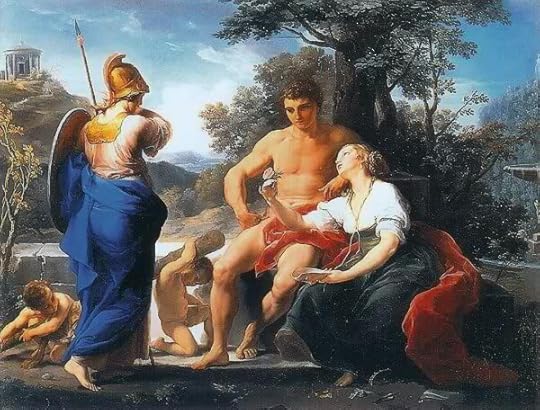
Voici la première traduction française d'un des textes fondamentaux de Diodore de Sicile (Ier siècle av. J.-C.), le quatrième livre de sa Bibliothèque historique, le premier à organiser la mythologie, telle que les Grecs se la racontaient.
On trouvera dans ce récit des aventures contées comme dans un roman picaresque, où paraissent, entre autres, Bacchus, Priape, Hermaphrodite, Héraclès, Jason et les Argonautes, les Lapithes et les Centaures, Thésée et Minos, Priam et Nestor, le chasseur Orion etc. C'est tout le "monde connu" qui est le théâtre des dieux et des héros avant que ne débute l'Histoire.
Anahita Bianquis est professeur de Lettres classiques. Janick Auberger, docteur ès lettres, est professeur d'histoire ancienne à l'Université du Québec à Montréal (UQAM). Elle a déjà traduit, dans la même collection, les fragments de Ctésias et deux livres de Dion Cassius.
Diodorus Siculus (Greek: Διόδωρος Σικελιώτης [Diodoros Sikeliotes]) was a Greek historian, who wrote works of history between 60 and 30 BC. He is known for the monumental universal history Bibliotheca Historica. According to Diodorus' own work, he was born at Agyrium in Sicily (now called Agira). With one exception, antique sources afford no further information about Diodorus' life and doings beyond what is to be found in his own work. Only Jerome, in his Chronicon under the "year of Abraham 1968" (i.e., 49 BC), writes, "Diodorus of Sicily, a writer of Greek history, became illustrious". His English translator, Charles Henry Oldfather, remarks on the "striking coincidence" that one of only two known Greek inscriptions from Agyrium (I.G. XIV, 588) is the tombstone of one "Diodorus, the son of Apollonius".
Diodorus' universal history, which he named Bibliotheca Historica ("Historical Library"), was immense and consisted of 40 books, of which 1–5 and 11–20 survive: fragments of the lost books are preserved in Photius and the excerpts of Constantine Porphyrogenitus.
It was divided into three sections. The first six books treated the mythic history of the non-Hellenic and Hellenic tribes to the destruction of Troy and are geographical in theme, and describe the history and culture of Ancient Egypt (book I), of Mesopotamia, India, Scythia, and Arabia (II), of North Africa (III), and of Greece and Europe (IV–VI).
In the next section (books VII–XVII), he recounts the history of the world from the Trojan War down to the death of Alexander the Great. The last section (books XVII to the end) concerns the historical events from the successors of Alexander down to either 60 BC or the beginning of Julius Caesar's Gallic Wars. (The end has been lost, so it is unclear whether Diodorus reached the beginning of the Gallic War as he promised at the beginning of his work or, as evidence suggests, old and tired from his labours he stopped short at 60 BC.) He selected the name "Bibliotheca" in acknowledgment that he was assembling a composite work from many sources. Identified authors on whose works he drew include Hecataeus of Abdera, Ctesias of Cnidus, Ephorus, Theopompus, Hieronymus of Cardia, Duris of Samos, Diyllus, Philistus, Timaeus, Polybius, and Posidonius.
His account of gold mining in Nubia in eastern Egypt is one of the earliest extant texts on the topic, and describes in vivid detail the use of slave labour in terrible working conditions.
Cette édition contient la traduction d'une partie de la bibliothèque historique de Diodore de Sicile, un grec du premier siècle de notre ère. Son œuvre complète embrassait l'ambition de présenter l'histoire de l'ensemble du monde connu, mais en ne mettant pas de côté les mythes et légendes rapportés par la tradition: il y cherche au contraire des germes de vérités que le temps aurait rendu fabuleux, et embrasse la théorie évhémériste selon laquelle les dieux et héros sont d'anciens personnages historiques divinisé suite à leurs grandes actions. Faisant feu de tout bois, on comprendra que Diodore ait été écarté du nombre des historiens.
Ce tome se limite à la mythologie des grecque, n'hésitant pas à compiler différentes versions des mythes et à les agréger en un ensemble plus ou moins cohérent. On retrouve l'ensemble des héros grecs, parmi lesquels Héraklès, Dionysos, Orphée, Jason, Thésée, etc. Héraklès se taille la part du lion dans ces histoires, écumant l'ensemble du monde connu pour exterminer bêtes féroces et brigands, et établir des villes et des dynasties: c'est un manuel de colonisation et civilisation du monde sauvage qui préfigure les conquêtes romaines. C'est aussi une glorification de la monarchie et de l'homme providentiel, à l'heure où César et son neveu ont établi une dynastie impériale et abattu la République.
Un bon condensé de contes et récit, mais j'aurais une réserve sur la densité du récit: le lecteur est littéralement enterré sous un tombereau de noms, de faits, d'aventures, de légendes, de récits contradictoires, si bien qu'il est facile de s'y perdre, et d'en oublier la plus grande partie.