

What do you think?
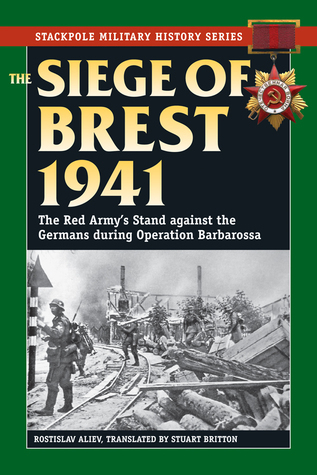
Siege of Brest 1941
On 22 June 1941, the first German shells smashed into the Soviet frontier fortress of Brest--Hitler's Operation Barbarossa had begun. As the Wehrmacht advanced, taking the Red Army by surprise, the isolated stronghold of Brest held out in one of World War II's most legendary defenses. This graphic account chronicles the siege of Brest during the opening days of Operation Barbarossa.
*Detailed, hour-by-hour reconstruction of the fighting, based on new archival research and eyewitness testimony
*Describes how the Red Army garrison held out against a German division
*Dispels the myths surrounding this remarkable story
*Detailed, hour-by-hour reconstruction of the fighting, based on new archival research and eyewitness testimony
*Describes how the Red Army garrison held out against a German division
*Dispels the myths surrounding this remarkable story
- GenresRussia
272 pages, Paperback
First published March 1, 2015
Ratings & Reviews
Friends & Following
Create a free account to discover what your friends think of this book!
Community Reviews
Displaying 1 - 1 of 1 review
June 16, 2018
As the Germans prepared to invade the Soviet Union in June, 1941, one of their first obstacles was a fortress sitting near the town of Brest: the Brest-Litovsk Fortress. Constructed in the 19th Century, the fortress was originally captured by the Germans in 1939 during their invasion of Poland. However, due to the terms of the 1939 German-Soviet Non-Aggression Pact, the territory around Brest was assigned to the Soviet Union and thus when the Germans invaded the Soviet Union they now had to capture the fortress a second time.
Although cut off from reinforcements and with no real chance of victory, the Soviet forces which were defending the fortress managed to hold out for more than a week against a German force which included infantry, very heavy artillery, air strikes and tank destroyers. The battle itself has acquired a legendary status in the Soviet Union, and while this book does not attempt to dispel the myth of the heroic fight, it does present what could be termed a more balanced and fair recounting of the battle. Based upon documents in both German and Soviet archives, as well as correspondence and interviews with participants and survivors on both sides, the author does a really good job of describing the very chaotic battle, although there are times he freely admits that what actually happened in a certain time and place is really unknown and he is presenting things as his available evidence would lead him to conclude. One of the things which I was very pleased with was the translation of the book--the author is Russian and it was translated from both German and Russian. Stuart Britton did a great job with the translation and the narrative never bogged down or stumbled over the English language.
This is definitely a good book about the opening days of Operation Barbarossa and worth picking up.
Although cut off from reinforcements and with no real chance of victory, the Soviet forces which were defending the fortress managed to hold out for more than a week against a German force which included infantry, very heavy artillery, air strikes and tank destroyers. The battle itself has acquired a legendary status in the Soviet Union, and while this book does not attempt to dispel the myth of the heroic fight, it does present what could be termed a more balanced and fair recounting of the battle. Based upon documents in both German and Soviet archives, as well as correspondence and interviews with participants and survivors on both sides, the author does a really good job of describing the very chaotic battle, although there are times he freely admits that what actually happened in a certain time and place is really unknown and he is presenting things as his available evidence would lead him to conclude. One of the things which I was very pleased with was the translation of the book--the author is Russian and it was translated from both German and Russian. Stuart Britton did a great job with the translation and the narrative never bogged down or stumbled over the English language.
This is definitely a good book about the opening days of Operation Barbarossa and worth picking up.
Displaying 1 - 1 of 1 review