Jump to ratings and reviews
Rate this book

The God of Vengeance

Rate this book
A new translation of the classic Yiddish drama by Sholem Asch about a Jewish brothel owner who tries to become respectable by commissioning a torah scroll to be written. Meanwhile, his daughter has a lesbian affair with one of his prostitutes downstairs. This translation debuted at Show World in Times Square in 1999 and "set Show World aflame" according to the Village Voice.

84 pages, Kindle Edition

First published January 1, 1907

7 people are currently reading
369 people want to read

About the author

Sholem Asch

259 books36 followers
Polish-American writer Sholem Asch (also written Shalom Ash, Yiddish: שלום אַש, Polish: Szalom Asz) sought to reconcile Judaism and Christianity in his controversial novels, such as The Nazarene (1939).

Sholem Asch composed dramas and essays in the language.

Frajda Malka bore Asch and nine other children to Moszek Asz, a cattle-dealer and innkeeper. Asch received tradition and as a young man followed, obtained a more liberal education at Włocławek, and supported with letters for the illiterate townspeople. He moved to Warsaw and met and married Mathilde Shapiro, the daughter of Menahem Mendel Shapiro. The Haskalah or Hebrew enlightenment initially influenced Asch, but Isaac Leib Peretz convinced him to switch.

Plot of God of Vengeance , his drama of 1907 features a lesbian relationship in a brothel.

He traveled to Palestine in 1908 and to the United States in 1910.

His Kiddush ha-Shem in 1919 in the earliest historical modern literature concerns the anti-Semitic uprising of Khmelnytsky in mid-17th century Ukraine.

He sat out World War I in the United States and a naturalized as a citizen in 1920. He returned.


People celebrated a 12-volume set of his collected works, published in his own lifetime in the early 1920s.

When people performed God of Vengeance , the highly esteemed play, on Broadway in 1923, authorities arrested and successfully prosecuted the entire cast on obscenity charges despite the fact that people in Europe already translated it into German, Russian, Hebrew, Italian, Czech, and Norwegian.

Farn Mabul ( Before the Flood , translated as Three Cities ), his trilogy of 1929 to 1931, describes early 20th century life in Saint Petersburg, Warsaw, and Moscow.

In 1932, the republic awarded the decoration of Polonia Restituta, and the club of poets, essayists, and novelists (PEN) elected him honorary president.

He later moved to France and visited Palestine again in 1936. Dos Gezang fun Tol ( The Song of the Valley ) about the halutzim or Zionist pioneers in Palestine reflects his visit of 1936 to that region.

He set his Bayrn Opgrunt (1937), translated as The Precipice , in Germany during the hyperinflation of the 1920s.

He settled in the United States in 1938.

He, however, later offended sensibilities with The Apostle , and Mary , parts of his trilogy, which in 1939 to 1949 dealt with subjects of New Testament. The Forward , leading language newspaper of New York, dropped him and openly attacked him for promotion.

Asch spent most his last two years in Bat Yam near Tel Aviv, Israel but died in London. His house in Bat Yam now houses his namesake museum. Yale University holds the bulk of his library, which contains rare books and manuscripts, including some of his own works.

Ratings & Reviews

What do you think?
Rate this book

Friends & Following

Create a free account to discover what your friends think of this book!

Community Reviews

5 stars
67 (27%)
4 stars
98 (40%)
3 stars
67 (27%)
2 stars
7 (2%)
1 star
3 (1%)
Displaying 1 - 30 of 47 reviews
Profile Image for Leah Horlick.
Author 4 books118 followers
November 28, 2017
I am losing my mind about the fact that a young, married Jewish dude in 1906 wrote this Yiddish play that features a ***loving lesbian relationship between a sex worker and her upstairs neighbour*** whose parents own the brothel. That features legit lesbian sex, commentary on domestic abuse, and a whole scene where the women who work in the brothel talk about choosing to leave home, escape abusive parents, and abandon arranged marriage for economic independence. How did I never know about this? ALSO when this play was first mounted in 1923 it was the first-ever lesbian kiss on Broadway and the WHOLE CAST WAS ARRESTED. I repeat, I am losing my mind.
Profile Image for Ярослава.
971 reviews927 followers
November 4, 2015
[Насправді читала в оригіналі, їдишем, і то в якомусь нестандартизованому правописі, тож собою пишаюся]

Свого часу Шолем Аш був чи не найбільшим іменем у популярній їдишній літературі, таким Сенкевичем від їдишу, жив з письменства, номінували його навіть на Нобеля - аж минуло півстоліття, і вже ані тої їдишної літератури нема, ані Аша ніхто не пам'ятає. Згадують у нього тільки екзотику штибу роману про Ісуса чи от "Бога помсти", написаної у 1906 році п'єси про лесбійський роман у борделі.
Насправді п'єса значно більш нав'язливо-моралізаторська, аніж може видатися на основі такого elevator pitch. Сюжет в трьох словах: власник борделю, одружений із колишньою проституткою, доньку свою береже як зіницю ока - хоче виростити з неї "порядну хазяйську дитину" ("כשרע יודישע קינד", шоб ви панімалі всю драму) і видати заміж за, на наші гроші, семінариста, який би дні просиджував над Торою і тим покращував усім карму. Але в доньки тим часом роман із однією з проституток у їхньому домашньому борделі, тож, коли стає відомо, що про її заручини вже домовлено, то втікає зі своєю коханою до якогось іншого борделю.
Коли батьки таки повертають її назад, то всі, значить, порядні книжні люди такі: "Та ну пофіг, все ок, нічого не сталося, просто дайте за неї посаг більший на пару сотень рублів - то всі на все заплющать очі", а її батько натомість такий: "Ні, ми всі прокляті, донька розплачується за наші гріхи, забирайте вашу Тору, ми її тут лише забруднимо" - і волоком волочить доньку в бордель. Загалом, мораль типу така, що типу ніколи не знаєш, хто в душі більш моральний і серйозніше сприймає релігійні приписи.
Profile Image for Chen.
Author 3 books12 followers
August 11, 2017
Like so many others, I was very predictable and got this after I saw Indecent on Broadway. I also felt guilty for being a bad Jew and not reading a classic (which also marked the first lesbian kiss on Broadway) written by one of my own peeps.

It's so interesting going into it knowing how it ends. You notice things along the way. It's also interesting when one knows from Indecent that the translation was a big deal because when the show moves to Broadway a scene was omitted that changed the context for one of the characters, i.e. - the famous rain scene.

And so when I purchased it I was racking my brain, trying to figure out how to find an accurate translation and to be honest, to this moment I'm not sure I did.

This translation is from circa 1918, and if IBDB is to be believed, was also used as the book for the B'way show way back when. If that's the case then it's probably true that I read an adjusted version.

Indecent teaches you that Sholom Ash approved the translation, not really knowing what he was approving due to lack of understanding of the English language.

That famous rain scene was a way of establishing that Manke really did love Rifkele and wasn't just scheming and using her.

Reading this, you can understand exactly where Dorothee Nolan, who played Manke, was coming from when she protested the absence of the scene.

And so reading this, I can't help but sense something is missing or at the very least wonder which version did our Indecent people quote on their show. The rain scene doesn't really appear as a rain scene here, it's more that the two women are discussing the fact that they *were* just outside in the rain. And while the text is quite suggestive for the time, some of the more suggestive sentences that were on Indecent are missing, making one wonder. Because with the fate that then befalls Rifkele, it really does seem like Manke was taking advantage of her. All of the above makes you realize just how thorough the research for Indecent must have been.

As a creation on its own, you gotta appreciate how trailblazing it is. And indeed Indecent teaches us that not all in the Jewish community were supportive of the story. Not when instead of a righteous Jew, we get a brothel owner, and not when the pure daughter falls for a woman who also happens to be a whore.

But it does a fine job of showing that there are people of all sorts, and the kind of downfall that can come upon a person if said person spends hers/his entire life in a bit of a seclusion. There are many stories about religious people who are being shielded from the world and what sort of a shock it is when they finally find out what's out there. Not all adjust well, and this is maybe a very sad example of that.

To be honest, I could've explored this world of a Jewish European town in the early 1900s and its hypocrisies and its peoples passions and do and donts even further which says a lot because it's already a three act play.

Anyway, when Indecent comes out on Broadway HD in January, you really should watch it.
Profile Image for Kaion.
519 reviews113 followers
February 20, 2019
I finished God of Vengeance (1907) at three in the morning, and so forgive my insomnia brain for summarizing my critical thoughts of this ground-breaking piece of Yiddish theater as ARGHHHHHHHHHHHHHHHHHHH.

On the plus side, it does, in fact, include Yiddish lesbians. On the minus side, it sort of not very positive rep?

Admittedly, this is mostly my own fault for taking NPR and Vogel at face value. Also for taking the first "God of Vengeance" Google hit and filing it away on my mental TBR for searching out in used bookstores and library sales.

To add to the confusion, there seems to be a sort of mix-up between Sholem Asch's original 1907 God of Vengeance with Donald Marguilies's (presumably more progressive) 2004 adaptation* of God of Vengeance, at least on Goodreads.

*Among other clues, Asch's takes place in a Polish ghetto circa 1907, while Marguiles's is transposed to 1930s tenement New York. Also Asch's protagonist is Yenkel Tshaptshovistch, as opposed to Marguiles's Ellis Island-ed Jack Chapman.)

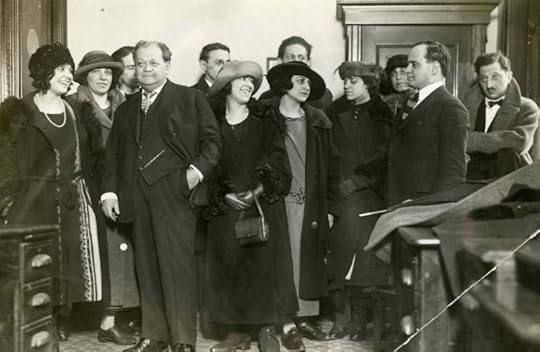
This headache I'm forming is why I'm studying drama, not queer theory. So have a happy pic of the 1923 Broadway cast at their trial for indecency:


__________________

Sholem Asch's 1907 Yiddish play God of Vengeance, which was controversial from the start. It told the story of a Jewish brothel owner who bribes a rabbi so that the rabbi's son will marry his daughter. Paula Vogel, Indecent's Pulitzer Prize-winning playwright, says, "The only problem in the original play is that the daughter falls in love with a prostitute downstairs." Asch's script includes a love scene between the two women. [...] "And then someone got the bright idea: 'Let's translate it into English and put it on Broadway,' " Vogel says. "At which point everyone is arrested."
http://www.npr.org/2017/04/29/5261579...
Profile Image for Nicole.
647 reviews23 followers
October 5, 2019
I know I’m a convert but this is genuinely one of the world’s classic plays. This edition features a modern, informative introduction by Richard Marx.
Profile Image for Vee.
522 reviews15 followers
May 31, 2022
has a lot of great scenes and quotes but why couldn't this have been longer. I know that it's a play and intended to be seen but still I want more so bad and I know it's extremely unlikely I'll ever see it on the stage so. the discussions about God are amazing, the love scenes between the two girls are heart-wrenchingly romantic & there's also a lot of small fun moments to keep you from feeling too sad
Profile Image for gideon.
182 reviews
October 21, 2025
hope to read more slowly in yiddish one day instead of rushing through for class. interesting to compare to tevye wrt men having breakdowns over their loss of masculine authority over their daughters & wives, but with added double standards of purity. soo good.
Profile Image for Nadine in California.
1,186 reviews133 followers
March 10, 2019
I am always on the lookout for books that bring the world of my grandparents closer to me. I didn't expect that to include lesbian lovers, but so much the better. I only knew my grandparents from the 1960's onward, when they were relatively Americanized (although one pair spoke only Yiddish and never did learn English) but I can imagine them in a similar setting, minus the brothel (or so I assume). I'd love to see it performed/interpreted by a Jewish theater today. (I'd also love to see it as a performance billed as Fiddler on the Roof, then sprung on the unsuspecting audience ;)

Update: PBS has a streaming video of the Broadway play 'Indecent', which is sort of a meta version of the play - it's a play about the play, so it gives a general sense of what the original was about while recounting its reception. I think it did a good job on the themes in the play, but I'd still like to see a faithful performance of the original, set in the original time period - especially in light of today's growing antisemitism and the conflicting identities of Jews today.
13 reviews
April 11, 2022
I'd be lying if I said I didn't enjoy a play in which the writers and cast took a chance by depicting love between two women. It's surprising to learn that in 1918 when same-sex relationships were taboo or illegal, a straight man wrote a love story between women. The underlying theme of mistreatment of women and children, which is hidden behind melodramatic and comical scenes, makes me appreciate the rain scene because it seems to tie everything together. Showing the readers that in a toxic society, love, regardless of sexual preferences, can still bring happiness. The cruelty and greed that afflicted society at the time are revealed to viewers and readers.
Profile Image for Richard.
770 reviews31 followers
April 12, 2023
I first became aware of both this play and Sholem Asch through a local theater company. They put on a presentation of Indecent, a play by Paula Vogel, that recounts the controversy of the play, The God of Vengeance. I loved the play Indecent and so was thus motivated to immediately get a copy of the play upon which it was based.

Sholem Asch's play “God of Vengeance” was first performed in 1907 to critical acclaim throughout Europe. However, when it came to Broadway in 1923 it was shutdown as being “obscene” and the director and actors arrested. The primary focus of Vogel’s play, Indecent, are the events that take place when God of Vengeance is performed in America.

Until recently, I would have said that by today’s standards The God of Vengeance would hardly raise an eyebrow. However, with the current rise of antisemitism and the anti LGBTQ backlash, perhaps this play is not so out of date as I had initially thought. The “frank depictions of sexuality and prostitution” noted in the 1923 arrest are small scenes in the play that are limited to dialog. The lesbian relationship is limited to words and an affectionate hug.

The play deals with a Jewish man who is married to a former prostitute. Living in a Polish shtetl, he runs his business in the basement of their home. Upstairs, literally above the brothel, he is raising his only child, a daughter, to be above reproach. As a father who wished for his children to be more successful than himself, the theme of a father’s love and dreams for his children naturally resonated with me.

While the lesbian relationship and prostitution got the major focus, there were several other things about this play that made it “ahead of its time.” For one, it was originally performed in Yiddish, a language that “cultured” Jews felt was beneath them and the “legitament” theater. It also pushed boundaries by a Jewish playwright giving a negative portrayal of Jews, at a time when they were being persecuted throughout Europe.

While Christianity focuses on taking god and religious dictates “on faith”, the old testament has many examples of Jews questioning god’s dictates. As my Rabbi once said, “Jews argue with god.” In God of Vengeance, Yekel rails at god for punishing his daughter for his and his wife’s sins.

This short play is quite powerful. Asch pulls no punches in presenting what are undoubtably his own questions about god and his Jewish religion. The play reads quickly and the action moves right along. While, as I have already mentioned, the issues seem mild to me in today’s world, I can only imagine the controversy this play raised in the early twentieth century.
Profile Image for Zoe.
172 reviews28 followers
November 25, 2025
I read the digitized scan that the Yiddish Book Center has, from a 1913 Yiddish publication by Tsentral, a Warsaw publishing house.

Incredible to think that this was written well over a century ago now. I read that this was the first sapphic kiss portrayed on the American stage, period. I can only imagine how sensational it must have been particularly for its Yiddish-speaking audience. What stands out to me as a 21st century reader, is that Rifkele's love for Manke is not really portrayed as something nefarious, much as other characters might react to it that way. Rifkele seems to be characterized pretty straightforwardly as an innocent young woman experiencing love for the first time. The play's judgment is reserved not for her, nor really for the under-class pimps and exploited sex workers who live below her, but is squarely leveled at her parents – Asch is taking aim primarily at hypocrisy in its various forms; both at the hypocrisy of Sore, who sees everyone in the upper-class as a moral fraud with good PR, and who aspires to the same, and at the hypocrisy of Yankl, who feels ashamed of his own sordid behavior, but still believes he can use his ill-earned gains to preserve the innocence of his daughter. In the end, his destruction of Rifkele's image – all Sore cares about – is due to his inability to recognize her innocence – all Yankl cares about – bringing about tragedy for both of them. Whether it is entirely a tragedy for Rifkele, to be yanked down from climbing the social steps of patriarchal marriage, and taken below into the cellar of society where her lover awaits, is a question the play doesn't fully answer.

Sidenote: the orthography of this Yiddish is a little tough – it helped to keep in mind that the spelling used here is strongly influenced by German.
Profile Image for Pia.
14 reviews
April 11, 2022
The God of Vengeance by playwright Sholem Asch centers around Yekel, a brothel house owner who believes that marrying his virgin daughter, Rifikele to a pious Jewish scholar will give her a devoted future, as well as it bestowing him a more cleaner one in the Jewish Community. The play was seen as unacceptable at the time and many of the actors that performed were blacklisted from show business, as it depicted a lesbian love scene and had the main exposition be set in a brothel, as well as having very adversary characters and domestic violence. I gave this play a 4, as it does take place in a brothel and many of the side characters kind of feel out of place and I just felt like some of the them were just too positive for being stuck in a place like that and it just rubbed me the wrong way. What I do like is the drama of the play, as it is centered around a really messed up idea of a father using his daughter as a way to get up in society without acknowledging her feelings. He says her greatest "asset" is her virginity and it really is horrify how he obsesses over it and goes far as beating her if she doesn't obey him in terms of her own genitalia. The concept is fucked up. Although, I think it is good because the entire story, Yekel isn't the only antagonist but it's all the characters. Everyone wants something at the expense of everyone else, there is always this cycle of abuse, and they use their own selfish desires to get their way. I have to appreciate the play for being different and highlighting the nature of the characters and rules of their society, as a lot of it had to be addressed and ended tragically for everybody. Although not for the audience. Honestly the play wasn't bad and I will probably read it again in the future.
Profile Image for martin.
549 reviews17 followers
September 21, 2021
Like many others I came to this through media reviews of the modern play Indecent. It seemed to me remarkable that a Polish Jewish American might write a century ago of prostitution and lesbianism among Eastern European Jews - and at that in Yiddish where his intended audience can only have been his fellow Jews.

It’s a relatively short, but claustrophobic and intense play that touches on religion, superstition, morality, corruption, the nature of God and famously also sexuality. Its message seems to be that no matter how hard we try we can never really be free of our errors and our immorality. Asch’s God is a vengeful, unforgiving power, although one might question whether the god here is more an empty and hypocritical set of strict social norms and prejudices. The love affair between the daughter and the young prostitute seems almost to be the purest part of the drama but then we see it perverted into a way to corrupt the daughter and steal her from her parents.

I’m not sure it’s a play that yields its full worth from reading; I’d love to see it performed on stage as I suspect I’d find it far more powerful in the hands of experienced directors & actors
Profile Image for Lehi Dawn.
14 reviews
April 10, 2022
Listen, it's not for everyone and I know that. Personally for me, I very much enjoyed this play. Is there sex scenes? Yes! Is this extremely vulgar and very out of the "standard" of society? Absolutely! I understand that there are limits on what to present in society, but I am a very odd duck who likes to be vulgar and expressive. Not that I am not a good person who is respectful and welcoming to all, but I do enjoy things that most people would find odd. I think its a shame for people not be open to books like this. Do I agree with the things it portrays? No. I don't believe that anyone human being should face abuse especially in marriage. Reading these types of books are enjoyable because you get to go through the pain, anxiety, and excitement the characters face through out the text. I very much did enjoy this book and I wish people were a little more open to text like these. It really is a rollercoaster of emotions.
14 reviews
April 8, 2022
I admired this play and the courage of its Author. It was like a bolt from the blue in early 20th century Eastern Europe. Moreover, the play “The God of Vengeance” touched upon the Jewish community, which from time immemorial has been very religious. The Jews were a nomadic people and have always been strangers and incomprehensible to others; they had to preserve their ethnicity and religiosity at all costs. And in the pursuit of these attributes, they have lost the authenticity of being: a religious Jew keeps a brothel, the value of a woman is determined by marriage, and violence turns into a manifestation of love. In my opinion, the love story of two women was a cry of the Author for the terrible, abusive condition of women who were used as a thing, as a second-class people. I suggest that this play will be relevant for centuries.
Profile Image for Sara G.
1,333 reviews24 followers
November 11, 2023
"Yes, Rifkele, I called you... Come, we'll stand in the May rain, splash water over each other and grow taller... [...] Come, Rifkele, I'll wash your eyes in the rainwater. The night is so beautiful, the rain is so warm and the air is so full of delightful fragrance. Come."

I understand how this play reached the level of popularity it did because it is honestly very much of its time both stylistically and conceptually. The late 19th-early 20th century period really did have swathes of tragic tales of good, earnest young people eager to love and their environment and society destroying them because of this love.

The fact of Rifkele and Manke both being women, while revolutionary and fundamental also seems incredibly small. Manke's sin of being a woman is far overshadowed by her sin of being a prostitute.
Profile Image for Himali Kothari.
184 reviews19 followers
March 31, 2024
A young prostitute falls in love with the daughter of the Jewish recently-turned-religious brothel owner who resides in an apartment above the brothel. Take into consideration that this story was published in 1907...a few years before the atrocities towards Jews would escalate to an unfathomable level, and the play takes on a whole other edge.
The play was severely criticised for its "obscenity". Production was stopped and the cast and crew were arrested.
A pity because at the core of it , God of Vengeance is a story about dreams and youth and love and hope. But when it comes to moral police, the focus is on isolated events which are mere cogs in driving home the intent of the storyteller.
Profile Image for Lukas.
121 reviews4 followers
July 24, 2017
I've been holding off with trying to read this...I am so happy that the whole thing, the original English translation is online. It took me forever to find it in my library, but all I had to do was use Google. I am currently researching Paula Vogel's "adaption" and plan to see it on Broadway next week. This play is one of the most well-crafted tragedies I have ever read. I know what happens. I know all the twists. But seeing it all set up is quite horrifying. I am interested in reading the modern adaption of it that Donald Marguilles wrote. I am excited to see what Paula Vogel did with it in her play. I heard nothing but great things. I am so happy that this a part of my research.
10 reviews
April 10, 2022
The God Of Vengeance by Sholem Asch, present us a very engaging story, in which a Jewish man sexually exploited women during late nineteenth century Russia. The reading is very engaging, smooth and easy, even in the most emotionally intense parts of the story. A play build on three acts that shows us how the guilt and shame of a man condemn him, not letting him set free of social stain. The hardest lesson to learn is to be honest and do the right thing, a task that cannot be passed go the next generation but it has to be done by our own efforts. That is the moral of the story, presented in a sad story about a girl who was condemned by his parents’ “sins”.
15 reviews
April 10, 2022
The God of Vengeance is an incredible play about such a big controversy at the time it was created. A play about a lesbian relationship that was likely least suspected the way it came together. A very interesting play to see the life of an abused and used girl for the benefit of her parents. I like the way the author was so daring for including all these controversial topics for the whole world to see. The way religion is used in the play is also very controversial in so many parts something a lot of people are against is bad religious talk. This is a very interesting play to read the ending is not as I expected. I would love to have been able to see it in film or live.
14 reviews
April 11, 2022
Sholem Asch’s “The God of Vengeance” is a rather powerful statement about the human condition, which I believe is one of the best things that can be said about a play. While such a provocative piece for it’s time, it’s still quite relevant to the current problems of today as faith of all types can lead people to questionable decisions, prejudice against partners of the same sex, as well as the delusions that one has control of their entire family for whatever reason. Due to this, Asch has managed to create a work of art that brings forth point after point that can expose the darker parts of humanity.
Profile Image for Malola.
678 reviews
June 5, 2025
Ah, the God-loving pious, such a good Torah-following Jew... always showing how miserable they truly are. *sighs and smiles to herself* lol
I must join the chorus of reviewers:
But, unlike the average GR reviewer, I haven't read Indecent yet. I was planning to do so, after I finished this play.
I loved the commentary on the value of freedom, and the hypocrisy of the God-fearing religious zealots.
Profile Image for Diane.
14 reviews
April 11, 2022
I did not dislike this play, but I also was not really a fan of it. I thought it was very interesting and I can see how it became so controversial, but I was not very interested in it.

I do think it would be intriguing to see a revival of the play. I would be interested to see if more modern audiences found it as controversial or if it would gain new popularity for its themes about religious hypocrisy and its lesbian representation.

Overall, I think this play was thought provoking, but I do not think I would read it again.
15 reviews
April 11, 2022
I quite enjoyed this play! The fact that it was written in a time where gay/homosexuals were not accepted shows the author was aware and ahead of his time. The play portrays a innocent daughter born from a father that owns a brothel and a mother who was a whore. She ends up falling in love with a girl that works at the brothel, even though her parents did their best to keep her pure and holy for a good young man. Her parents paid for their sins through the actions of their daughter. This play was pretty easy to read for someone like me who doesn't read them often.
13 reviews
April 25, 2022
This was a good read for me. At times there were some terms or words that I was unfamiliar with but with a little help and a quick google search I was able to read it quite smoothly.I have not read many plays that display/ show representation of the lgbtq+ community and I feel this is one of the better ones that I have read. I feel that this play is a very powerful statement in the world especially during the time it was first performed, and still today. I feel that it was well written and realistic, especially because it had a rebellious teen and an overbearing parent.
Profile Image for sophie.
85 reviews2 followers
November 7, 2024
one of the many shocking examples that men really are aware of and understand the patriarchy. like...play about the patriarchy in an insane way. i think the other reviews overstate the centrality of lesbianism; lesbianism is definitely IN this play, but it is about so much more than that. it is about patriarchy as a whole. it is about how men use women as objects to project infinite things onto: their own guilt and self-hatred, their anger, their desires, their livelihood, their worth. loved it, would love to see it put up as a production
Profile Image for Jennifer.
44 reviews
January 17, 2021
This is an extraordinary play, and the history behind it (shown in Paula Vogel's beautiful play Indecent), is equally extraordinary. It features a tender, celebrated relationship between two women in the early 20th century, a time when LGBT characters were invisible, reviled, or killed off. Each time I re-read it, I am stunned at how tenderly Asch, a heterosexual 26 year old man, wrote Rivkele and Manke and their love.
14 reviews
April 18, 2022
I enjoyed this play. Reading it was more of a classic play to read which is why I enjoyed it. I really liked how the play was written in a time where the gay/homosexuals were not being accepted. I wouldn’t say this would be a favorite play but if I were to talk about the play to a family member or a friend, I would include how much I liked it and the reason why I like it of course. I feel like it is a very powerful statement being said in the play.
Profile Image for Morgan.
6 reviews1 follower
July 24, 2024
marvelous, sexy, scandalous, brief, bleak. paints a vivid picture of eastern european shtetl life at the dawn of the 20th century and the compounding oppressive forces (both material and cultural) that make a virtuous life for the most devout among us impossible. In his depiction of a devout Jewish family who run a brothel out of their basement, Asch illuminates a world in which the women are pawns to satiate men's desire for virtuousness and respect.
Displaying 1 - 30 of 47 reviews

Can't find what you're looking for?

Get help and learn more about the design.