

What do you think?
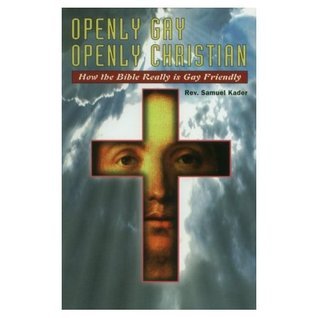
Openly Gay, Openly Christian: How the Bible Really Is Gay Friendly
Book by Kader, Samuel
192 pages, Paperback
First published July 1, 1999
Ratings & Reviews
Friends & Following
Create a free account to discover what your friends think of this book!
Community Reviews
Displaying 1 - 5 of 5 reviews
May 16, 2024
A GAY PASTOR LOOKS ONCE AGAIN AT THE INTERPRETATION OF THE BIBLE
Samuel Kader wrote in the first chapter of this 1999 book, “Over the last several years, there has been a great deal of verbal, preached and printed rhetoric against the gay, lesbian and bisexual community coming from various segments of the Christian Church. In some cases this stems from blatant homophobia. But I believe in many cases this stems from a sincere desire to see others ‘get right with God.’ Yet by not fully understanding what they are talking about, people are only badgering the lesbigay community with the very Book that was designed to bring freedom. This stems from an ignorance of what the Bible actually says about homosexuality as well as relying on traditions of Biblical interpretations handed down through the ages… It is my desire to dispel the myths… and open our hearts to the understanding that fosters love… I am presenting the conclusions I have drawn after two decades of research… I have been a pastor in the gay community since 1980. I have pastored four churches, spoken in countless others, been to a variety of Christian conferences both within and without the identified gay Christian community.” (Pg. 9)
Of Sodom, he explains, “in Ezekiel 16… the Word of God is again correcting Israel of antiquity… comparing it to Sodom. This time the Word not only says that by comparison to Israel’s folly in idolatry, Sodom was a saint, but also gives a complete rundown of all the sins of Sodom. Homosexuality is clearly missing from the list! If God had ever wanted to say that Sodom was condemned for homosexuality, here is the logical place to include it, but it is conspicuously absent as a problem in Sodom.” (Pg. 35)
Of Lev 18:22 and 20:13, he acknowledges, “If we were to take this at face value, with no further investigation, we could only come up with one probably conclusion. That would be that any time a man had sex with another men the way he would have had with a woman there is only one thing we can do. We must kill him. That’s what the Bible seems to say we should do. There are people who take this attitude. But we have to look at the New Testament concept of the law if we’re going to understand the law… if we’re going to live by the law, and try to get everyone to live by the letter of the law, we find that the letter of the law brings death. But the Spirit gives life…” (Pg. 38)
Later, he advises, “for Christians, the Old Testament law if not the code we life by. We are not saved by deeds. We are saved by grace. For it is by grave we have been saved through faith, and that is a gift of God. No matter what laws we look at in Leviticus no one has ever been able to keep them all. Everyone falls short of perfection somewhere.” (Pg. 53)
He suggests, “Some people think the Bible and its writers were homophobic, especially Paul. To coin a word, I think they were homo-ignorant. Attempting to reconcile first and second century understanding of sexuality into a modern framework is virtually impossible. What the apostle Paup, his Christian contemporaries, and the society around him believed about sexuality would be rejected as ridiculous myth by even the most conservative, prudish Christian today…” (Pg. 69)
He notes, “Male prostitution as part of pagan religious ritual also was very common in the early Roman empire. Male prostitution in Paul’s day was often associated with pagan religious rites within the pagan shrines… To equate male prostitution with homosexuality per se is in as much discord and as inaccurate as equating all female heterosexuality with female prostitution.” (Pg. 73)
He argues, “The Bible never clearly states whether Jonathan and David had a sexual consummation of their relationship, but the Bible never denies it either. It does clearly state the feelings involved, and that it is not wrong for a man to be in love with another man. There is nothing needing ‘deliverance.’ There is no ‘homosexual lust’ demon to cast out. There is an acknowledgement of love, deep and pure and intimate in its expressed emotions. The Bible does not rebuke those feelings, nor does it denigrate those feelings. It DOES show David’s honor in keeping his vows to his very special loved one.” (Pg. 118)
He concludes, “It is no longer acceptable for non-gay Christians to keep gay Christian brothers and sisters at arm’s length. What God has cleansed, no long call unclean. Leave it up to the Spirit of God to do the cleansing, sanctifying, and filling of the new vessel in Christ. Each believer is admonished to work out their own salvation with fear and trembling. We gay Christians await that opportunity within the confines of the Church. Some churches are already starting to glimpse that vision. At the risk of being catapulted out of fellowship groups and denominations, they are still performing weddings for same-sex couples and accepting God’s gay children into the fold with full participatory rights as full citizens of the kingdom. Everyone may just be surprised by how much God can do if we will cooperate with God and come together as one Body.” (Pg. 158)
This book will be of keen interest to LGBT Christians, and their sympathizers.
Samuel Kader wrote in the first chapter of this 1999 book, “Over the last several years, there has been a great deal of verbal, preached and printed rhetoric against the gay, lesbian and bisexual community coming from various segments of the Christian Church. In some cases this stems from blatant homophobia. But I believe in many cases this stems from a sincere desire to see others ‘get right with God.’ Yet by not fully understanding what they are talking about, people are only badgering the lesbigay community with the very Book that was designed to bring freedom. This stems from an ignorance of what the Bible actually says about homosexuality as well as relying on traditions of Biblical interpretations handed down through the ages… It is my desire to dispel the myths… and open our hearts to the understanding that fosters love… I am presenting the conclusions I have drawn after two decades of research… I have been a pastor in the gay community since 1980. I have pastored four churches, spoken in countless others, been to a variety of Christian conferences both within and without the identified gay Christian community.” (Pg. 9)
Of Sodom, he explains, “in Ezekiel 16… the Word of God is again correcting Israel of antiquity… comparing it to Sodom. This time the Word not only says that by comparison to Israel’s folly in idolatry, Sodom was a saint, but also gives a complete rundown of all the sins of Sodom. Homosexuality is clearly missing from the list! If God had ever wanted to say that Sodom was condemned for homosexuality, here is the logical place to include it, but it is conspicuously absent as a problem in Sodom.” (Pg. 35)
Of Lev 18:22 and 20:13, he acknowledges, “If we were to take this at face value, with no further investigation, we could only come up with one probably conclusion. That would be that any time a man had sex with another men the way he would have had with a woman there is only one thing we can do. We must kill him. That’s what the Bible seems to say we should do. There are people who take this attitude. But we have to look at the New Testament concept of the law if we’re going to understand the law… if we’re going to live by the law, and try to get everyone to live by the letter of the law, we find that the letter of the law brings death. But the Spirit gives life…” (Pg. 38)
Later, he advises, “for Christians, the Old Testament law if not the code we life by. We are not saved by deeds. We are saved by grace. For it is by grave we have been saved through faith, and that is a gift of God. No matter what laws we look at in Leviticus no one has ever been able to keep them all. Everyone falls short of perfection somewhere.” (Pg. 53)
He suggests, “Some people think the Bible and its writers were homophobic, especially Paul. To coin a word, I think they were homo-ignorant. Attempting to reconcile first and second century understanding of sexuality into a modern framework is virtually impossible. What the apostle Paup, his Christian contemporaries, and the society around him believed about sexuality would be rejected as ridiculous myth by even the most conservative, prudish Christian today…” (Pg. 69)
He notes, “Male prostitution as part of pagan religious ritual also was very common in the early Roman empire. Male prostitution in Paul’s day was often associated with pagan religious rites within the pagan shrines… To equate male prostitution with homosexuality per se is in as much discord and as inaccurate as equating all female heterosexuality with female prostitution.” (Pg. 73)
He argues, “The Bible never clearly states whether Jonathan and David had a sexual consummation of their relationship, but the Bible never denies it either. It does clearly state the feelings involved, and that it is not wrong for a man to be in love with another man. There is nothing needing ‘deliverance.’ There is no ‘homosexual lust’ demon to cast out. There is an acknowledgement of love, deep and pure and intimate in its expressed emotions. The Bible does not rebuke those feelings, nor does it denigrate those feelings. It DOES show David’s honor in keeping his vows to his very special loved one.” (Pg. 118)
He concludes, “It is no longer acceptable for non-gay Christians to keep gay Christian brothers and sisters at arm’s length. What God has cleansed, no long call unclean. Leave it up to the Spirit of God to do the cleansing, sanctifying, and filling of the new vessel in Christ. Each believer is admonished to work out their own salvation with fear and trembling. We gay Christians await that opportunity within the confines of the Church. Some churches are already starting to glimpse that vision. At the risk of being catapulted out of fellowship groups and denominations, they are still performing weddings for same-sex couples and accepting God’s gay children into the fold with full participatory rights as full citizens of the kingdom. Everyone may just be surprised by how much God can do if we will cooperate with God and come together as one Body.” (Pg. 158)
This book will be of keen interest to LGBT Christians, and their sympathizers.

August 27, 2026
Openly Gay/Openly Christian is NOT for everyone, for sure. His method is Biblical Exegesis. If you don’t know what that is, it is a word for word study of scripture verses. While I think for many from traditions who do not hold a “high view of scriptures” they might find it tedious, but for those coming from conservative view of scriptures like me, when I was coming to terms with whom God, our creator, had made, this would have challenged my theological understanding of homosexuality with a view of scriptures study that I would have accepted.
I believe this book would be especially helpful for LGBTQ+ youth and young adults from conservative Bible Based denominations that old an inerrant theology such as Southern Baptist, Assembly of God, the conservative Church of Christ, not to be confused with the United Church of Christ, Church of the Nazarene, Pentecostal Holiness, and a host of conservative evangelical independent churches.
I especially like the treatment for the Leviticus passages (Chapter 4) and Romans 1 (Chapters 10&11), the ones I struggled the most to reconcile my understanding that I was not what was being described in these passages.
The book near its’ end with the story of Jonathan and David, a beautiful love story, given strength to challenge the notion that they were only best friends. They were best friends but more. The word used, as Kader reminds us of is the same word for love that Michal had for him that he had for Jonathan.
Then this book has affirming other same-sex relationships within the church. So, this is not new. It is history that is never told because in our time they, many church leaders, want same sex relationships to be considered sinful…lustful, out of control, and not of the quality described by Jonathan, that he loved David enough to give up is throne. And I especially liked the reminder that neither David nor Jonathan are condemned because of that love, in contrast to David being chastised by the prophet Nathan over his affair with Bathsheba.
Finally in Chapter 21 I found the personal stories of God breaking down the walls between the church and gays empowering. If these people, such as Benny Hinn and Evelan Schave, from very conservative charismatic denominations can overcome homophobia, that gives me hope that the Holy Spirit can breakthrough the hard-heartedness of my faith tradition, Southern Baptist and keep those youth and young adults from the hard struggle I faced to believe that being gay was ok with God.
That is a good place to end this review.
I believe this book would be especially helpful for LGBTQ+ youth and young adults from conservative Bible Based denominations that old an inerrant theology such as Southern Baptist, Assembly of God, the conservative Church of Christ, not to be confused with the United Church of Christ, Church of the Nazarene, Pentecostal Holiness, and a host of conservative evangelical independent churches.
I especially like the treatment for the Leviticus passages (Chapter 4) and Romans 1 (Chapters 10&11), the ones I struggled the most to reconcile my understanding that I was not what was being described in these passages.
The book near its’ end with the story of Jonathan and David, a beautiful love story, given strength to challenge the notion that they were only best friends. They were best friends but more. The word used, as Kader reminds us of is the same word for love that Michal had for him that he had for Jonathan.
Then this book has affirming other same-sex relationships within the church. So, this is not new. It is history that is never told because in our time they, many church leaders, want same sex relationships to be considered sinful…lustful, out of control, and not of the quality described by Jonathan, that he loved David enough to give up is throne. And I especially liked the reminder that neither David nor Jonathan are condemned because of that love, in contrast to David being chastised by the prophet Nathan over his affair with Bathsheba.
Finally in Chapter 21 I found the personal stories of God breaking down the walls between the church and gays empowering. If these people, such as Benny Hinn and Evelan Schave, from very conservative charismatic denominations can overcome homophobia, that gives me hope that the Holy Spirit can breakthrough the hard-heartedness of my faith tradition, Southern Baptist and keep those youth and young adults from the hard struggle I faced to believe that being gay was ok with God.
That is a good place to end this review.

January 4, 2013
This book dives deep into the concordances and tells the story of Scripture in a different way. I'm not sure to whom this book is addressed, since the deep plumbing of Biblical depths is more-suited to clergy, and the pastorally-sensitive last two or three chapters are more-suited to laypeople. I can't judge the quality of the scholarship, but the book is fairly clear in its thinking, and may be more useful to seminarians.

Read
April 1, 2015This covers the same ground on many other books on the topic. It takes a textual analysis approach, and each biblical passage discussed is filled with references to Strong's concordance and the possible meanings of Hebrew and Greek words. I wouldn't say the scholarship is the strongest, however. One passage that is covered here and not many other places are the various reference to eunuchs as sexual minorities in Daniel, Isaiah, Matthew, and Acts.

August 9, 2016
An interesting and in-depth look at the Bible, the culture of the times it was written, the Hebrew and Greek languages, and how they all fit together. For the most part it well thought out and easy to follow. I thought the author was clutching at straws in one section, but it didn't detract from the overall message being presented.
Displaying 1 - 5 of 5 reviews