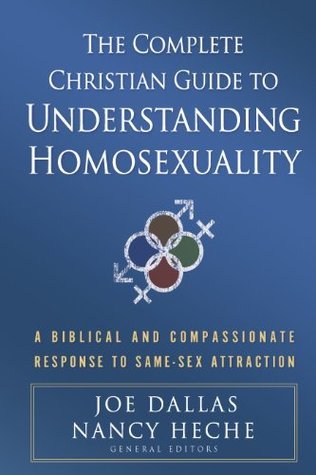
Throughout the Complete Christian Guide, the authors repeatedly fail to make any moral distinction between consensual and nonconsensual sex acts and relationship structures. In a chapter about same-sex marriage, one author rhetorically asks “If a father wants to marry his 14-year-old daughter, on what grounds can we deny him? Wouldn’t that be discrimination?” (p. 356) And that’s the end of the paragraph—the text moves on and leaves this question dangling as if there is no obvious answer to a query conflating consensual same-sex marriage among adults and an incestuous marriage between a parent and child that any reasonable person would recognize as nonconsensual (children cannot give consent) and therefore inherently abusive. This is just one example, but the absence of the topic of consent can be felt throughout the book. There is never a meaningful discussion of where consent fits into a framework for sexual ethics.
In one chapter, Dallas (the main author) seeks to dismantle the common arguments made by advocates of pro-gay theology. He does this by isolating each passage of scripture that may reference homosexuality and then setting up a dichotomy between what he calls the traditional view and the (pro-gay) revisionist view. This dichotomy gives the reader the impression that these two opposing views are our only options when interpreting these passages. Meanwhile, there is no discussion of biblical hermeneutics or historical criticism. Nor is there a meaningful discussion of biblical inerrancy or inspiration (these views are largely assumed to be shared with the reader). 2 Timothy 3:16 is used as a proof for inspiration, but nowhere is it mentioned that most scholars believe the pastoral letters (1 & 2 Timothy) are pseudonymous and not actually written by the apostle Paul. Dallas does not disclose his interpretive methodologies because that would undermine his goal of holding out his interpretation as a “common sense reading.” However, I do not think, for example, that it is common sense to assume the apostle Paul had the same understanding of human sexuality as a Hellenized Jew in the 1st-century Greco-Roman world as we do now.
I think a quality exegesis of these passages would require quality biblical criticism. What is our interpretive framework here? What methodologies of interpretation are we using? What was the biblical author’s intent in writing this passage? Who was the intended audience? What historical context may be informative of the biblical author’s point of view? These questions are not answered here, and their importance is not acknowledged in any meaningful way. I do not believe answering these questions would result in anyone arriving at a “pro-gay” theology as defined by Dallas but rather it would surely affect how we use the biblical text in trying to answer complicated questions about human sexuality.
These are just a couple of the major deficiencies in the book. I caution anyone who reads this with the hope of obtaining a “complete” understanding of homosexuality, Christian or not.
Reading Recommendations:
The New Testament on Sexuality by William Loader
Sexing the Body by Dr. Anne Fausto-Sterling