Provoked by Graham Greene’s The Quiet American , this novel tells the story of Phuong, from her childhood in the Vietnamese district of Cu Chi to her return there as a guerrilla fighter. Phuong’s unmentioned past, subdued personality, and lack of political expression are the subjects of the novel, which begins during the Vietnam war. From the tunnels of Cu Chi, Phuong fights outside a village near her birthplace. There, she recalls her upbringing, her journey to Saigon, and the years she spent there as a spy for the Vietminh. Under orders from the communist committee, Phuong ensnared Thomas Fowler, a British journalist, because he was a rich source of information. Later, Phuong was ordered to become the mistress of Alden Pyle, a newly arrived American whom she realized was, like her, a covert operator.
Creina Mansfield was born in Bristol in 1949. She studied literature at Cambridge and became a teacher of English at secondary school level. She lived in Dublin for a number of years and is now living in Macclesfield, Cheshire, England with her husband and two teenage sons. Her first book, Fairchild was published in Hong Kong. Cherokee, Creina's first book with The O'Brien Press, was published in 1994, followed by My Nasty Neighbours in 1995.
Her last books are It Wasn't Me, the story of how Jack deals with the school bully, and Snip Snip for younger readers. Creina's writing has been praised as 'original and compulsive' by Books Ireland and her books have been very favourably reviewed.
(I usually don't feel the need for that .5 stars thing, but in this case I find it applicable)
Won through Goodreads!
---
I've never known the definition of a "strong female hero." People seem to toss this word around all the time, throwing characters at you: Katniss Everdeen and some others come to mind.
I've never seen it. I never thought I would. Then I met Phuong. (Phương, in Vietnamese--my little cousin's name!).
Phương is a strong woman--almost all her life has been devoted to her cause, which seems to be (sorry, my historical context is lacking) fighting for the Vietminh? You see how innocent and childlike she is in the beginning, thinking there is good all around the world, and then it's ripped from her. It's actually sad, seeing her character evolve from loving to almost...cynical. She's tough and hardened, like a lot of characters are changed to. I found myself longing for better times with her.
The book opens up with her killing American soldiers without batting an eyelash: no, it's not necessarily humane, but she's become hardened, and it's her reality now. (Phương is the definition of badass, by the way. It's sad how it happens, though.)
Some horrific things are described in this book, and you get a glimpse of what happens in war: civilians die, get blown to bits, people are separated and killed before they can be reunited. Old and young alike.
It's good to see things from Phương's side, seeing as most books in America about the Vietnam War are from the U.S.'s side or people from South Vietnam. It's kind of interesting because I've also been reading a bit about Ho Chi Minh, who apparently can be hailed as a national hero who freed Vietnam from French and Japanese rule and united it. I've only ever grown up hearing bad things about him and communism because my family is from South Vietnam; my grandfather was a captain in the navy of South Vietnam, and was forced to retire because he was shot in the lung and there were no supplies to help him (interestingly enough it's how he became a devout Roman Catholic, convinced God had saved him). Apparently, Ho Chi Minh's dream was just to see North and South Vietnam reunited again, and he genuinely thought communism was the best way to do it.
The Vietnam War and the characters in this book seem all to be about good intentions that don't always yield the best results. A good example is Pyle; I have no idea what he thought he was doing, but I guess he thought it was for the best.
I feel like I have to clarify some things: I'm Vietnamese American, so I know more than average about Vietnamese culture and writing and stuff, but again, there's American in that. I was born and raised in America, so I know more about English and American things than Vietnamese, unfortunately. I also don't know as much about the Vietnam War (the American War in Vietnam), the Vietminh, the causes for fighting, etc. And I've never read The Quiet Soldier by Graham Greene, whose book this is sort of like an extension of (though it's said in the foreward that you can read this without having read The Quiet Soldier).
There are some strange things in the book, like not including the diacritics for any word except "đường vật"--I'm guessing it's slang for "penis," because I've never heard of it before (Google Translate says so: it's literally "sugar cane," but when I look it up on Google Images I get a lot of nonsense pictures). Áo dài is referred to as ao dai, khăn đống as khan dong, etc.
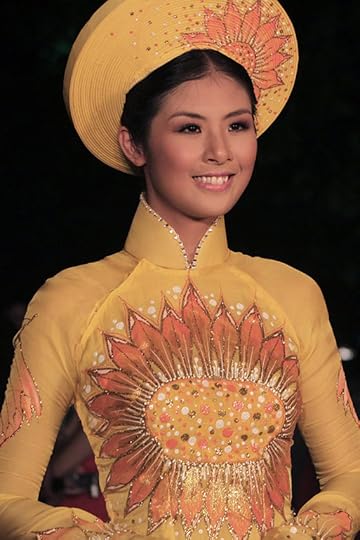
By the way, an áo dài is this:
A khăn đống is the accompanying headdress:
There was also the bizarre spelling of names with no diacritics: Tha'm, So~n, and Qua^n, instead of what I'm guessing is Thám or Thàm, Sõn, and Quân.
There's a bit of French that's given no translation, and if I weren't studying French, I probably wouldn't have been able to figure out the meanings from the context clues alone:
She answered haughtily, "Je suis avec un groupe Américain qui arrivera bientôt."
Sometimes it's unclear which language is being spoken, since Phương knows English, French, and Vietnamese, and the two non-Vietnamese men that communicate with her mostly use French and occasionally English, believing she doesn't understand English.
Oh, and some Vietnamese foods/things are written in Vietnamese, but as for the case of nước mắm, it's just translated as "fermented fish sauce"...which, I'm sorry, but it sounds funny in English, haha.
Throughout the book I've been flipping between wanting to read The Quiet Soldier, and I think now I mostly want to read it because .
These are minor things, though. My major complaint is that as I was nearing the end of the book I felt a sort of despair when the pages started running out, and I would've LOVED to see more development of Pyle's and Phương relationship; Pyle seemed sweet on her, though yes, it did seem she was like a piece of meat for him and Fowler to fight over. I'm glad Phương would have none of that. (Still, I really, really wanted to see the relationship grow. Sigh.)
The little complaints make it seem like I didn't like the book, but I do. I was completely sucked into the story and I cared about Phương like I haven't for any main character. Some passages in the book are genuinely beautiful.
I feel like I'm not doing this book justice; hopefully, later I'll be able to better articulate my thoughts.
Overall, it was a very enjoyable read, and it had an addictive quality that I haven't had in a book for a very, very long time--maybe it's because I actually cared for the characters and the plot. I found myself constantly going back to the book when I had nothing to do, and even when I had a lot to do. Thank you, Creina Mansfield, for writing it, and thank you to the cosmic forces in the universe that let me read it :)