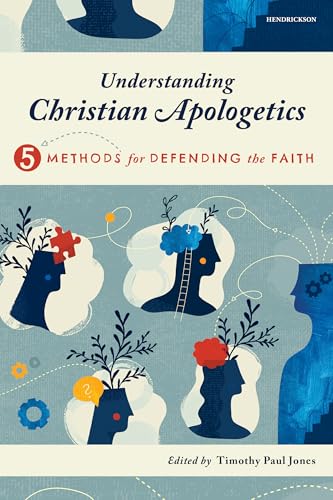
For Christians who want to understand the different apologetic methods to help them have a defense for their own faith.
God has called Christians to be prepared to defend their hope in Christ, but what’s the best method for making this defense? In this book, five apologists set out together to determine which approach to apologetics is the most faithful to Scripture and the most useful in a secular age. Understanding Apologetics presents in counterpoint form five popular approaches to the defense of the Christian faith that have developed throughout history—from the early days of Christianity through to our practices today. Apologetics philosophies explored here ApologeticsPresuppositional ApologeticsEvidential ApologeticsClassical ApologeticsEcclesial ApologeticsCurated and edited by the host of the popular broadcast The Apologetics Podcast, Dr. Timothy Paul Jones breathes new life and passion into the ancient art of Christian apologia. Expect Understanding Apologetics to be the standard textbook in seminaries and Bible colleges for many years to come.
I'm highly suspicious of apologists who speak on and write volumes about systematic theology and cultural apologetics and suddenly grow mute or ignorant on the topics of race, gender, and the social upheaval wrought by Christians, especially white Christians in the last 500 years of Western civilization and expansion.
How is it possible and so easy to advance the gospel whilst diminishing historical and sociological issues presently experienced by Christians and non-Christians? How are we to present the gospel to people who do not even have a language to understand tenets of the gospel or a post-religious environment where Christian forced or coerced conversions were a major staple of its formation for centuries?
After realizing the author was one, white, and two, an employee of the Southern Baptist Theological Seminary, it all made sense. Granted, I had my suspicions while working through the book but did not know until I finished it.
And if you do not know, the SBTS and the SBC (Southern Baptist Convention) are historical spokespersons for the white supremacist Christians. They're all things glory to God for scripture and truth UNTIL it comes to race and gender. Then you see them recoil like the vipers they are. This is a critique of both the book and the philosophy.
This book works if you're white, male, and conservative, following a Christian supremacist ideology which purports that if people do not comprehend the gospel it is because they're possibly intellectually dense.
I highly suggest you read apologetic pieces written by Global South Christians and non-evangelical theologians (if apologetics as a pursuit is even necessary).
I'm an evangelical and I despise the contradictory anti-intellectual sentiment fervently present and festering within these circles.
3.6/5 Solid book to get a toe depth understanding of the different ways of doing apologetics. The responses were mostly helpful to see how each position differentiated itself from the other. They did a good job finding commonality between each of their positions, however, they often spent more time on commonality than difference so I'd walk away wondering what the point of having the 5 different views are if they all basically agree with the others position but just prefer a different method. Needed some firmer disagreement.
My one major critique of the book is that the author of the Cultural Apologetics chapter was incredibly unhelpful. His responses to the other positions was always one where he said he'd take what he'd learned and apply it to his own way of doing apologetics. It made his comments utterly useless, though they demonstrated humility. It made me wonder why he was invited to engage with these things if he was only learning about them. He did not seem like an expert at all. The only time he'd critique is if an author forgot to mention that Augustine was African, which, in context, had no bearing on the argument.
This was a seminary read, and it was everything you would have hoped. The truth is conversations around apologetical methods can be confusing. Especially to someone that is not particularly intrigued by those conversations. My lack of particular love for apologetics is likely routed in my lack of gifting for it. This book was deeply helpful to me.
Timothy Paul Jones and his 4 other scholars (an co-authors) engage with one another on a scholarly yet approachable level that is extremely helpful and edifying to the reader. The clarity of thought, autobiographical elements, definition of terms, and engagement with both church history and present evangelicalism was great.
This is 5/5 because it does everything that you want it to at a great length. It is a good textbook and I am really thankful to have read it.
This was an excellent overview of 5 of the most common apologetics methodologies. For those who are looking for an in depth analysis of the various argument styles used by each methodology this is not the book for you. For those who are just trying to figure out what the basic approaches to apologetics are and find some resources to pursue further study this is excellent!!! Highly recommended!
Didn’t feel like the clearest introduction to the methods due to space constraints but did the job. D.A. Horton wasnt here to argue, he was just here for a good time.