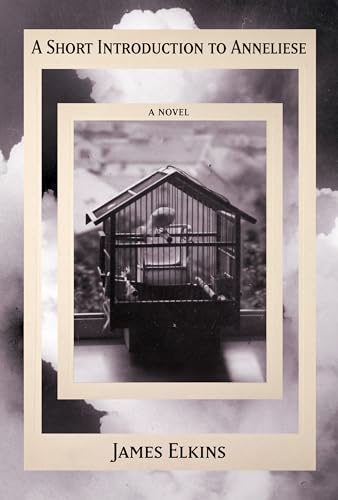
A Short Introduction to Anneliese is the second volume in author James Elkins’ multi-volume mega-novel Five Strange Languages being published by Unnamed Press, all of which trace the final year of Samuel Emmer’s life before he disappears.
When Samuel Emmer meets unemployed biologist Anneliese Glur for dinner during his stopover in Frankfurt, he has no notion of what to expect. Anneliese is an old friend and former colleague of his boss, and he agrees to dinner for no other reason than he has nothing better to do. As it turns out, Anneliese is a torrent of observations, digressions, theories, hypotheses, and resentments. She complains about her niece, who lives with her and her brother Paul, and about their uncle Hans, whose dementia haunts Anneliese’s concerns about the state of her own mind. She deconstructs the “awfulness” of language, calling it an ill-fitting suit, and challenges the validity of memory.
Most surprising is what Samuel comes to realize by the end of this strange that the insufferable but deeply compelling Anneliese is conducting a kind of interview with him – the purposes of which are not entirely clear. A month later, back home in Guelph, Samuel finds himself on the phone with Anneliese, listening to her once again.
Her monologues are wild, seemingly endless, often laugh-out loud funny, and occasionally repellent; but nothing is random, for Anneliese Glur is systematically introducing Samuel not just to her work, but to a breakdown in her mind, which she describes as thirteen distinct problems in her thinking. She is fascinated by long books, and she tells Samuel what she thinks of dozens of books including epic poems, encyclopedias, Joyce, Proust, Aquinas, Velikovsky, Roussel, Wallace, Murnane, Sade, Gibbon, Schopenhauer, and Ossian. She is no longer sure that she is sane, and she needs Samuel to read her book – a comprehensive theory of the essence of life, that transcends category or definition – to see if it makes sense. But first, through a series of long conversations, she introduces him to the world of her mind.
A Short Introduction to Anneliese has notes, which comprise a separate narrative at the end of the novel, written by Samuel in extreme old age (whom readers will recognize from Weak in Comparison to Dreams). This Samuel scarcely remembers Anneliese. Instead, her way of talking sounds to him like music. Her startling ideas have evaporated, leaving only melodies.
James Elkins (1955 – present) is an art historian and art critic. He is E.C. Chadbourne Chair of art history, theory, and criticism at the School of the Art Institute of Chicago. He also coordinates the Stone Summer Theory Institute, a short term school on contemporary art history based at the School of the Art Institute of Chicago.
Long complex books are slow-acting poisons, everything in them is coated with a thin lacquer of poison, every stone in those opalescent worlds has been licked by the author’s poisoned tongue.
A Short Introduction to Anneliese is volume 2 of a five volume experimental novel by James Elkins. Book 3, Weak in Comparison to Dreams, was published before this and the first book, Stories, like Illnesses, is due in Autumn 2026.
And based on the first of these that I have read I can confidently say this is one of the great literary projects of the century - indeed Elkins has been working on the project for 20 years.
The series as a whole concerns Samuel Emmer, whose job is to monitor the water supply in a town in Ontario. The main “present day” narrative focus on a year of his life from October 2019, before he disappeared. His own accounts of what happened are written from 2-3 years later, but the books as a whole include his own notes, having rediscovered the manuscripts some 40 years later, in his 80s. He has no real memories of what he describes, indeed he sees the person of those times as a separate being, but they do provoke musical resonances. In a sense Elkins/Samuel’s project is anti-Proustian as where in Proust’s work the madeleine dipped in the tisane provokes a flood of memories, here it is more for Samuel that the re-discovery of events of his past explain, in a sense, his present day obsessions some four decades later, particularly for music.
Each of the five novels has a very distinct style - here Anneliese, who dominates much of the novel with a monologue Samuel struggles to interrupt, is explicitly Bernhardian - simultaneously hilariously un-self-aware, manically obsessed verging on mad and yet intellectually brilliant. And the novel’s, and Anneliese’s, focus is on long books, long novels in particular, and the failure and insanity inherent within them.
Elkins own description of this book:
“This is the story of Anneliese Glur, an unemployed Swiss biologist who has been working in nearly perfect solitude (no social media, no colleagues, no readers), for twenty years.
When she meets Samuel Emmer, she tells him about her niece, her cat, her toothpaste, her illnesses, and everything else that comes into her head, especially her theories. Samuel tries to sympathize, but she shows no curiosity about his life. Her monologue is wild, endless, funny, repellent, and weird, but it is not random, and as it goes on Samuel realizes she is systematically introducing him to her work. She is no longer sure if she is sane, and she needs Samuel to read her notebooks to see if they make sense. She speaks more intensely and hypnotically each time they meet, drawing him further into her imagination. As soon as she’s finished writing, she says, he will have to quit his job and devote a year to reading her work, which is over a million words written in a hundred notebooks.
Her brother sends the notebooks to Samuel. He is overwhelmed: she may have written a kind of masterpiece. He leaves his office, intending never to return.
This is a novel about very long, complex writing projects, and what it means to spend years writing without readers. It’s for anyone who has battled through War and Peace, Proust, or any novel over a thousand pages long. Anneliese has read long books in hopes of finding guides to her own work, and she decides every book over a certain length is insane, including hers—and by implication, this one as well.
A Short Introduction to Anneliese has notes, which comprise a separate narrative at the end of the book. They are written by Samuel in extreme old age. He has found his memoir about Anneliese—the one we’re reading, which he had written as a middle-aged man—and he’s reading it again for the first time in forty years. He scarcely remembers Anneliese. Instead her way of talking sounds to him like music. Her startling ideas have evaporated, leaving only melodies.”
Elkins project is an immensely complex and meticulously constructed one, built on his own manifesto on how novels can or should be written, and comes with detailed explanatory notes available on his website, which add to the appreciation of the series: https://jameselkins.com/writing-sched...
I don't have the capacity for anything like what Anneliese or Stockhausen accomplished. Her notebooks defeated me after just a couple of hours. Still, I think this book I wrote, and these notes, are a little like her notebooks. She would laugh at that, because this book is short in comparison to what she did. Yet I think I have described what really matters about her. She would hate that, because I have drained the sense out of her life's work by turning it into music-but I no longer care about her science or what she wrote. I have been faithful to the peculiar way she thought. When I look at Stockhausen's unusual notations, when I count his thirty-second notes, or try to memorize his rules, I feel like I'm listening to the obscure words and unusual languages Anneliese used. His piano pieces have the same relentless grinding machinery of theories and rules. Perhaps these notes are a way of making her strange language into another one, even stranger. Maybe there is no way to translate an intricate language, invented by just one person, back into an ordinary one.
James Elkins does it again. A Short Introduction To Anneliese is another masterpiece, following in the path of the equally-excellent Weak in Comparison to Dreams .
Both of these novels are part of Elkins’ Five Strange Languages - a collection of writings about Samuel Emmer, a middle-aged biologist living in Canada, on the cusp of a very life-changing year. Weak in Comparison to Dreams , the third book (and first to be published) felt like a fever-dream about fear and observation. Anneliese , on the other hand, is about madness and legacy.
For apt readers, A Brief History of Anneliese contains plenty of rich humor and nods to the reader. The first instance lies in the title of the book, as the novel is far from short, clocking in at almost 600 dense pages. Unlike Weak , which has our hero traveling the globe and meeting a cast of characters - this time we are stuck with the manic, brilliant (!?), garrulous Anneliese, who monologues through the majority of the book’s first four-hundred pages. Her rants are overwhelming, tangential, all-encompassing - but never once boring. Elkins finds ways to keep these diatribes full of life, humor, horror, and heart. When reading them, we empathize with Samuel. Anneliese may drive us crazy, but we can’t look away. There’s something utterly compelling about her and her compendium of ideas.
At some point, if you’re like me, you’ll ask: “where’s this all going? Can Elkins stick the landing?” The answer is a categorical yes. Without spoiling a thing, the last two hundred pages of the book surprised and moved me in a myriad of ways I wasn’t quite expecting. It’s a bit of a magic trick, what Elkins does - and I, for one, was completely astonished.
I can’t recommend this book enough. It’s fiercely funny, deeply philosophical and unshakably sad. Thank you to Unnamed Press for publishing these tremendous, unclassifiable books. I can’t wait for the book three.
Really fantastic stuff, I thought the narrator of the first novel was a joyously hilarious insane lunatic but he's a pillar of sense compared to the wonderfully imagined Anneliese. It's just so entertainingly written! I read it at 500 words a minute with a 35% comprehension rate, maybe I'm a hedgehog reader, lol.
One of the best novels in years. This manages to be so many things at once, it is so satisfying as it progresses through comedy and horror and comedic horror, it really hits the tragi-comic sweet-spot.
I laughed many times and the whole thing is wonderfully entertaining and interesting while hitting the beats of pathos and humor throughout.
Absolutely brilliant. Absolutely insane. A Short Introduction to Anneliese is Book 2 in a five volume experimental novel by James Elkins. It follows the life of Samuel Emmers, and each novel explores a particular theme. This book explores long, complex novels, and how writing them affects their authors (oftentimes driving them toward insanity). We actually don't learn much about Samuel through this book, but he is a side character in the torrential flood that is Anneliese. Anneliese picks Samuel out to read her work, a lifelong project contained in 66 volumes of notebooks (with other volumes cross referencing them). She is afraid she has lost her mind in the process and she wants Samuel to enter her world, to have someone else see what she has crafted for 40 years, to hope that her life's work is not in vain.
The novel is primarily Anneliese monologuing to Samuel through the majority of the book, with notes from old Samuel at the end, translating his experiences into music. It's really brilliant in how you relate to her character. At first you hate her and want her to shut up, but something keeps you going. As you keep reading, as she opens up to you about the 13 Disorders of her mind and the sheer volume of effort she has taken to work on these notebooks, you begin to sympathize. You're still annoyed and a little bored, but you are held like a fly trapped in a spider's web, too fascinated to stop. You begin to care for her and hope everything works out, and the end leaves you feeling a little gutted. And the only way you've known this character is through her own monologue. I believe it's meant to be written part comedy/part tragedy.
The way this book explores mental illness and depression is incredible. I especially appreciated the Despair Theory toward the middle of the book, one of Anneliese's 13 Theories, and her use of the comet and her examples from Robert Burton's book, The Anatomy of Melancholy (one I have not read). Another interesting element was her monologue on how she read all the longest books in the world to find a parallel to her own work and came up dissatisfied. It reminded me of the Preacher in Ecclesiastes, when he searches over and over for meaning in the different contexts of his life.
James Elkin's work is so interesting. His writing is almost a parallel to Anneliese's--if you read about this novel on his website, he has countless amounts of pictures, data, graphs, and summaries to represent his work. This is a novel he has been working on for 20 years, and I think he might be a little insane too if he's able to write this. As I read this book, I realized he must also be a genius, to be able to take all these concepts and remember them and blend them together.
I love Anneliese. She annoys me but I love her anyway. I love her fascination with worms (she classifies everyone in her life as a different type of worm), and her brilliant insanity, and her honest search for meaning through her writing. Her nine and a half hour breakfast is legendary. I actually read that passage to several people because I was so entertained. "I need to concentrate on my work. I feel confident that you can manage to cook at least one dish correctly, so please just bring me every single thing on the breakfast menu, one after another, except the four items I have already tried, do not bring me scrambled eggs, fried eggs, omelets of any kind, or boiled eggs, just bring me everything else, in order, from the top of the menu to the bottom, and do not speak to me again."
Elkin's work is a fascinating rabbit hole to fall down, but it's hard to know how to recommend it to people. (Read this weird book that begins with a 200 page rant!) But I think if you do read it, you'll at least be entertained, if nothing else. However, I'd start with Weak in Comparison to Dreams, as I think I appreciated this more after reading that book first.