A range of artists share their very diverse approaches to painting in watercolor, to give the reader an idea of how adaptable and enjoyable this medium is
Covering the definition of watercolor and practical materials needed, this guide also takes readers through the drawing involved, and the particularities of painting landscape, garden, still life, and portraits. It also discussesd using colored paper and opaque paint, and explores a variety of contemporary artists using watercolor. Watercolor has an anomalous position in the visual arts. The contradictory ideas that it is very difficult to use and that it is a beginner's medium mean that it has long been sidelined in favor of oil and acrylic paints. But while watercolor painting does have particular difficulties, it is transparent and therefore fairly unforgiving, its advantages are huge. It is light and easy to carry the tools around, it is easy to clean and to prepare, it is unobtrusive, and a lot of the material you need you will already have around the house—a jam jar, water and don't forget the most important item: toilet paper. Watercolor is also a great and constantly evolving challenge, and can be used in all sorts of ways. This book is filled with practical information and aristic inspiration for painters.
Librarian Note: There is more than one author in the Goodreads database with this name. Please see:Charles Williams
Charles Williams is a British artist. He is a founder member of the Stuckist art group and a member of the New English Art Club.
Charles Williams was born in Evanston, Illinois, USA, and raised in England. He was educated at Kent College in Canterbury, Maidstone College of Art and the Royal Academy, London, where in 1992 he won the top prize for painting as well as the prize for anatomical drawing.
In 1996, he was elected to the New English Art Club (NEAC) of which he is now a committee member and with whom he regularly exhibits in the Mall Galleries in London. He has shown in London galleries since 1992, and in 2004 he had a solo exhibition at the Bakersfield Museum Of Art in California, as well as showing in many major competitive exhibitions in London, the UK and abroad, including the Threadneedle Prize for figurative painting, the Marmite Prize and the Hunting Prize. He is also a member of the RWS,
In 1999, along with fellow artist Eamon Everall, he became one of the 12 original founder members of Stuckism, the radical anti-conceptual art movement. Williams exhibited regularly with the Stuckists, was a joint winner of their Real Turner Prize 2002,[1] and was a featured artist in the major show, The Stuckists Punk Victorian, at the Walker Art Gallery, during the 2004 Liverpool Biennial.
Williams' paintings use a narrative content to give a sense of the wider concerns of his subjects.[1]
His book, Basic Drawing (pub. Robert Hale), summing up his teaching methods, was published in September 2011, and the follow-up, "Basic Watercolour" is expected in 2014.
WIlliams teaches in the Painting School of Canterbury Christchurch University Fine and Applied Art degree course in his native Canterbury.
I found this an excellent introduction to watercolour painting. I have been battling away on and off with watercolours for years, using wholly the wrong approach, and doing it all in a bull-headed sort of way. The results have been very poor. I tried reading several books to teach me to paint, but I couldn't get on with them at all. This book was refreshingly different.
The author is not only a respected artist, he is also a very experienced teacher, and yes, he can teach! Besides describing everything in simple terms, he is also warm and funny, and the book is a pleasure to read. One gets the sense that over the years he has taught piles of students how to use watercolour, and that is reassuring. You feel you are in good hands.
Now for the not-so-nice-bit. Painting with watercolours is an extremely strange pastime, and intuitive it ain't..... As Williams says "Painting with a transparent medium causes a huge problem. It's not 'the easy medium'; it's not remotely appropriate for children and it's really not for 'beginners'. In fact there is probably a PhD in the influence of watercolour in putting people off painting." But then most of us who have fiddled around with watercolours know this for ourselves. On the other hand it is a wonderfully practical medium to use. You don't need a studio, you can use it anywhere. It is only when you have to put the damned paint onto paper that you start encountering problems.
Anyway enough whinging. Williams is great at taking us step by step through what we need to do before, during (and after) painting with watercolour. It is quite mind-boggling stuff, and I am now determined to put a lot of what he has said into practice. I'm not committing myself 100% to his techniques. He is obviously a massively skilled drawer and painter, and I can't quite bring myself to jump off the cliff and into the wild blue yonder of his techniques, but I am going to do my best to try out a lot of what he has suggested. He is also a purist, as one of the founding members of The Stuckist Art Group; and a lot of what he says in the book points to this. "Wait until this layer is dry - there's a lot of waiting around in watercolour painting...(You can use a hair dryer if you want to, but I frown on this.") This is where we differ. I am more than happy to take shortcuts, including radiators and hair dryers - although he has persuaded me that some shortcuts are really not acceptable.
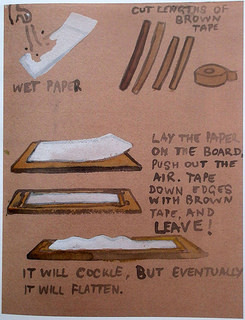
Herewith some pictures from the book. Firstly, he illustrates some of the instructions with little paintings he has done himself, which I found most endearing, e.g., instructions for stretching paper.
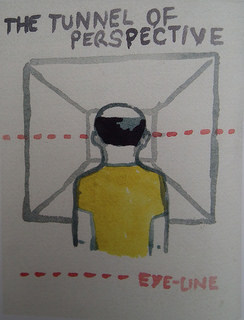
And herewith (a blissfully simple) lesson on perspective.
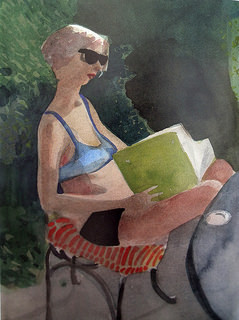
An illustration of his own work...a portrait of his wife in the garden.
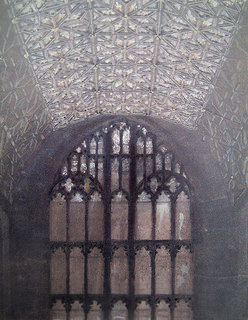
And he ends the book with examples of work done by friends of his. I feel a bit ambivalent about this section - the work is often way too advanced for beginners to able to identify with it. For instance I could no more hope to paint something like this than fly to the moon under my own muscle power.
(A detail of The Chapter House by Stephen Moriarty.)
On the other hand, the interviews with the artists that accompany the paintings are extremely interesting.
All in all I thought this book was excellent, and I can't wait to start putting some of it into practice. I feel I owe the author a big thank you.
Next day add:
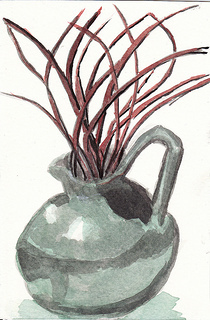
And finally - herewith the first picture I have tried to do using one of his techniques. With the body of the vase here I have tried to work by building up the highlights and shading using multiple washes, really trying to LOOK to see where they were, rather than just outlining the vase, and then adding rather childish side shadows and highlights. I lost heart with the sticks, they are more my usual painting-by-numbers technique. But I tried with the vase to follow his suggestions....