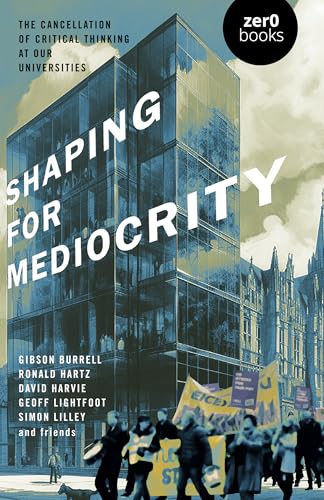
In 2021, as part of a programme called Shaping for Excellence, bosses at the University of Leicester made redundant numerous scholars in what was simultaneously an attack on academic freedom and trade union organisation. The authors of Shaping for Mediocrity not only had front-row seats in the campaign against these mass redundancies, they were in the ring - both as targeted employees and as trade union officers and negotiators. Shaping for Mediocrity tells the inside story of these attacks and the campaign against them. It situates this story within a longer history of struggle to make the university a place where critical thinking is possible, showing how events in Leicester are both reflective of higher education in the UK following four decades of neoliberal 'reform' and a particularly egregious instance of the increasingly authoritarian management of public institutions such as universities.
An insightful case study about redundancy, academic freedom, the rise of Business Schools, and trade-union struggles at the University of Leicester. At many points, the book's narrative attempts to project into more generalisable terrain, for example when sketching the effects of Thatcherism on the UK HE system or the disciplinary traditions of critical management studies and political economy. However, it often reverts back to the specific context at the University of Leicester. This made me struggle with parts of this book since the authors' personal experiences of going through the horror of being made redundant is more present in this book than is probably beneficial for the larger stories about academic freedom and university management.
The book is at its best when it contextualises examples of institutional decision-making with the scholarship of critical management and higher education research. However, the text's fixation on the role that individual actors (i.e., university senior management) played in the author's experience of redundancy, to me, felt like an attempt to establish a coherent narrative to a traumatic experience which can probably be equally well explained by the general direction that UK HE is increasingly taking. To be clear: I strongly believe that personal voice and experience has a place in academic writing; however, in this instance, this didn't strike the right balance to me at many times. Nevertheless, the book represents an important document evidencing the negative impacts of the marketisation of HE on both academics and critical thinking more widely. What has happened at Leicester is shameful and despicable. Yet, the authors' hopeful suggestion that universities can be what we [read: scholars and students, not management-make them] is a powerful and much needed message.
A necessary read as VCs migrate from hatchet jobs on one university (Leicester) to another (Swansea). The authors call it mimetic isomorphism - one university following another. We have the same problem again today: one Welsh university after another sacking hundreds of staff to the point that experts are warning of a tipping point, one where the teaching provision is no longer able to be delivered. In this book, VC's prioritising 'buildings over brains' is clear. Why have none of the redundant staff gone to ECHR after the long discussion of academic freedom?
A very interesting and timely description of the current crisis in UK universities through the lens of a group of academics who were made redundant in a single university. Much of this book is focused on narrating a conflict (at times it is less a case study than a chronicle), so the wood can be difficult to tell from the trees, but several chapters reflect on broader issues, such as conflicts over what a university is/should be in an era of profound change. I liked the discussions of academic freedom as ideal and reality in law and practice. I have recommended it.