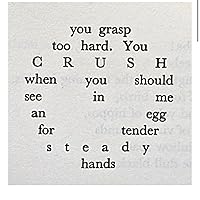
Robin has tapped into her own psyche and extracted raw resin born of the tediums of life and mixed it with her sugars of creativity to deliver a delightful collection of poems that also feels like a memoir. I appreciated how thoughtful these stanzas were and the connective tissue between some of them.
I was fascinated by the reoccurring symbolism of caves and eggs. Could the caves be a refuge from the outside? Outside where the Breaking News is emanating from, which only piles on to the self inflicted anxiety from the inside. An inside out egg is probably what bearing your soul out to the world must feel like — your protective shell moot. I could be way off target, but the fun of this collection of poetry is in its mystery and clues like an emotional cipher.
There is an eclectic range of ideas from 'the first man who found a cave', recognizing beauty in the eyes of another, typos, foods of the future, Michael Myers, death, love and airplanes , and more. I was busting out laughing at some of these lines! Robin has a knack for the unexpected, and she's a writer I will be following from now on. I suggest you do too!
Thank you to @variant.lit for sending a copy for an honest review.
PS. Thank you, Robin, for introducing me to Bonnie "Prince" Billy! Good stuff!
Beauty & the Rebellion - a review of "Inside Out Egg"
In Robin LaMer Rahija’s debut poetry collection, we are jackknifed into the absurdity of beauty coexisting with banality, and saved by the hope of another snowfall. Her poetry balances the rebellion of Charles Bukowski with the undeceived clairvoyance of Margaret Atwood.
The collective focus of this edition is honesty surrounding everyday life. Robin leverages veritas through sensual, unvarnished prose: “as though love/were a sourdough,/ dying then restarting,/ grown through being given away.” In “Quail Eggs at the Farmer’s Market,” she articulates hope with heart-rending clarity. Eggs “glowing/like Sassoferrato’s Madonnas,” are taken home to “pretend/I could create anything beautiful enough to be loved.”
The forms leap between long and short, with “Breaking News” interrupting the flow in provocative irony. What appears simple invokes the paradox of a koan. In “Inside Out Egg,” we bear witness to the sacred and profane with equal attention, bringing to mind a Thích Nhất Hạnh quote: “There can be no lotus flower without the mud.”
I recommend this collection to all lovers of contemporary poetry, and look forward to seeing more excellent work by Robin LaMer Rahija in the future.
If ever there were a collection for working class femmes, this is our poetic anthem. If ever my car crashes and my body is left unidentified, these are the poems I want them to find and use the words enclosed to replace me. The imagery and symbolism utilized in this collection breaks all the rules, just like Robin tells us she will by the second poem in the series. This collection tells a story of sisterhood for those born with "female" on their birth certificate and a warning for all the girls who will soon become women.
I started this book and finished it just like that. Every page I read, every word I divulged in, I didn’t want it to end. Robin LaMer Rahija’s poetry details the oddities of life and how complex yet simple things really seem to be.
She delves into topics such as mental illness and death but does it in a humorous manner that makes you forget that gruesome nature. Her poetry brings you to the realization of just how weird and beautiful and terrifying and exhilarating life really is. Robin’s writings feel like the most perfectly crafted ramblings that make everything feel so real.
Since I've gotten this collection, I have read it over and over. This is an addictive work. Within the pages of this realist poetry lies a series of raw emotions, capturing the essence of everyday life with unflinching honesty. Each poem serves as a mirror reflecting the intricacies of human existence, inviting readers to delve into the depths of their own experiences. Rahija skillfully navigates the complexities of the human condition with this collection.
Witty, tongue-in-cheek, but also vulnerable, Robin Lamer Rahija's book is a time capsule of the 2020's. She writes like a friend you've wanted to get closer to for a while, and this is the moment you spill all your secrets--poems that feel new but also nostalgic at the same time.
This book touched my soul! I felt universally connected to others after reading it and would encourage everyone to get a copy. Layout cleverly done, thoroughly enjoyable !
First of all, thank you to Variant Lit for sending me an advanced reader copy of "inside out egg!" It was an honor to have read it for you all.
"inside out egg," by Robin LaMer Rahija, is truly a wonderful poetry collection, as it walks the tightrope between being very dense and layered while using those layers to create a striking tone of truth that ends up being stronger than telling the truth itself. We see this in how Rahija examines the themes of what we can’t have, and what we settle for because of that inherent lack. When she writes that “hedgehogs are the new foxes” and “sloths are the new hedgehogs” in “I Can Never Put a Bird in a Poem because my Name is Robin and that is NOT Fair,” she is demonstrating a level of suppression that we have had to force onto ourselves as a result of overall zeitgeist of the last decade. Her use of substitution here allows for her to bring in animal symbolism (notice how sloths are slower than hedgehogs, which are slower than foxes) while also embodying a loss of what we once had in the ‘before times,’ if you will.
In addition, in “Quail Eggs at the Farmer’s Market,” Rahija analyzes and implies a personal void while also never giving the void a specific name. The pairing of quail egg symbolism (as well as her “ach[ing]” for them) with her belief that she cannot “create anything beautiful enough to be loved” implies more than Rahija ever needs to confess or admit to her audience. "inside out egg" is phenomenal at staring you down with just a side glance. It’s chilling how potent this effect is; through and through, Rahija proves that less is more.
Rahija is inventive and exacting in her analysis of the difference between desire and satisfaction. The transitions between images in Rahija’s poems feel sudden yet inevitable, like the wonderful whiplash or a Rubik's Cube sliding into place. Her slanted metonymies and substitutions have this incredible ability to communicate the truth more clearly than confession ever could. Her poems are, in fact, her insides out.