

What do you think?
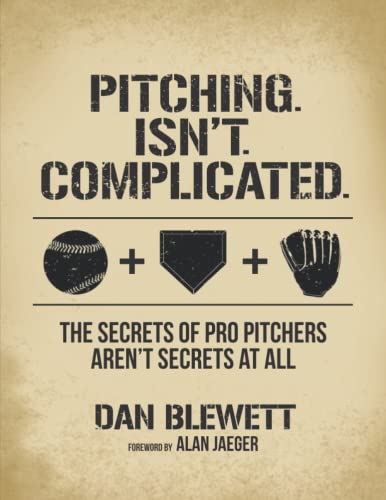
Pitching. Isn't. Complicated.: The Secrets Of Pro Pitchers Aren't Secrets At All
The perfect pitching book for coaches and players who want high-level pitching knowledge that's easy enough for beginners to understand.
Pitching Isn't Complicated is a book of advanced pitching drills, concepts and strategy, explained in simple, easy-to-understand terminology. If you're a young player to learn or a coach trying to do better for his players, this book will teach you everything you need to know, and nothing that you don't.
In the Book You'll Learn:
Stretch and windup mechanics used by the pros
How to assess and correct pitching mechanics
The most effective pitching drills to fix problems and form a routine
Pitch grips and action for the fastball, curveball, two-seamer, cutter and changeup
Command basics and how to improve control
Mental training techniques for pitchers
Situational pitching
Pitch-call and pitch sequencing strategy
How to form a good routine
Professionalism and dealing with failure
Advice on strength training, arm care and injury prevention
Pitching Isn't Complicated is a concise, simple explanation of the pitching maxims that every pitcher must have to pitch at an elite level. It is both practical and appropriate for players of all ages and coaches of all experience levels.
Grab a copy of Pitching Isn't Complicated today.
Pitching Isn't Complicated is a book of advanced pitching drills, concepts and strategy, explained in simple, easy-to-understand terminology. If you're a young player to learn or a coach trying to do better for his players, this book will teach you everything you need to know, and nothing that you don't.
In the Book You'll Learn:
Stretch and windup mechanics used by the pros
How to assess and correct pitching mechanics
The most effective pitching drills to fix problems and form a routine
Pitch grips and action for the fastball, curveball, two-seamer, cutter and changeup
Command basics and how to improve control
Mental training techniques for pitchers
Situational pitching
Pitch-call and pitch sequencing strategy
How to form a good routine
Professionalism and dealing with failure
Advice on strength training, arm care and injury prevention
Pitching Isn't Complicated is a concise, simple explanation of the pitching maxims that every pitcher must have to pitch at an elite level. It is both practical and appropriate for players of all ages and coaches of all experience levels.
Grab a copy of Pitching Isn't Complicated today.
- GenresBaseball
219 pages, Paperback
Published December 13, 2013
Ratings & Reviews
Friends & Following
Create a free account to discover what your friends think of this book!
Community Reviews
Displaying 1 - 2 of 2 reviews

September 12, 2026
I have a lot of respect for Dan Blewett. I follow his content, subscribe to his member platform, and genuinely appreciate the foundational work he puts out for youth sports. The first part of this book offers great structural advice, solid beginner drills, and straightforward daily routines that can help a young arm build basic mechanical consistency.
However, looking at this book through a modern, biomechanical lens, it leans far too heavily on antiquated, limiting dogmas from the pre-2020 era that do more harm than good for individual player development.
The biggest issue is the rigid, one-size-fits-all approach to how an athlete is "supposed" to throw:
* The Fallacy on Cutters: Blewett claims cutters serve no real purpose unless thrown at high velocities (85+ mph). That completely misunderstands barrel evasion and pitch tunneling. A cutter doesn't need to be 92 mph to break bats; late 2- to 4-inch glove-side movement that tunnels off a fastball profile induces weak, off-barrel contact at 50, 60, or 70 mph just as effectively.
* The "One True Curveball" Dogma: The book treats 12-to-6 or 1-to-7 overhand curves as the only acceptable breaking balls. Arm slot is dictated by an athlete's skeletal morphology, spine angle, and natural posture. Forcing a natural high-three-quarters pitcher to pull down into a pure 12-to-6 snap causes severe mechanical inefficiency and unnecessary joint strain, while ignoring that a sweeping 1:30-to-7:30 or 2:00-to-8:00 slurve/curve is a devastating, natural weapon.
* Ignoring Forearm Biases & The Neutral Grip Myth: The book acts as though a neutral grip is the only valid way to pitch. It completely overlooks natural supination vs. pronation biases. Natural supinators naturally excel with gyro sliders, cutters, and spiked curves, while natural pronators thrive with sinkers and arm-side run. Trying to flatten every kid out into a neutral mold ruins what makes their arm unique.
* The "Adult Velocity Governor" Myth: Echoing ideas from his older content, there’s this limiting premise that if you learn or return to pitching as an adult, you can't break 70 mph due to humeral bone adaptation. While growth plates dictate bone retrotorsion, throwing velocity is ultimately driven by ground reaction forces, a rigid lead-leg block, hip-to-shoulder separation, and kinetic whip. Setting arbitrary ceilings caps an athlete’s growth mindset before they even start.
* Old-School Fear-Mongering: The traditional fear surrounding pitches like the screwball or unique grips misses the modern sports science consensus. Fernando Valenzuela’s arm trouble wasn't caused by throwing a screwball; it was caused by throwing 250+ innings and 150-pitch complete games year after year.
At the end of the day, what is the fundamental purpose of pitching? It’s to get strikes and disrupt a hitter’s timing. The rulebook doesn’t mandate a single mechanical cookie-cutter image—it just says you have to deliver the ball legally. Whether an arm throws overhand, three-quarters, or sidearm, you build around their natural structural strengths and elevate them rather than making them feel broken because they don't match a textbook photo.
A decent primer for basic practice drills, but approach the mechanical and repertoire dogmas with caution. Elevate the individual, don't force them into a box.
However, looking at this book through a modern, biomechanical lens, it leans far too heavily on antiquated, limiting dogmas from the pre-2020 era that do more harm than good for individual player development.
The biggest issue is the rigid, one-size-fits-all approach to how an athlete is "supposed" to throw:
* The Fallacy on Cutters: Blewett claims cutters serve no real purpose unless thrown at high velocities (85+ mph). That completely misunderstands barrel evasion and pitch tunneling. A cutter doesn't need to be 92 mph to break bats; late 2- to 4-inch glove-side movement that tunnels off a fastball profile induces weak, off-barrel contact at 50, 60, or 70 mph just as effectively.
* The "One True Curveball" Dogma: The book treats 12-to-6 or 1-to-7 overhand curves as the only acceptable breaking balls. Arm slot is dictated by an athlete's skeletal morphology, spine angle, and natural posture. Forcing a natural high-three-quarters pitcher to pull down into a pure 12-to-6 snap causes severe mechanical inefficiency and unnecessary joint strain, while ignoring that a sweeping 1:30-to-7:30 or 2:00-to-8:00 slurve/curve is a devastating, natural weapon.
* Ignoring Forearm Biases & The Neutral Grip Myth: The book acts as though a neutral grip is the only valid way to pitch. It completely overlooks natural supination vs. pronation biases. Natural supinators naturally excel with gyro sliders, cutters, and spiked curves, while natural pronators thrive with sinkers and arm-side run. Trying to flatten every kid out into a neutral mold ruins what makes their arm unique.
* The "Adult Velocity Governor" Myth: Echoing ideas from his older content, there’s this limiting premise that if you learn or return to pitching as an adult, you can't break 70 mph due to humeral bone adaptation. While growth plates dictate bone retrotorsion, throwing velocity is ultimately driven by ground reaction forces, a rigid lead-leg block, hip-to-shoulder separation, and kinetic whip. Setting arbitrary ceilings caps an athlete’s growth mindset before they even start.
* Old-School Fear-Mongering: The traditional fear surrounding pitches like the screwball or unique grips misses the modern sports science consensus. Fernando Valenzuela’s arm trouble wasn't caused by throwing a screwball; it was caused by throwing 250+ innings and 150-pitch complete games year after year.
At the end of the day, what is the fundamental purpose of pitching? It’s to get strikes and disrupt a hitter’s timing. The rulebook doesn’t mandate a single mechanical cookie-cutter image—it just says you have to deliver the ball legally. Whether an arm throws overhand, three-quarters, or sidearm, you build around their natural structural strengths and elevate them rather than making them feel broken because they don't match a textbook photo.
A decent primer for basic practice drills, but approach the mechanical and repertoire dogmas with caution. Elevate the individual, don't force them into a box.
January 22, 2024
In contrast to certain pitching theorists who share their insights without firsthand experience, Dan Blewett brings a field-tested perspective in his book, drawn from his own journey. With a deep understanding of what truly works and effective communication skills, Blewett's book strikes a balance, covering the basics comprehensively while presenting them in a way that resonates even with seasoned pitchers, helping them grasp the reasons behind the techniques they've been taught.
What sets this book apart is its in-depth exploration beyond the basics, particularly in crucial areas like situational pitch selection. Blewett's explanation of pitch selection is unparalleled, offering a logical and insightful approach that I haven't found in any other book. Chapter 11, dedicated to situational pitch selection, is a gem that every catcher and pitching coach should have in their library.
In summary, while other books on pitching theory may boast authors with impressive credentials but limited personal experience, Dan Blewett's book stands out as a practical guide tailored for pitchers aiming to genuinely elevate their craft. It's not just for coaches and managers; it's a must-read for any pitcher striving for improvement.
What sets this book apart is its in-depth exploration beyond the basics, particularly in crucial areas like situational pitch selection. Blewett's explanation of pitch selection is unparalleled, offering a logical and insightful approach that I haven't found in any other book. Chapter 11, dedicated to situational pitch selection, is a gem that every catcher and pitching coach should have in their library.
In summary, while other books on pitching theory may boast authors with impressive credentials but limited personal experience, Dan Blewett's book stands out as a practical guide tailored for pitchers aiming to genuinely elevate their craft. It's not just for coaches and managers; it's a must-read for any pitcher striving for improvement.
Displaying 1 - 2 of 2 reviews