«Моя жизнь» — автобиографический роман, документально-поэтическое повествование, написанное Марком Шагалом, великим художником, чья жизнь волей исторических сдвигов разделилась между Витебском и Парижем, между Россией и Францией. Перевод на русский (исправленный для настоящего издания) принадлежит Наталье Мавлевич, лауреату премии «Мастер».
Since I first heard about Marc Chagall (probably in the beginning of 90s), he felt special not only because of his unique painting style but especially because of his deep connection with Vitebsk -- the families of both of my parents are from Vitebsk, although they didn't return there after the WWII.
Then sometime this year I listened to this tiny audiobook for children about Marc Chagall: Kunst-Stucke fur Kinder. Marc Chagall - Das Brautpaar mit dem Eiffelturm. Short as it was, it intrigued me by mentioning that the famous image of Fiddler on the Roof is based on Chagall's childhood memories of his uncle playing fiddle on a rooftop of his house. And when I heard there that Chagall wrote an autobiography shortly before living Russia forever, I took note: I just had to read it, to see what he had to say about Vitebsk and what exactly he wrote about his uncle fiddling on the roof.
The only e-book version of it I could find was this Russian e-book available on amazon.com. As I finally got to reading it, I was immediately charmed by its kaleidoscopic mix of simplicity and freshness, intimacy and lyricism, humor and depth, sadness and passion, dirt and poetry. It's been a long time since I read a book where it was impossible not to highlight chunks of the text on each page, to preserve them if not in my memory, then al least in Kindle/GR quotes.
And there was so much about the life of a poor Jewish family in Vitebsk. I kept thinking that the life of my grandmother's family (her father was a shoemaker) might have been very similar. Who knows, they might have even been neighbors.
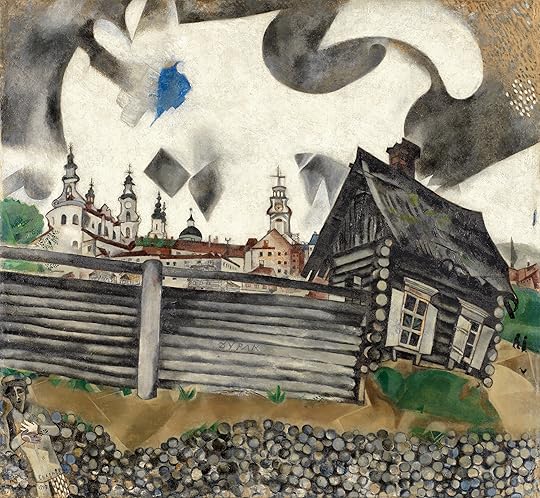
The Grey House, 1917, Thyssen-Bornemisza Museum, Madrid. (Image credit: Marc Chagall, Public domain, via Wikimedia Commons.)
The book is short -- only 210 pages -- and the last 30% are taken by the afterword written for this Russian edition, first published in the 1990s. The afterword revealed the disappointing truth of the peculiar origins of this Russian text (a perfect reflection of Marc Chagall's "there is no prophet in one's own homeland" fate). It appears, Chagall, who wrote in Yiddish and Russian, breaking grammar rules to his heart's content in both, wrote his memoir in Russian. When in 1923 he left the Soviet Russia for good, settling down in Paris, Chagall's wife, with the help of their daughter's French teacher, translated his book to French. Ma Vie was then published in France in 1928. Parts of it, together with a few other texts by Chagall, also appeared in Yiddish in the US soon after the WWII. By the time it finally became possible to publish Chagall's book in Russia (Gorbachev's times, I suppose), the original notebooks had long disappeared. So this Russian text I've been reading is the Russian translation of the French translation of the long-vanished Chagall's Russian original. It's a good translation as it absolutely enchanted me by its rhythm and its poetry, but I wish I could find the French translation, only one step removed from the original.
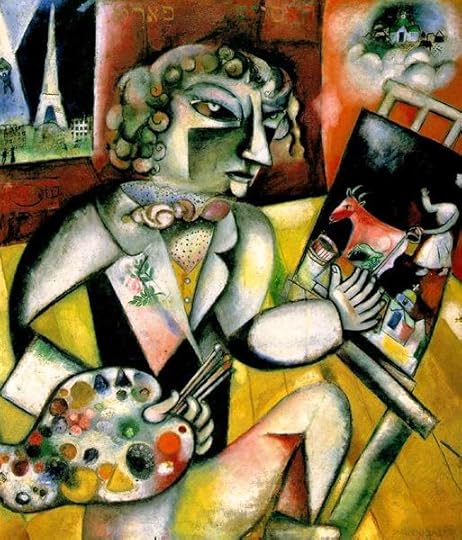
Self-Portrait with Seven Fingers, 1913. (Image credit: Marc Chagall, Public domain, via Wikimedia Commons).
All the parts of Chagall's memoir were equally fascinating to read: his stories of his family, his numerous aunts and uncles, his grandparents; his descriptions of the Jewish life in Vitebsk and nearby Liozno, where his butcher grandfather lived; his school years in a Russian school (Jews were not allowed to study there, but one of the teachers was open to bribing); his first inklings of the wish to paint; his studies at Penn's art studio in Vitebsk; his sisters happily using his paintings as foot mats; Chagall's uncle being afraid to shake his hand because the weird nephew might paint him, and this is a sin; leaving to Sant-Petersburg to study painting; the fear of being caught and arrested as a Jew staying in the capital without the special permission; poverty, the constant search of a corner to sleep at, of money to live on etc.; eventually being indeed arrested as a Jew without the permission to be in Sant-Petersburg and feeling glad for having a roof to sleep under and a piece of bread to eat; leaving to Paris in 1910 and finding himself right in the epicenter of La Bohema; the first exposition in Berlin in 1914; coming home for a 3 month visit and getting stuck because of the war; wedding; army service as a clerk in a military office in Sant-Petersburg; pogroms; mass desertions; the February Revolution; the October Revolution; back to Vitebsk to open an Art School; becoming the director of the Art School, decorating the town with festive placards for the first revolutionary anniversary, painted in his typical style (commissars not exactly happy with flying green cows); great projects to open a museum of art, to teach young people; being thrown out of the school by rivals; going to Moscow, decorating the famous State Jewish Theater; teaching art to orphan children in a pedagogic colony in a village near Moscow; getting sick and tired of still not being paid for his work for the theater even two years later, of feeling foreign, of not being appreciated, of not being able to fully devote his life to painting and leaving the Soviet Russia for good...
The abominably long sentence above is in stark contrast with Chagall's unashamedly short and sharp sentences, teeming on the pages of his book like colorful brushstrokes on his canvas. I loved all of them, but the last page of the book was like a kick in the stomach. Chagall was only 35 in 1922 when he left the Soviet Russia for good, just 5 years after the October Revolution, and yet he had already understood with crystal-clear certainty where the wind was blowing.
ПИСАЛ ЭТИ СТРАНИЦЫ как красками по холсту. Если бы на моих картинах был кармашек, я бы положил их туда... Они могли бы дополнить моих персонажей, слиться со штанами «Музыканта» с театрального панно... Кто может увидеть, что написано у него на спине? Теперь, во времена РСФСР, я громко кричу: разве вы не замечаете, что мы уже вступили на помост бойни и вот-вот включат ток? И не оправдываются ли мои предчувствия: мы ведь в полном смысле слова висим в воздухе, всем нам не хватает опоры? Последние пять лет жгут мою душу. Я похудел. Наголодался. Я хочу видеть вас, Б..., С..., П... Я устал. Возьму с собой жену и дочь. Еду к вам насовсем. И может быть, вслед за Европой, меня полюбит моя Россия. Москва. 1922 г.
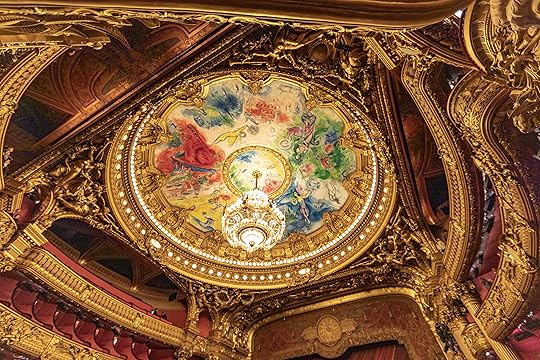
Palais Garnier, Opera de Paris: in 1964 a new ceiling painted by Marc Chagall was installed on a removable frame over the original. It depicts scenes from operas by 14 composers.(Image credit: Ninara from Helsinki, Finland, CC BY 2.0 , via Wikimedia Commons).
P.S. Alas, there was no mention of Chagall's uncle playing his fiddle on the roof (he must have mentioned this somewhere else in later years), so I had to console myself with the description of the same uncle playing fiddle like a shoemaker (aka badly) and his father (Chagall's grandfather) listening, and with the charming story of everybody looking for his grandfather, who went missing from the holiday celebration, only to find him quietly sitting on a rooftop, munching on a carrot and enjoying the good weather.
По субботам дядя Hex надевал плохонький талес и читал вслух Писание. Он играл на скрипке. Играл как сапожник. Дед любил задумчиво слушать его. Один Рембрандт мог бы постичь, о чем думал этот старец — мясник, торговец, кантор, — слушая, как сын играет на скрипке перед окном, заляпанным дождевыми брызгами и следами жирных пальцев.
А еще мама рассказывала мне о своем отце, моем дедушке из Лиозно. Или, может, мне это приснилось. Был праздник: Суккот или Симхас-Тора. Деда ищут, он пропал. Где, да где же он? Оказывается, забрался на крышу, уселся на трубу и грыз морковку, наслаждаясь хорошей погодкой. Чудная картина.