Le lecteur retrouve, dans ce récit, des personnages - l'oncle Charles, le modèle, Corinne, Paulou – apparus dans Histoire publié deux ans auparavant. C'est dire qu’il se situe dans le sillage et le prolongement de ce roman magistral. Mais, par la place faite à la peinture et une première évocation de « l’extraordinaire Orion aveugle marchant vers la lumière du soleil levant », il annonce l’œuvre à venir, Orion aveugle (1970) achevé ensuite dans les Corps conducteurs (1971).
« Un homme observe, depuis la terrasse d’un café, la fenêtre d’un appartement, avant de pénétrer dans l’immeuble et frapper de plus en plus violemment à une porte. Il suppose, poussé par la jalousie, la présence à l’intérieur d’une femme et d’un homme, le peintre et son modèle enlacés. Ces deux personnages apparaissent sur des photographies, décrites par le narrateur, qui associe à l’image de son oncle Charles des souvenirs d’enfance. La traduction d’un passage des Commentaires de César, où l’oncle aide le neveu, est associée à des souvenirs de la Seconde Guerre mondiale. Accompagné d’un ami grec, le narrateur recherche le site de la bataille de Pharsale (I). « Lexique » est une suite de parties intitulées, et disposées selon l’ordre alphabétique : « Bataille », « César », « Conversation », « Guerrier », « Machine », « Voyage », « O » [Zéro]. Autant de mots nodaux où se croisent les fils d’un texte touffu (II). « Chronologie des événements » entrelace, autour d’un voyage fait en train par O pour la réalisation d’un ouvrage de critique d’art, des scènes qui évoquent ses amours avec le modèle, des moments où apparaît Corinne enfant, des descriptions de tableaux, des descriptions du monde observé depuis le compartiment, des souvenirs de guerre ou d’un voyage en Grèce. Disparate, ce matériau constituera le roman : O s’assied à sa table, devant un dictionnaire et certains objets qui entreront dans le récit qu’il se prépare à écrire. Cette scène finale figure en tête d’Orion aveugle, dessinée à l’encre (III). » --Didier Alexandre
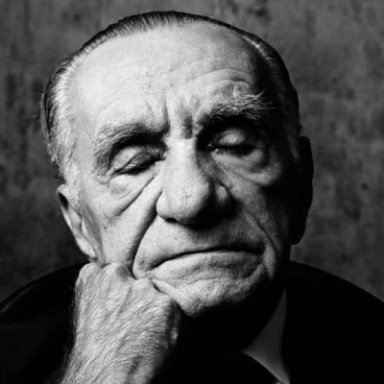
Awarded 1985 Nobel Prize in Literature, for being an author "who in his novel combines the poet's and the painter's creativeness with a deepened awareness of time in the depiction of the human condition."
Claude Simon took one decisive Roman clash and buried it under 200 pages of wallpaper, pigeons, and cotton fields. Caesar walloped Pompey at Pharsalus in 48 BC. Simon commemorates the occasion by staring out a Paris window at a café while a girl in red buys cigarettes. Veni, vidi, verbose.
Simon uses the battle as a metaphorical backdrop to explore themes of memory, time, and the fragmented nature of human experience. The complex structure and stream-of-consciousness style challenges readers to piece together the narrative from various perspectives and time periods, a task too lofty for this reader.
Simon, a key figure in the Nouveau Roman (New Novel) movement, employs a non-linear narrative that shifts between different characters and events. This technique reflects the chaotic and often disjointed nature of memory. The protagonist, who remains unnamed, recalls his experiences during World War II, his relationships, and his reflections on the ancient battle. The novel's rich, descriptive passages evoke a sense of place and time, immersing you in the sensory details of the protagonist's world.
The title promises legionaries and cavalry charges. Delivery consists of a fellow called O., an eye, an oval, a cipher, watching a drunk slump across a table for what stretches into a full consular term. Simon splits the book into three movements. Achilles Running Motionless, Lexicon, and Chronology of Events reshuffle one deck of images, and the café happens to seat actual card players, so the metaphor deals itself.
Every scene returns like a boomerang with commitment issues. The pigeon takes flight and freezes aloft. The Latin lesson repeats. The sex scene repeats, then repeats again, in case you relished the sweat cooling the first three times. Zeno lurks behind all of it. Valéry's arrow flies and stays put, Achilles sprints and stalls, and Simon builds something that gallops in place for hours. The experience resembles a treadmill that Zeno patented and taxed at the gate.
The plot, such as it survives, sends O. and a friend across Greece hunting the genuine battlefield. Locals bicker over which battle even happened there. One swears it was the scrap against the Turks, another backs Kynos Kephalai, the Dog's Head. So the grand quest for Pharsalus ends at a village soccer match beside a rusting reaper. Simon evicts punctuation, drops in stray Greek signage and Latin grammar drills, and turns paragraphs into a green thicket of dust and cotton. A father counting money and reeking of fermented grape drills Caesar's Civil War into the boy word by word and ridicules each mangled line. The boy offers "obstacled shores." The old man mocks the image of a soldier sheltering inside a river. The old man had a point.
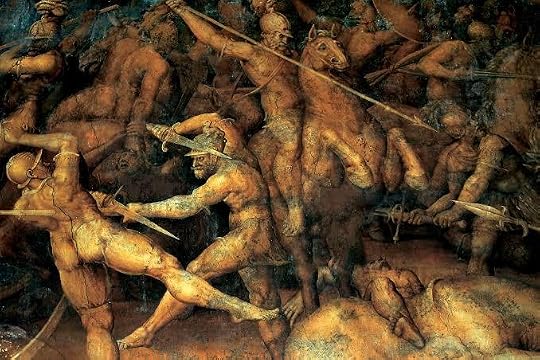
Half the book catalogues battles Simon keeps offstage, favoring mosaics, postcards, and museum reproductions. He would sooner inventory a painted javelin than swing a real one. The Chronology flattens everything into cold present tense, taking O. apart like a geometry problem, complete with a cone of vision labeled TOF. Romance expires where the protractor begins. A boxer nicknamed Hercules bellows into a wall phone at a scheming sweetheart in a romance comic strip, antique muscle smashed against drugstore pining. That is probably the wittiest beat available in the book, and Simon entombs it in a paragraph the length of a Roman road.
Credit where due. Simon does capture how recollection actually operates, everything blaring at once, sordid and grand, war and lust and a corroding harvester sharing one breath. The writing carries real majesty when it slows to watch daylight creep across a desk. The trouble is scale. Splendor stretched over 200 unpunctuated pages turns into an endurance sport. The Nouveau Roman set adored this, and Simon later bagged a Nobel, sweet vindication for anyone marketing old wars as fresh sentences. Claude Simon says describe the pigeon. You describe the pigeon. You describe it once more. That is the game, and the reader loses with dignity. This reader came, read, and surrendered.
The book is both visually engaging and confusing as hell. You would think that once you reach the end, things clear up - think again, and again. While I found the book challenging to follow, I can appreciate its unique approach to storytelling. I couldn't get into it, but I also didn't see a reason why I should.
Oh, France... [image error] "...in Pompey’s camp could be seen ingenious hammocks of verdure the tents covered with fresh grass several even like that of Lentullus shaded by ivy so that it was easy to suppose that men who sought pleasures so superfluous gradually we had managed to get settled As April came on the little leaves of the hombeam grew larger the underbrush was speckled at first with bright dots then it became a kind of light mist of transparent green Under the tent we had arranged a litter of tiny interwoven branches which protected us from the damp I didn’t know you could sleep so well with a saddle for pillow its hollow I didn’t yet know that death the sun was setting the shadows of the mountains moved farther and farther the heat had not diminished but the light was not so bright now In their shaded parts the hills were tinged with blue After the evening meal they practiced the trumpet the brassy sounds ringing in the twilight echoing under the great trees until dark the workmen from the quarry had gone a truck half loaded with pink blocks was parked under the loading platform The truck the platform another platform and a little shed nearby were entirely covered with a layer of grayish dust now there are no more pigeons on the square the wet asphalt has dried it is dull gray and no longer reflects the facade of the buildings opposite except in certain places where the accumulated water has not yet completely evaporated near the grille of a tree behind the Métro entrance where the water accumulates in a slight declivity at the base of the wall the façade of the building no longer being lit up by the sun these puddles no longer make bright gilded patches but simply gleam..."
This novel employs Simon’s middle style wherein, possibly caused by his experiences with PTSD late in life from his experiences in the Meuse Offensive, his already loose hold on reality was slipping, of which is something of a fixture of Simon’s works meaning that he utilized himself as a test subject to further dissect and eviscerate the lacerations caused by his existence.