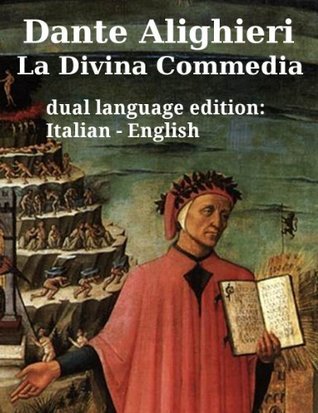
La Divina Commedia - The Divine Comedy (Inferno, Purgatorio, Paradiso) by Dante Alighieri in two languages (italian, english), and one dual language, parallel ... (translated) Vol. 2)
This electronic edition includes the original italian version and the line by line translation by H.W. Longfellow.
You can move quickly back and forth by simply clicking a link in the Table of Contents. The Logical TOC (NCX) allows you to jump back and forth between topics with a simple press of the Kindle 5-way toggle (this option may not work in the free sample).
English and Italian Some of the editions have a synopsis at the start of each "Canto" Separate yes Superior Kindle yes
You will find a single language edition in - LA DIVINA COMMEDIA (italian edition)
It includes also a parallel edition, with a line by line - LA DIVINA COMMEDIA italian - english (Longfellow)
These are some samples of the easy to read single and dual language format Dante wrote The Divine Comedy in 3 line stanzas with triple rime and this format has been maintained.
LA DIVINA COMMEDIA italian Nel mezzo del cammin di nostra vita mi ritrovai per una selva oscura, ché la diritta via era smarrita.
Ahi quanto a dir qual era è cosa dura esta selva selvaggia e aspra e forte che nel pensier rinova la paura!
LA DIVINA COMMEDIA italian - english (Longfellow)
1 Nel mezzo del cammin di nostra vita 1 Midway upon the journey of our life
2 mi ritrovai per una selva oscura, 2 I found myself within a forest dark,
3 ché la diritta via era smarrita. 3 For the straightforward pathway had been lost.
Dante Alighieri (May/June c.1265 – September 14, 1321), was the major Italian poet of the Middle Ages. His Divine Comedy, originally called Commedia and later called Divina by Boccaccio, is considered the greatest literary work composed in the Italian language and a masterpiece of world literature.
Dante Alighieri, or simply Dante (May 14/June 13 1265 – September 13/14, 1321), is one of the greatest poets in the Italian language; with the story-teller, Boccaccio, and the poet, Petrarch, he forms the classic trio of Italian authors. Dante Alighieri was born in the city-state Florence in 1265. He first saw the woman, or rather the child, who was to become the poetic love of his life when he was almost nine years old and she was some months younger. In fact, Beatrice married another man, Simone di' Bardi, and died when Dante was 25, so their relationship existed almost entirely in Dante's imagination, but she nonetheless plays an extremely important role in his poetry. Dante attributed all the heavenly virtues to her soul and imagined, in his masterpiece The Divine Comedy, that she was his guardian angel who alternately berated and encouraged him on his search for salvation.
Politics as well as love deeply influenced Dante's literary and emotional life. Renaissance Florence was a thriving, but not a peaceful city: different opposing factions continually struggled for dominance there. The Guelfs and the Ghibellines were the two major factions, and in fact that division was important in all of Italy and other countries as well. The Pope and the Holy Roman Emperor were political rivals for much of this time period, and in general the Guelfs were in favor of the Pope, while the Ghibellines supported Imperial power. By 1289 in the battle of Campaldino the Ghibellines largely disappeared from Florence. Peace, however, did not insue. Instead, the Guelf party divided between the Whites and the Blacks (Dante was a White Guelf). The Whites were more opposed to Papal power than the Blacks, and tended to favor the emperor, so in fact the preoccupations of the White Guelfs were much like those of the defeated Ghibellines. In this divisive atmosphere Dante rose to a position of leadership. in 1302, while he was in Rome on a diplomatic mission to the Pope, the Blacks in Florence seized power with the help of the French (and pro-Pope) Charles of Valois. The Blacks exiled Dante, confiscating his goods and condemning him to be burned if he should return to Florence.
Dante never returned to Florence. He wandered from city to city, depending on noble patrons there. Between 1302 and 1304 some attempts were made by the exiled Whites to retrieve their position in Florence, but none of these succeeded and Dante contented himself with hoping for the appearance of a new powerful Holy Roman Emperor who would unite the country and banish strife. Henry VII was elected Emperor in 1308, and indeed laid seige to Florence in 1312, but was defeated, and he died a year later, destroying Dante's hopes. Dante passed from court to court, writing passionate political and moral epistles and finishing his Divine Comedy, which contains the Inferno, Purgatorio, and Paradiso. He finally died in Ravenna in 1321.
I read this poem again and again. This poem really leave a great influence in my point of view. Despite being an agnostic, I enjoyed the morale values and the punishment the author portrayed in his journey. This book also inspired me to wrote short poems when I was in Highschool. Highly recommended especially for people who likes doing YOLO.
This all makes a lot more sense if you read Machiavelli's History of Florence first. Many of the folks in Dante's hell were old political rivals from the Guelph and Ghibelline days.
Imagine you had been slighted by many of your friends, defeated by your enemies, and was made victim to the machinations of corrupt leaders and civil servants. Now imagine, what your revenge might be.
Dante was not a violent man, so his revenge was not bloody. Dante was a writer, so his revenge took the form of a book, The Divine Comedy, in verse that would both entertain and educate readers, and malign those responsible for his situation.
Amore per Virgilio al massimo , Beatrice luce pure ma un po’ cattiva . Un libro per vendicarsi di quelli che gli stanno antipatici e un continuo lamentarsi di Firenze e del papato .