This book and the review will be of interest to Proustians and to aficionados of the history of clothing in the arts. De Osma, as the major biographer of Fortuny, clarifies the facts on his life often stated incorrectly by Proust scholars, and underlies the significance of his work to contemporary artists.
Mariano de Fortuny y Madrazo (1871-1949) was a painter born in the South of Spain to a family that married two clans of artists, the Fortuny and the Madrazo. Apart from Madrid, the family lived in Paris and Rome but finally settled in Venice living in two palazzi, the Martinengo (Mariano’s mother) and the Orfei (Mariano and his French wife Henriette).
After Mariano’s death the palazzo was donated to the City of Venice by his widow and it became the Palazzo Fortuny. Currently it is difficult to visit since it only opens for some special exhibitions. I was lucky in that there was such one during my recent visit to Venice and the 2013 Biennale.
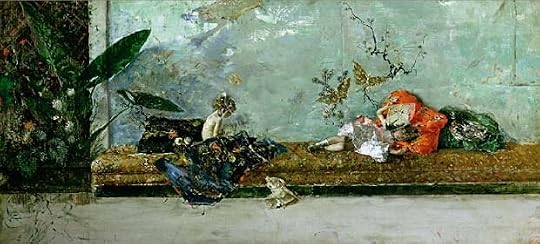
Mariano’s father painted a lovely portrait of his two children. This painting, now in the Prado, had a premonitory nature for it showed the then toddler Mariano wearing a mask over his forehead and sitting naked amongst folded up damasks and silks.
For even if Mariano liked to think of himself as a painter, he has lived on into posterity thanks to his contributions to the theatrical machinery (invented a suitable lamp for the stage) and for his designs with extraordinary textiles.
And it is also his textiles that made him enter the World of Proust.
In La recherche, Fortuny is a major leitmotiv, as stated by Proust himself. His gowns act as the intermediary vehicle that offers to his Narrator the possibility of regeneration. From an existence in which he was wasting away his time in an obsessive love that dragged him into the sinking and dark depths of an unfruitful and obsessive passion, he could be reborn in his imaginary paradise. For such is Venice for him. The golden city of art and water holds the promise of liberation and the path that will allow him to recover and regain his lost time.
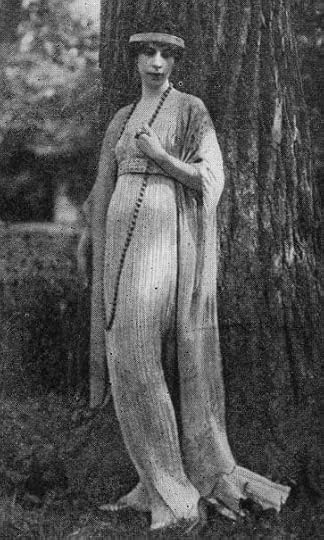
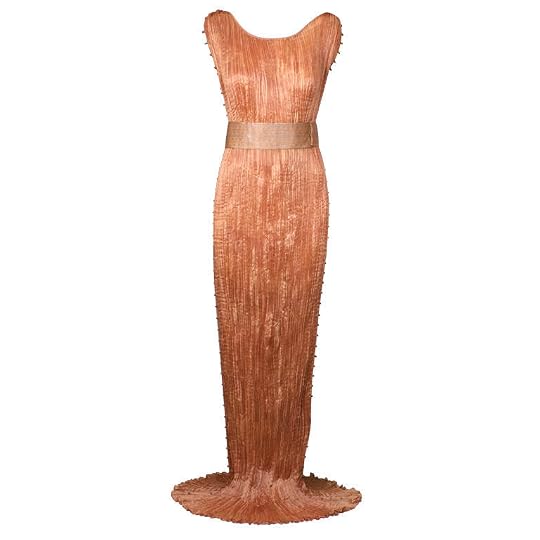
And for this traveling through time, the atemporal gowns, the Delphos constitute the perfect clothing. Designed to hide nothing and embellish while covering, became the double skins in the erotic and intimate scenes. And it is this finery that offered to the Narrator the promise of redemption, when he sees them in Carpaccio’s paintings--from where they originated.
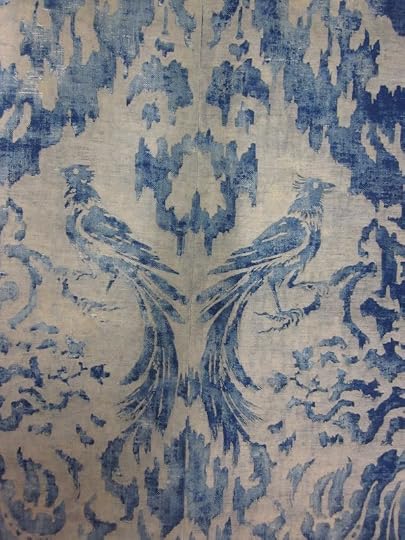
These Fortuny designs with their couples of oriental birds drinking from a fountain hold the key to a creativity that will survive time.
Death and Rebirth.
And De Osma tells us that not only Proust, but the salvation implied by Fortuny’s gowns has been renewed when Anne Leibovitz dressed Susan Sontag in one such Delphos dresses, when she was laid for her final rest.
Beautiful essay, which I read in its French version, on the links between Fortuny and Proust, through Venice and the Ballets Russes. Still they may never have met. Fortuny’s dresses played a small but crucial role in Proust’s great novel, not only clothing Albertine, but also as symbols linking art, memory, death and resurrection.