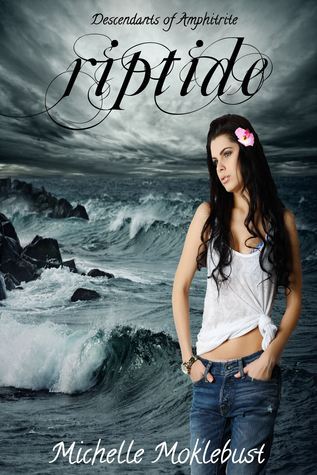
Dani’s life is going great. She’s close to her family, gets good grades, and her boyfriend Reese is awesome. Except he’s really not, but no one knows that. The night a handsome boy named Max saves her from nearly drowning, Dani is immediately attracted to the new kid in town and, even though she has a boyfriend, she can’t get him out of her mind.
The People of the Sea have lived beneath the waves for millennia, since the night Atlantis sunk and the goddess Amphitrite turned the survivors into mercreatures. Although the Mers occasionally find themselves in a position to interact with humans, they strive to remain undiscovered.
When Dani and Max break into the local aquarium to free a mysterious creature that washed up on the shores of New Atlantis, Dani is forced to confront everything she thought she knew about the world. What do you do when everything you thought you knew turns out to be wrong?
Michelle has been writing since she was in middle school, but when the question of publishing came up,she always said, "Someday." In 2012, after battling breast cancer, someday became today and she released her first novel, Ghost Whispers. Her second Young Adult Urban Fantasy novel, Riptide, which draws from Michelle's lifelong fascination with the Atlantis myth, was published in 2013. She has also been a special education teacher and a photographer. When she isn't writing, you can find her reading or taking pictures.
In addition to her novels, Michelle has written three short stories in the Chosen series. The third story, With a Flick of the Wrist, was included in the fundraising anthology, The Many Tortures of Anthony Cardno, published in 2014.
I thoroughly enjoyed reading Riptide, the debut novel in the Descendants of Amphitrite series. Author Michelle Moklebust has created a riveting world in which she combines mythology, the after effects of cataclysmic climate change,and the dramatic tension of first loves. The story unravels through the narrative of main characters Dani, (a good girl with a weakness for a bad boy), and Max (NOT the bad boy, but one with secrets of his own). Moklebust's writing is very sensory, and she carries you through the adventure alongside her characters. If your interest is at all piqued by the myth of Atlantis, the sea Goddess Amphitrite, dolphins, and the possibilty of mermaids being real, then you need to grab a copy of Riptide and dive in!
Michelle Moklebust's second book retains the charm and strong focus on female lead characters that served her so well in her first novel (2012's Ghost Whispers) and builds on them. What Riptide main character Dani shares with Ghost Whispers' Alexis is a trait of indeciveness (in decisions of love and day-to-day matters) that inhibits her ability to discern what's really going on around her until it's too late. In most other respects, Dani is a new, and to me more engaging, character: unlike Alexis, Dani shows no fear as the supernatural (in this case, the mer-people of what used to be Atlantis) begins to interact with the mundane (the surface world); she dives right in (pun intended) when love and lust aren't throwing big old distractions in her way.
Love and lust come in three forms: Dani's current (as the novel starts) emotionally (and eventually physically) abusive boyfriend Reese; new beau (with a secret: her's a merman!) Max; and Max's cousin Thomas (who just happens to be a Prince). Dani questions each relationship (or potential relationship) multiple times in the course of the novel, which clouds her perception of the bigger picture. Of the three, Reese is the least developed and most stereotypical: a jock who thinks he can do no wrong and is the king of the school's football team. Thomas also comes across a bit one-note: the womanizer who can't help but compete with his cousin on all levels. Max is the most fully realized of the male characters and is clearly, despite various set-backs, the man for Dani.
The bigger picture that Dani is not seeing is a combination of socio-political machinations for the People of the Sea (including Arranged Marriages for Max and Thomas and a mysterious artifact that needs to be hidden) and the impact of the surface world learning of their existence. Dani's mother is a marine biologist with a stake in uncovering the truth of the "mer-man" that was captured and given into her aquarium's care until federal armed forces take over. The two "big picture" issues begin to dovetail nicely into each other as the novel draws to a close.
One plot point I'm still not clear on is the method by which the mer-youth (who can transform to a "human" phase with legs and lungs) become enrolled at New Atlantis high school. The novel is set in the not-too-distant future on a land-mass that has risen in the Atlantic after the climate change crisis has sunk a good portion of the continental United States and Canada. One would assume that current identity and background checks, health records and the like, will be even more stringent in 30-50 years than they are now. The rest of the novel's world is so well-realized that this one point stuck out to me: how have all these mer-people, with no surface history, managed to become such a part of this school's social fabric in so short a time? Perhaps the author will explore this in the second book, although the cliffhanger ending of Riptide heavily implies that, like the final volume of the Harry Potter saga, the school is about to take a back-seat to more wide-ranging adventures.
Despite my dislike of major cliffhangers as endings for books in a series, I have to admit that I want to know more about Dani, Max, Thomas, Dani's friend Mitch and Katy and Dani's family (her mother is pretty integral to this story, her brother and father far more off-panel) and hope Moklebust will give us the follow-up to Riptide in short order.
This book was the perfect summer read. A young adult novel with a strong female lead, a hot love interest, and a story line glistening with mythology in a post catastrophic climate changed world, Riptide lives up to its name. It'll grab your attention, suck you in, and wont let you go until you turn the last page. What impressed me the most was how well Ms. Moklebust captured the attitude and thinking of teenagers (although sometimes I wanted to jump in and give them a maturity check), and I absolutely loved how she incorporated the mythology so deeply into her story, especially regarding mermaids. I can't wait to read the next book! :)
*I was given a signed copy from the author when I participated in a giveaway*