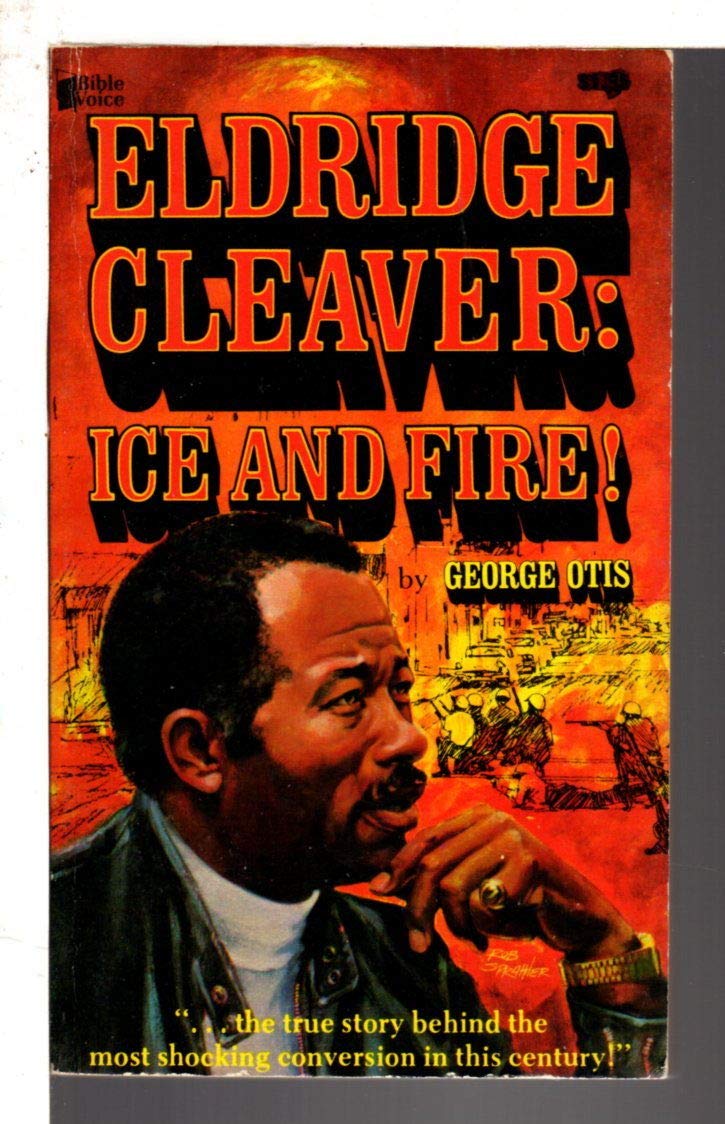
This is a brief and sketchy account of Eldridge Cleaver's life up until 1977, by which time he had become a born-again Christian. It's written in hacky, journalistic prose and, given that it's about somebody's spiritual journey, it's curiously the Christianity purveyed is trite and banal and lacking in depth. It's also mundanely teleological, portraying Cleaver's life as ineluctably leading towards his becoming a Christian. The author, George Otis, caricatures the Panthers, presenting them in an almost entirely negative light, and is always eager to take the police point of view on things. Otis thinks it unlikely that there was any concerted covert state programme to destabilise the Panthers, a judgement history has not been kind to. The book deserves a star, though, for charting the journey of an American (albeit black) radical who, through enforced exile, came to realise that the communist and socialist regimes he idolised from a distance were more repressive to live under than the United States he had thought so fascist and totalitarian. Being a right-wing Christian, Otis doesn't mention homophobia as one of the distasteful attitudes Cleaver oozed in his Soul On Ice manifestation. I daresay that it's one attitude that will have continued on without transformation into his new born-again life.
AN INTERESTING PORTRAYAL OF CLEAVER’S “EVANGELICAL” PERIOD
Pioneering Christian broadcaster and author George K. Otis Sr. founded ‘High Adventure Ministries’ which broadcasts from Jerusalem.
He explains in this 1977 book, “Cleaver’s grandfathers on both his mother and father’s side had been Baptist preachers. His mother… had taken her young son to a neighborhood Sunday School for a time, but his father (now deceased) left home while Cleaver was still a boy… It was Cleaver’s father who first sowed bitter seeds of Antichrist in the youngster’s mind.” (Pg. 22)
Of the fateful April 6, 1968 shootout with Oakland police, Otis comments, “there was a miracle on 28th Street! Few men have ever survived through 90 minutes of such fury. It was as though God had other plans for Cleaver that Cleaver himself didn’t know. Had angels been dispatched to protect the life of a rebellious black so that one day he might have another chance?... The revelation of this miracle would come slowly; not until Cleaver’s eyes were fully opened.” (Pg. 50-51)
Otis includes an interview with “a Berkeley policeman employed in the Bay area law enforcement during the volatile ‘60s,” who said, “I feel very strongly … that Panthers were not supported that much by the black community. The black community saw a lot of what their young men were doing and didn’t like it, and wanted no part of it. Many wanted it to be suppressed. I knew of numerous occasions when Panthers would go in and commandeer foodstuffs from black-owned stores. Then they would go and present it to schools as some great gesture of benevolence. And yet they were stealing from someone else to give out these things---to get the cameras on them.” (Pg. 62)
Otis observes, “A serious student of Cleaver may ponder whether something ‘snapped inside’ April 6, the day of the shootout… Certainly the man described by the Berkeley cop as ‘a moderate’ appeared far from moderate on April 6, and for some time thereafter… from that afternoon, Cleaver displayed certain paranoid behavior. His language dipped to a new low of repetitious obscenities. His brilliant and analytical mind showed evidences of staggering… The Cleaver who had steadied the blacks in northern California for two whole days after King’s assassination was suddenly manifesting a different personality.” (Pg. 81)
He suggests, “Cleaver didn’t have to ‘snap.’ He let himself be victimized by that ‘Lawless One’ he had unwittingly served since a boy… He used the last of his free time in America as if anointed by old Satan himself… Along with his diabolical anointing, he must also have gotten a foul spirit… He became so foul-mouthed that even Huey Newton sent word from his prison cell ordering Cleaver to clean up his language.” (Pg. 82, 89)
He recounts, “Thanks to that ‘assist’ by old [Superior Court Judge Raymond J.] Sherwin it became easy for Cleaver to slip out of the country and decline the waiting hospitality of the ‘San Quentin Hilton… [But] with each communist ‘paradise’ visited, Cleaver grew more and more shaken at the absence of the very freedoms Marxist ideology boasts about… The truth was that they were the world’s most repressive societies… Fidel Castro’s Cuba quickly set hm up in lavish style… What Cleaver saw, heard and felt in this first Communist showcase was bitter disappointment. Cleaver and another Panther … began to slip messages out of Havana to Black Panther member about their disappointment.” (Pg. 91)
Otis notes, “Several statements in ‘Soul On Ice’ reflecting on his sexual aggression hint at a conscience not yet seared… Cleaver, like any other person, should be gauged not on what he was but rather on the man he now is… Kathleen Neal was in many ways remarkable before she met Eldridge, and now as Kathleen Cleaver, wife of one of America’s most controversial figures, she has proven more remarkable… It appears the years of running may now be over for the Cleavers---possibly they are the wiser.” (Pg. 101-102)
Of Cleaver’s conversion experience, Otis writes, “when he was back in Paris… ‘I was suddenly struck by the realization that there was no light in our house---there was no light in our lives! There was no purpose…’ He found himself worried and utterly depressed… he had never felt this deep weariness---this feeling of being at the end of his rope… He looked up and saw the stars in the heavens… ‘Suddenly I saw an image of Jesus Christ! And this completely terrified me. When I saw that image… something snapped back, and I began to shake like a leaf and cry uncontrollably.’ … Some force outside himself made him fall down on his knees… From somewhere came the memory of parts of the Lord’s Prayer and the 23rd Psalm. He began to recite over and over again… In his library was a copy of the Bible… [He] ran inside to get it… he read until words began to swim before his eyes… When he awoke the next morning, he saw his way back home.” (Pg. 107-108)
After Cleaver returned to the United States, Otis says, “These days Eldredge Cleaver is listening to Bible teaching on cassettes. He is reading and submitting to lots of personal counseling.” (Pg. 140)
Otis acknowledges, “Eldridge has become ANOTHER MAN; newly sensitized and tired of hate. He is also a proud man and the barrage of criticism from both flanks stings. Not all Christians are… ready to put their money on Eldridge Cleaver… A few are still ready to hold the coat of his stoners. There still hovers uncertainty and vacillation in some parts of the church… Efforts to find a suitable church podium for the new Eldridge was … met with a measure of nervousness… The sanctuary of historic Hollywood First Presbyterian… wasn’t the only church to decline the honor of welcoming a speaker them remembered as a blaspheming revolutionary.” (Pg. 147-148)
Of course, in the time since Otis’s book was published, Cleaver became disillusioned with Evangelicalism, and in 1983 he was baptized as a Latter-Day Saint (Mormon). He became a conservative Republican, twice ran unsuccessfully for office, divorced his wife (of 20 years) Kathleen, and became addicted to crack cocaine until he finally died at age 62.
Otis’s book is a fascinating and balanced perspective on Cleaver up through 1977, and he resists the temptation to turn Cleaver into a ‘saint’ (as “conversion stories” often do).
The fact that these Evangelical stooges glorify Cleaver's complete and unprincipled betrayal of the struggle of the African working-class against US imperialism, as part of his shallow and decadent retreat into right-wing jingoism, is a shining example of how organized religion is nothing more than a festering scab on humanity's collective body, created to manufature the ideology of the complacent slave. This book is only handy if you are low on toilet paper.
It is safe to say that the Pharisees who published this F-grade bologna don't give a damn about the emancipation of the black masses - after all, if people - workers, of any race or nation, were emancipated, who would pay the tithes?