I truly relished this biography about a living American legend, Sylvan Hart, who lived on the banks of the Salmon River, the "River of No Return" in Idaho's wilderness area. In fact, I want to read it again, to renew a taste of our old American West and how the pioneers struggled to exist, to live from day-to-day. How they constructed their own homes, provided their own food, and kept themselves entertained. In his case, Sylvan must have been extremely innovative to have kept himself, a lone man, entertained in the wilderness, amused and distracted from the daily grind.
"To him who has once tasted the reckless independence, the haughty self-reliance, the sense of irresponsible freedom, which the forest life engenders, civilization thenceforth seems flat and stale. Its pleasures are insipid, its pursuits wearisome, its conventionalities, duties and mutual dependence alike tedious and disgusting. . . . The wilderness, rough, harsh, and inexorable, has charms more potent in their seductive influence than all the lure of luxury and sloth. And often he on whom it has cast its magic finds no heart to dissolve the spell, and remains a wanderer and an Ishmaelite in the hour of his death." --Francis Parkman
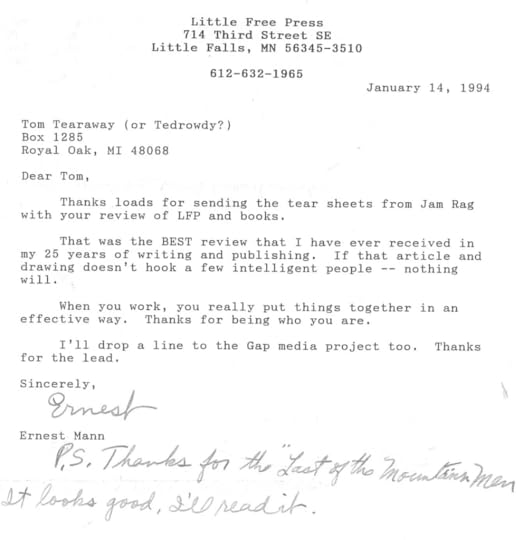
When I read this book in 1994, the plucky and somewhat dismissive semi-hermit recalled to me Walden and its author Henry David Thoreau. Like Thoreau, this man had to make it town for supplies, etc. occasionally. However, for this living anachronism it was a rocky trek, not the "stroll" it was for Thoreau. Like a connection to the Transcendentalist Movement, this man was proud of his self-sufficiency and the study in solitude and self-reliance compelled me to gift it to the only like-minded person I knew: Ernest Mann:
Read this when in high school as an article in an old Sports Illustrated. Later I found this expanded version in a used book store. It was highly influential in my life.