Jump to ratings and reviews
Rate this book

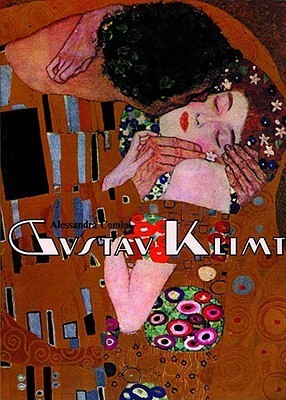
Gustav Klimt

Rate this book
The modern artist's reverse Freudian technique of obscuring content through detail symbolism is illuminated in a descriptive and analytical text and reproductions of paintings of imposing and passionate women. Bibliogs

112 pages, Paperback

First published September 27, 1975

1 person is currently reading
78 people want to read

About the author

Alessandra Comini

51 books14 followers
Short Biography for Dr. Alessandra Comini
www.alessandracomini.com / / / www.megancrespi.com


Alessandra Comini is University Distinguished Professor of Art History Emerita at Southern Methodist University in Dallas, Texas. She received her B. A. degree from Barnard College, her M. A. from the University of California at Berkeley, and her Ph. D. "with distinction" from Columbia University where she taught for ten years. She has also taught at the University of California, Berkeley, Yale University, served as the Alfred Hodder Resident Humanist at Princeton University, and been named Distinguished Visiting Lecturer at Oxford University's European Humanities Research Centre (1996). Voted “outstanding professor” by her students sixteen times and H.O.P.E. honoree four times, she has been extended the Distinguished Teaching Prize of the Meadows School of the Arts (1986) and the United Methodist Church Scholar/Teacher of the Year Award (1996). An undergraduate and a graduate scholarship in her name have been established by former students, one a professor of surgical oncology in Little Rock, Arkansas; the other, co-owner of an international antiques business in Dallas.

The author of many reviews, essays, and articles for national and international publications and a regular contributor to Stagebill (with Internet redistribution), Professor Comini has published eight books, of which one, Egon Schiele’s Portraits (l974, reissued in paperback, l990 and 2014), was nominated for the National Book Award and received the College Art Association’s Charles Rufus Morey Book Award. Her other books are: Schiele in Prison (l973), Gustav Klimt (l975, with French, German, and Dutch editions; reissued l986, 1990, 1994, 2001), Egon Schiele (l976, with Italian, French, German, and Dutch editions; reissued l986, 1994, 2001), The Fantastic Art of Vienna (l978), The Changing Image of Beethoven: A Study in Mythmaking (l987; reissued in paperback with a new preface in 2008), and Egon Schiele Nudes (1994). She contributed the chapter on Scandinavian artists to the l990 book World Impressionism, essays for the Washington National Gallery’s l992 catalogue and exhibition of Käthe Kollwitz (German edition, 1993) and 1994 catalogue and traveling exhibition of Egon Schiele. as well as an eponymous essay for the 1994 book on La Traviata, Violetta and Her Sisters and one for the 1996 English National Opera booklet, Salome. A major essay on the visual Wagner appears in the 1997 book The Threat to the Cosmos, two on Mahler in Muziek & Wetenschap, 1996 and in Gustav Mahler et l’ironie, 2001, and one on Beethoven in Beethoven and His World, 2000, as well as one on allegory in Klimt und die Frauen, 2000 (English edition, 2000). The Cleveland Psychoanalytic Society commissioned a lecture “Toys in Freud’s Attic” for 2000, published in Between Rousseau and Freud in 2002, and the Santa Fe Opera commissioned special lectures from her for six consecutive years from 1997 through 2002 (and again in 2006), as has the Dallas Symphony Orchestra for the years 2000 through 2006, and the Indianapolis Symphony Orchestra for 2007. In the fall of 2007 she lectured on Sibelius and Mahler in London and on Klimt and Mahler at the Neue Galerie in New York. where she also spoke on Schönberg in 2010 and on Expressionism, “The Decisive Decade,” in 2011. In 2014 she spoke at the Dallas Museum of Art’s symposium on the Wittgenstein/Czeschka vitrine.

A featured speaker at the Leipzig Gewandhaus Symposia under conductor Kurt Masur during the 1970s and 1980s, Professor Comini, who is also an amateur flutist, has participated in many congresses and symposia from Helsinki, Stockholm, Amsterdam, London, Dublin, and Oxford to Montpellier, Hamburg, Graz, Vienna, Budapest, and St. Petersburg in her special field of musical iconography. In recognition of her contributions to Germanic culture she was awarded the Grand Decoration of Honor in l990 by the Republic of Austria. Her lively

Ratings & Reviews

What do you think?
Rate this book

Friends & Following

Create a free account to discover what your friends think of this book!

Community Reviews

5 stars
38 (37%)
4 stars
43 (42%)
3 stars
18 (17%)
2 stars
2 (1%)
1 star
0 (0%)
Displaying 1 - 4 of 4 reviews
Profile Image for Ted.
515 reviews736 followers
August 2, 2017


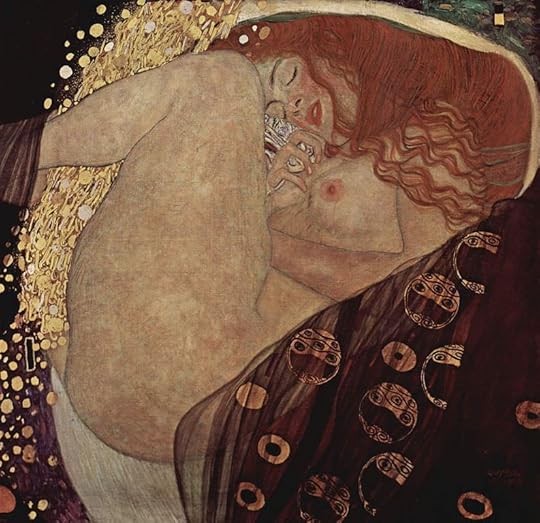
DANAE 1907-08
77x83cm 30x33in


This selection of paintings by Gustav Klimt is called a "Poster Book". The format is large format, 15 1/4" by 11 3/8".

It contains 22 full-page reproductions of Klimt's paintings. The reverse side of each reproduction is blank. The book is designed to allow easy removal of the reproductions for framing and/or wall hanging.

The book also contains three additional reproductions (not full page), a short introductory essay by Ina Stegen, and a list of principal dates in Klimt's life.

The paper quality is high, and the color reproduction seems top-notch. The paintings are framed beautifully on the 15x11 pages, in most cases covering either the entire width or length of the page.

There is no text on the reproduction pages. Instead the name, date, size, and location of each painting is given in a List of Plates in the front. The cover illustration (Danae) is one of the posters, as is the illustration used on the back cover (Farm Garden with Sun Flowers).


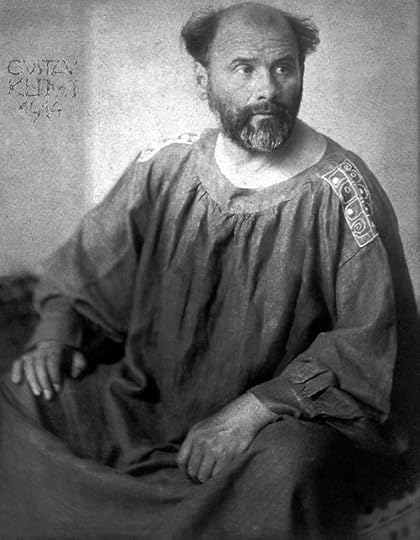
Gustav Klimt 1862-1918
looking like he could have stepped out of one of his paintings, no?

Klimt was an Austrian symbolist painter and one of the most prominent members of the Vienna Secession movement.

Author/editor Ina Stegen, in her introduction to this book, sets the stage for the years of Klimt’s best known output.
The sensuous flowing lines and decorative refinement, the literary symbolism and erotic allusions of Art Nouveau dominated the European art scene of the years around 1900. In Vienna the new style was supported by a group of artists who in 1897 decided to leave the Viennese artist association and constitue a more progressive group, the “Seccession”. Gustav Klimt became their president and artistic leader.

Stegen writes that it was only in this same year that Klimt began to evolve the style of painting for which he is famous, when he began work on three ceiling paintings for the University of Vienna. With these paintings he became “the herald of a new style”. Unfortunately for the European art world (and for the human spirit, I might add) these paintings were never displayed at the University, being deemed pornographic and characterized by “perverted excess”. Two of them were exhibited in Paris before being presented to the University; all three traveled a tragic and convoluted path, ending in May 1945 when they were destroyed by retreating SS forces. (See here, and especially the “Outcome and destruction” section.)

Be prepared to weep when you behold what was lost, even in the colorless photographs that were taken of them:Philosophy , Medicine and Jurisprudence .
Here’s a color detail of the Medicine painting. (I couldn't find sizes for these paintings, but as they were commissioned for ceiling display, they must have been huge.)

Stegen describes Klimt’s “highly personal style:
… which rejected traditional illusionist painting as well as the “light-realism” of the Impressionists. Increasingly, his compositions are oriented towards the picture plane, background and foreground are linked together by ornamental patterns, between which gently modeled areas of impressionistic texture set an accent of added aesthetic refinement. The contrast of richly detailed surfaces and large open spaces recalls the impact of Japanese woodcuts on Art Nouveau painting in general.
Stegen notes that in some of the later paintings Klimt pushed this style to its limits, producing works in which “the picture content has become completely subordinate to the overall concept of decoration.” An example:

She goes on,
That Klimt was aware of this inherent danger is documented by the fact that he did not continue in this extreme formalization. The paintings of his last decade reflect a much greater spontaneity, a freer painterly treatment which fills his ornaments with life and his marvelous landscapes with a vibrant sense of light and energy.
Following are some of my favorite Klimt paintings, all of which are reproduced in this poster book.
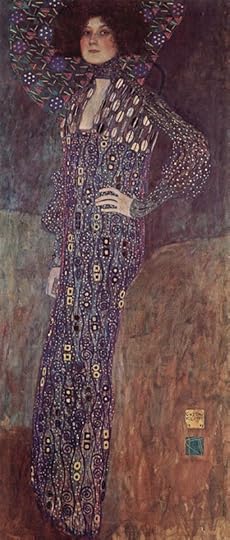
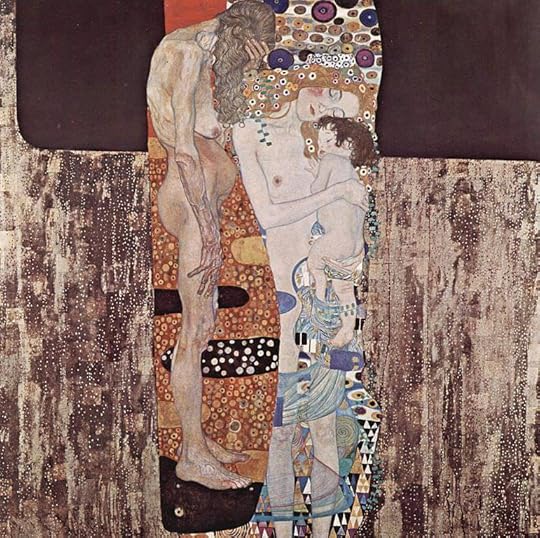
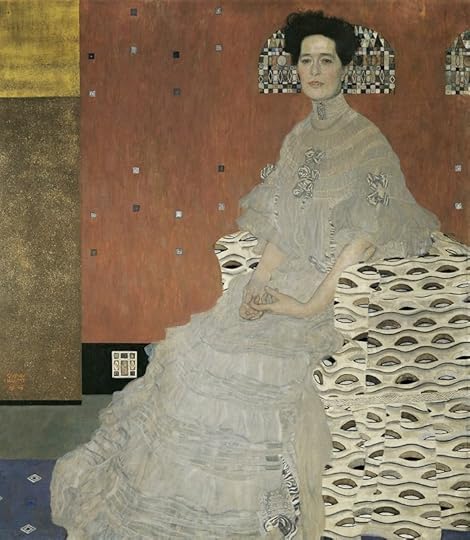
EMILIE FLOGE 1902
181x84cm 71x33in


THREE AGES OF WOMEN 1905
180x180cm 71x71in


FRITZA RIEDLER 1906
153x133cm 60x52in


THE KISS 1907-08
180x180cm 71x71in


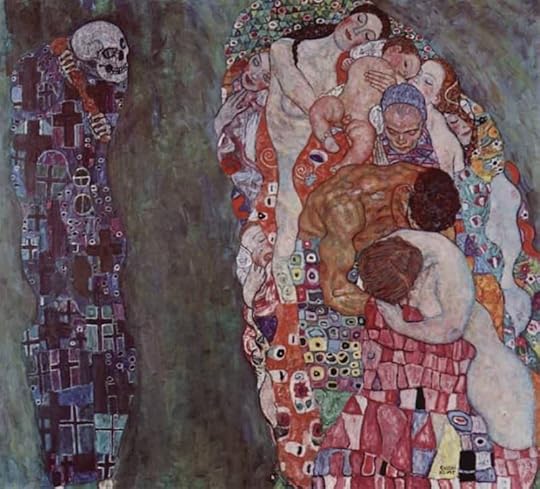
DEATH AND LIFE before 1911, revised 1915
178x198cm 70x78in


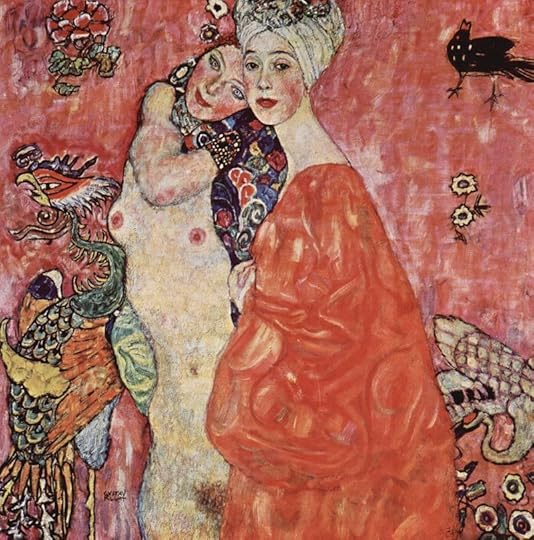
THE WOMEN FRIENDS 1916-17
90x99cm 35x39in (destroyed by fire in 1945)
Profile Image for a.g.e. montagner.
244 reviews42 followers
May 14, 2012
I libri della collana Quadrifolio sono frutto di una scelta radicale che, come tale, non può che incontrare la mia simpatia.
Parte testuale sostanzialmente assente, se non per un paio di pagine introduttive; riproduzioni di ottima qualità; grande formato (circa 25 x 28 cm), a cui si aggiunge la caratteristica peculiare di questa serie: i libri sono impaginati con ante apribili, permettendo di raddoppiare o perfino quadruplicare la superficie disponibile per ogni singola opera. Una sorta di pop-up per adulti, che avranno la sensazione di entrare nei quadri, di potersi muovere a proprio agio dentro i capolavori dell'arte. E questo è particolarmente vero nel caso di Gustav Klimt, che fece del decorativismo e del dettaglio prezioso una costante della sua produzione.
È così possibile, finalmente, ammirare le opere giovanili e storicistiche in ogni loro minuto particolare; immergersi nei decorativismi floreali della maturità, nelle ampie campiture dorate del periodo della Secessione; perdersi nei paesaggi naturali, simili sotto molti aspetti alle ninfee di Monet; attardarsi sui cromatismi quasi fauve delle opere tarde. E soprattutto è possibile godere del Fregio di Beethoven nella sua interezza: l'opera, realizzata nel 1902 in occasione dell'inaugurazione del Palazzo della Secessione a Vienna, viene solitamente riprodotta a frammenti a causa del formato (2,2 m d'altezza, per più di trenta metri di lunghezza complessiva). La soluzione adottata qui è tanto semplice quanto spregiudicata: tre+tre ante apribili orizzontalmente, per un totale di un metro e mezzo (!) di carta per ciascuna delle tre sezioni del fregio.
Non vorrei suonare troppo borghese, ma la mia sensazione è che un progetto editoriale del genere faccia sentire un po' meno la nostalgia dell'aura nella riproduzione dell'opera d'arte.
La sequenza è organizzata in ordine grosso modo (anche se non rigorosamente) cronologico, seguendo l'evoluzione dello stile di Klimt lungo trent'anni di carriera.

Cercavo un libro con cui prepararmi alla mostra klimtiana del museo Correr di Venezia: http://www.mostraklimt.it/ (invero piuttosto piccola; ma questo è un altro discorso), e quand'ho visto questo volume non ho avuti dubbi.
Displaying 1 - 4 of 4 reviews

Can't find what you're looking for?

Get help and learn more about the design.