Note: The decision was made to consolidate all Disney publications under the name Walt Disney Company. This profile is for Walt Disney, the characters he created, and the company he founded. Any questions, please ask in the Librarian's Group.
Walter Elias “Walt” Disney (December 5, 1901 – December 15, 1966) was an American film producer, director, screenwriter, voice actor, animator, entrepreneur, entertainer, international icon, and philanthropist. Disney is famous for his influence in the field of entertainment during the 20th century. As the co-founder (with his brother Roy O. Disney) of Walt Disney Productions, Disney became one of the best-known motion picture producers in the world. The corporation he co-founded, now known as The Walt Disney Company, today has annual revenues of approximately U.S. $35 billion.
Disney is particularly noted for being a film producer and a popular showman, as well as an innovator in animation and theme park design. He and his staff created some of the world's most famous fictional characters including Mickey Mouse, a character for which Disney himself was the original voice. He has been awarded four honorary Academy Awards and has won twenty-two competitive Academy Awards out of fifty-nine nominations, including a record four in one year, giving him more awards and nominations than any other individual. He also won seven Emmy Awards. He is the namesake for Disneyland and Walt Disney World Resort theme parks in the United States, as well as the international resorts Tokyo Disney, Disneyland Paris, and Disneyland Hong Kong.
Disney died of lung cancer in Burbank, California, on December 15, 1966. The following year, construction began on Walt Disney World Resort in Florida. His brother Roy Disney inaugurated the Magic Kingdom on October 1, 1971.
The Walt Disney Company (NYSE: DIS) (commonly referred to as Disney) is the largest media and entertainment conglomerate in the world in terms of revenue. Founded on October 16, 1923, by brothers Walt Disney and Roy Disney as the Disney Brothers Cartoon Studio, the company was reincorporated as Walt Disney Productions in 1929. Walt Disney Productions established itself as a leader in the American animation industry before diversifying into live-action film production, television, and travel. Taking on its current name in 1986, The Walt Disney Company expanded its existing operations and also started divisions focused upon theatre, radio, publishing, and online media. In addition, it has created new divisions of the company in order to market more mature content than it typically associates with its flagship family-oriented brands.
The company is best known for the products of its film studio, the Walt Disney Motion Pictures Group, today one of the largest and best-known studios in Hollywood. Disney also owns and operates the ABC broadcast television network; cable television networks such as Disney Channel, ESPN, and ABC Family; publishing, merchandising, and theatre divisions; and owns and licenses 11 theme parks around the world. On January 23, 2006, it was announced that Disney would purchase Pixar in an all-stock transaction worth $7.4 billion. The deal was finalized on May 5. On December 31, 2009, Disney Company acquired the Marvel Entertainment, Inc. for $4.24 billion. The company has been a component of the Dow Jones Industrial Average since May 6, 1991. An early and well-known cartoon creation of the company, Mickey Mouse, is the official mascot of The Walt Disney Company.
This book is what you might call, "A Thinker." You know, the kind of book you finish, and then you sit back and ponder, ask yourself some hard questions. For example, "Who wrote this book?" and "Does Disney REALLY not employ an editor?"
Seriously though, this book got me thinking. Disney is huge; they must employ tens of thousands of people in dozens of sub-companies/divisions. One of those companies or departments must be devoted to producing books based on movies (this group is labeled "Milking it" in the org chart). Within that department, there are probably the novelization people, the stickerbook people, the boardbook people, the continuing adventures people, etc. At the very bottom of the org chart, physically in the back corner of the basement office, sits an intern, a third-year international relations major from MSU.
I assume something like the following actually occured:
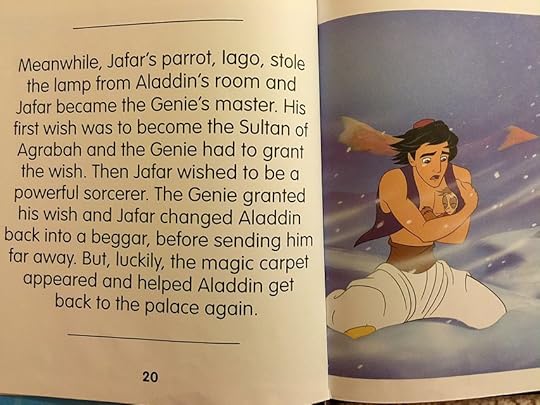
Boss (wearing suspenders, smoking a cigar): "Jim, good news. I've got a project for you. We need you to write a book for Aladdin." Intern Jim: "But I'm a business maj-" Boss: "Don't worry about it! Art's sending over the pictures; you just have to slap some words next to each one." Intern Jim: "But I'm not a writer..." Boss, snorting a bit as he laughs: "You think these kids can read? I told you - the pictures are there, and it'll look stupid if the facing pages are blank, so your job is to put words there. You'll do great. The kids will love it!"
[two days later. Intern drops proof on boss's desk]
Intern Jim: "Here you go. I wasn't really sure what direction to go on a couple of parts-" Boss, tossing proof into "Outgoing" bin: "Nonsense! It's perfect! The kids will love it!" Intern Jim: "So how long does it usually take for the editors to go through this?" Boss, glancing up, surprised to see the intern is still there: "The what now?" Intern Jim: "The editors?" Boss chuckles, shakes his head: "What do you think this is, the NY Times?" He gets up from his desk and guides Intern Jim out of his office. Intern Jim: "You know, this WAS kind of fun. I told my mom that I wrote a book, and she's all excited about seeing my name in print." Boss, looking uncomfortable for the first time: "Yes... about that..."
Maybe it didn't happen like that; I don't know. I DO know I've spent way too much time thinking about this. I even wrote a post about it on my blog. Anyway, while this deserves full marks for stimulating my imagination, it's kind of a failure otherwise.