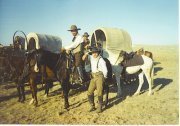
Kevin Costner's award-winning film, Dances With Wolves was first released in 1990. Dakota Epic is a first-hand account of the filming from an extra's viewpoint. Bill Markley, a reenactor on the set, kept a journal during the filming. "When I was selected to be in Dances With Wolves, I had no movie or reenacting experience, so everything was new to me." From a rookie's viewpoint, Bill takes us into the world of movie-making and reenacting. Experience the filming of the opening Civil War scenes. Visit the "frontier" at Ft. Hays. And be with the Lakota and cavalry at the concluding Search for Dunbar. This is a rousing, humorous look behind the scenes of movie-making. The illustrations were created byJim Hatzell, a reenactor and artist who drew a wide variety of sketches while on the set. Bill and Jim have worked together to develop a unique view of life on the Dances With Wolves film set. If you have ever wondered what the background people were doing and thinking during and between filming, then this is the book for you. You will never view the people in a film"s background quite the same after reading this book.
A long-time member of Western Writers of America, Bill Markley's latest book, Billy the Kid and Jesse James: Outlaws of the Legendary West (October 2019) is the second in the Legendary West series. Which outlaw was the best at what he did, Jesse James or Billy the Kid? The first in the series, Wyatt Earp and Bat Masterson: Lawmen of the Legendary West (May 2019) compares the lives of these two great lawmen of the Old West. Which lawman did the most to tame the frontier, Bat Masterson or Wyatt Earp? This joint biography reveals the intersection of their legacies and attempts to answer the questions about their place in the story of the West. Old West Showdown: Two Authors Wrangle over the Truth about the Mythic Old West (October 2018) was selected as a 2019 Will Rogers Medallion Award finalist. In this book, Bill and coauthor Kellen Cutsforth explore ten old west controversial events and characters fully realizing they will be stirring up multiple hornets' nests. Kellen takes one side of each story and Bill takes the other side--point/counterpoint. How did the gunfight near the O.K. Corral actually happen? Why did the James Younger gang try to rob the bank in Northfield, Minnesota? What really happened at Wild Bill Hickok's first gunfight? Were he and Calamity Jane lovers? Did Custer make bad decisions at the Little Bighorn or did his officers let him down? Did Buffalo Bill really ride for the Pony Express and do all the things he claimed? Did the army have Crazy Horse killed to get him out of the way? Did Pat Garrett really kill Billy the Kid? Geronimo-hero or terrorist? Wyoming's Johnson County War--were the small ranchers really rustlers? Bill's book, Deadwood Dead Men (September 2013) is a historical novel of Deadwood, Dakota Territory, in August 1876 during the time of Wild Bill Hickok, Calamity Jane, and others. Western Fictioneers selected Deadwood Dead Men as a finalist for its 2014 Peacemaker Award in the category Best First Western Novel. History, especially American history, and travel have fascinated Bill Markley since he was a boy growing up on the family farm in Pennsylvania. Moving to Pierre, South Dakota in 1976, to work for the state Department of Environment and Natural Resources was a natural fit for Markley, where he immersed himself in local history and participated in Civil War and Western frontier reenacting. Markley has been in films such as Dances With Wolves, Son of the Morning Star, Far and Away, Gettysburg, and Crazy Horse. He worked in Antarctica, traveled the South Pacific, kayaked and backpacked in Alaska, chaperoned a Boy Scout troop to Japan, and has camped, hiked, and rode horseback through the West. Markley has written three additional books, Dakota Epic, Experiences of a Reenactor during the filming of Dances With Wolves, and Up the Missouri River with Lewis and Clark and American Pilgrim, A Post September 11 Bus Trip and Other Tales of the Road. He writes for South Dakota Magazine, Roundup, True West, and Wild West. Markley's story "Kenneth McKenzie, King of the Upper Missouri" appears in WWA's anthology, Roundup! Markley and his wife Liz, live in Pierre where they raised two children.
Dances With Wolves is one of my favorite Western movies. Not that it makes the annual tray of films I've got to watch again and again. But in the extravagant way Costner treats the landscape, the movement of peoples (indigenous fols and former soldeirs) and the depth of his characters. Who can ask for a crazier captive white woman? And what picture better portrays the tentativeness of new settlers, the Lakota or even the wolves? I loved it. And no, I haven't forgotten how long the film is.
Markley's book about being an extra in the film brings it all back. More so, Markley contributes an entertaining narrative about the filming of the picture: Yankee and Rebel reenactors fighting over the remaining hot coffee, deals with night security guards about creeping onto the set to show it to their friends, the disappointment of not being picked to film a second sequence or to see new friends leave because they weren't asked back.
A veteran of a half-dozen films now, Markley clearly understands the life and role of extras in these big films. His master of the area was enjoyable--I write place-based historical fiction, so I'm always looking at characters and geography--so too his attention to the smaller details of where they acted, ate and camped.
It's embarrassing to say, but this is my first Bill Markley book. Markley is an officer with the Western Writers of America. Bill, everything was superb. I'll be reading more.
It was interesting in that this book talks about places I've been to. It wasn't very well written, but it did make me want to watch Dances with Wolves again.