Eleanor Fortescue-Brickdale (1872-1945) was an accomplished painter, illustrator and designer whose artistic life bridged the Victorian and modern worlds. Her work was much influenced by the Pre-Raphaelite artists whose love of detail, colour, symbolism, storytelling and nature was so hugely influential on mid Victorian Britain. Eleanor's own work carried the Pre-Raphaelite style forward into the 20th century. Indeed she became known as 'the last Pre-Raphaelite'. Despite her huge popularity in her own time, Eleanor's work has been neglected since her death in 1945. This book is the first monograph on the artist. It is the result of extensive research by Pamela Gerrish Nunn, whose work on Pre-Raphaelite women artists has done so much to re-assess the art history of the Victorian period. Here, the author takes us on a journey through Eleanor's training, career and achievements to re-establish her as an important and fascinating figure in the history of Pre-Raphaelite art.
Published by Liverpool University Press with National Museums Liverpool
A good introduction into the art of Eleanor Fortescue-Brickdale, who in addition to having a name I can't help but pronounce in an affectedly posh accent, was an artist in the Pre-Raphaelite style. She outlived many of that generation, and was known for her illustrations of poetic works. She also illustrated the Golden Book of Famous Women, which I hope to track down, not only for her contributions but also because a lot of fictional characters are included in it, alongside historical figures.
While my favorite Pre-Raphaelite-esque artist will always be Waterhouse, with Millais as a close second (not trying to be snooty here, I fell in love with Pre-Raphaelite art via Pinterest in high school), it's great to learn about Fortescue-Brickdale, who was unknown to me until recently. (Again, Pinterest is to thank.) Unfortunately, I can't find an online copy of "At the Sepulchre," an illustration of Mary Magdalene at the tomb before meeting the resurrected Jesus.
There's not much published on Fortescue-Brickdale, so this is a good enough place to start. Her artwork isn't as famous as the rest of the Pre-Raphaelites, and I think A Pre-Raphaelite Journey was inhibited by what artwork is available to see and reprint. Hopefully, Fortescue-Brickdale's work will become more accessible over time so we can more easily enjoy the beauty she offers the world.
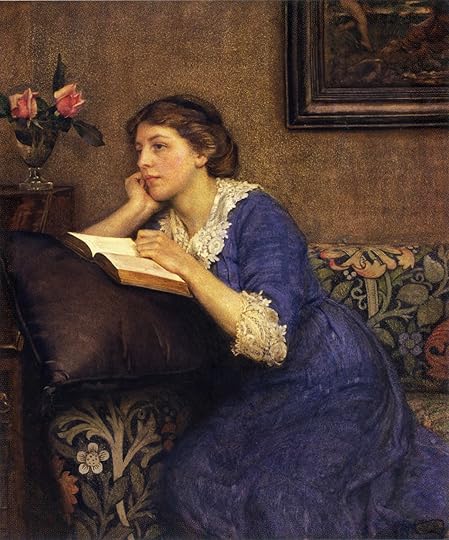
Portrait of Winifred Roberts, 1913. Nunn encourages the reader to note the William Morris print on the sofa, and the Byam Shaw painting (Cupid Driving the Lovers) on the wall.