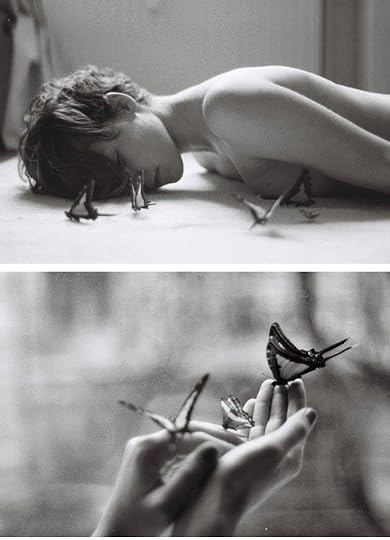
"Ispred kolodvora me muškarac pitao da li ga želim opet vidjeti. Nisam znala. -Imam ljubavnika, ponovila sam neodlučna. U stvari sam mislila na krv, mjereći koliko me peče među nogama. Govorila sam sebi: vidjet ćemo što će krv reći. Hoće li teći. Hoće li prestati. Ili će se rana inficirati. Rekla sam: -Bilo je dobro. Zaista. Ali ne znam da li to želim ponoviti. Opet je imao lice bez izraza, oboren pogled, umoran osmijeh. Dodala sam: -Javite se drugim ženama. Ne računajte više na mene. Slegnuo je ramenima: -Ne želim se više javljati drugim ženama. Pomislila sam da je to normalno. Da sam ja u stvari drugačija od drugih žena koje se javljaju na oglase. Ja nisam ništa htjela. Jednostavno sam usnula san, i slučaj mi je dao priviđenje da je san ostvarljiv. Što se ostalog tiče, nije mi trebao nitko. Ljepotu, zdravlje, obrazovanje, ljubav, dobila sam više od većine žena. Ali otuda želja za ispunjavanjem maštarija svih muškaraca ostavljenih od rođenja... -Nazovite u ponedjeljak. Mislim da je lakše odbiti muškarca preko telefona..."
Caroline Lamarche werd geboren in Luik, 1955, waar zij haar studie Romaanse filologie voltooide. Zij publiceerde haar eerste werk, een dichtbundel getiteld L'arbre rouge (De rode boom), in 1991. Daarna richtte zij zich voornamelijk op het schrijven van proza. In 1996 verscheen Le jour du chien, gevolgd door onder andere La nuit l'après-midi in 1998 en J'ai cent ans in 1999. Voor De dag van de hond, verschenen in de Franse Bibliotheek, ontving zij de Belgische staatsprijs voor literatuur 'Victor Rossel', ook wel de Belgische Prix Goncourt genoemd.
Night in the afternoon is an intriguing and superbly written novella, but perhaps rather not suited for the faint of heart (let alone for wusses like this reader).
Looking at the cover of the English translation of Caroline Lamarche’s Night in the Afternoon, I probably wouldn’t have taken this slender book home so lightly (I remember how my daughter asked to wrap Datumloze dagen because of the naked woman on the cover). The cover of the original French edition I found in the library with the minimalist blue and white cover design trademark of Les Editions de Minuit didn’t reveal anything about the content.
Compare both covers:
Just to say, I went in blindly. The title La Nuit l'Après-Midi brought echoes of Marguerite Duras (10:30 on a Summer Night) and Jean Rhys (Good Morning, Midnight) to my mind. It evoked an alluring atmosphere of darkness, as well as a whiff of promise of mystery, of bleak adventure.
From the title of the English edition of which this novella forms a part, Night in the Afternoon and Other Erotica and the cover I perhaps should have guessed more what was between the covers. Still I wouldn’t have expected to bump into an exploration of sadomasochism (just mention nipple clamps and I wince). Nevertheless I read on, reading this in one sitting, despite some explicit scenes which were rather torturous to read - mercifully short in this case gets its full significance.
Other than the synopsis of the English translation suggests, the woman whose thoughts and sensations are central in this brief novel is not ‘caught between two lovers’. Nor would I call the novel a ‘deeply satisfying exploration of illicit passion’. Both descriptions seem somewhat off the mark and euphemistic, too weak, too gentle to cover the load.
From the reflections and the self-observations in the interior monologue of the narrator something more complex emerges.
From the beginning there is an answer on the glaring question why the narrator decides to embark on sadomasochist practises – at least an answer to the question what triggered her desire to do so:
Why: The truth is, I answered a dream. One night I dreamed that an unknown man took me by force, with grim determination, his gestures so precise and quick he could as easily have been murdering me as making love to me. Above our two bodies, two birds were flying. One was a peacock, his tail spread in a helix, flying the way no peacock has ever flown, graceful as a swan and strong as an eagle. The other was a bird-woman with blood-red feathers. She spiralled to the ground, crash-landed, and lay there in her scarlet finery. I recognized myself in her. I was that winged woman, it was my face that looked up at the sky why while my body surrendered to the stranger’s violent lovemaking. Besides us, and open box, containing an assortment of instruments – pliers, tongs, scalpels. I looked at them, surprised and deeply curious. Who was going to open me up, and why? I trembled with desire, the desire to be at the mercy of tools like these, which cut through flesh, pull the wounds open, and keep them open.
Engaging herself in copious sex with Gilles, her genteel married lover and experimenting with BDSM with an unnamed redheaded man she finds by responding to a contact ad ('Masterful man seeks flexible young woman to share intimate moments’) the woman uses both men in her quest for redemption, changing scenery just like the customers of the tourist agency she works for are always on the lookout for unusual destinations.
Gilles stands for softness and sensual pleasure, the redheaded man for excitement, transgression, experimentation. Exploring the power dynamics and its impact on her body and mind with the clinical precision required in a laboratory, she seeks to undo the emotional numbness she experiences, maybe because of a childhood trauma (whether sprouting from real or imagined event). Sex for her seems a rite of purification and a self-imposed shock therapy inflicted by the hand of someone else. She is pushing boundaries to tap into other dimensions in herself, to find an ecstasy that is almost religious or mystic, transcendence.
The novella made me aware I am clueless in this genre (apart from stories of Anais Nin and a couple of graphic novels I am not sure I read anything else alike). Is this pornography? If not, what is it? Does the name of the game matter? Despite the numerous graphic sex scenes, it feels inadequate to categorize this simply as a piece of literary erotica. Intense and unsettling, it doesn’t come across as though Lamarche’s purpose is to turn on the reader (but what do I know?). Lamarche seems more interested in showing the changes and evolution of the psyche of her narrator (but isn’t the brain the most erotic part of our bodies?). Throughout her experiences, the woman grows more autonomous in her decisions, her vulnerability turns into strength. The dream eventually will lead her to the royal road to the comprehension of the unconscious: her desire to become a mother.
In a survey inquiring why people are drawn to BDSM practices one quarter of the participants described their motive as seeking an altered mental or psychological state, seeking a different level of consciousness, focusing attention or finding relaxation, an experience of ‘floating’. This corresponds strongly with the state of mind of the woman evoking her experiences in this novella. Perhaps it is what Lamarche hopes to find when exploring the crossing of borders in her writing - the expansion of consciousness rather than a flight from reality as Angela Carter wrote in The Sadeian Woman: And the Ideology of Pornography(book I haven’t read yet but was reminded of reading this book and watching a documentary on Carter):
The pornographer has it in his power to become a terrorist of the imagination, a sexual guerrilla whose purpose is to overturn our most basic notions of these relations, to reinstitute sexuality as a primary mode of being rather than a specialised area of vacation from being.
I was keen to read Caroline Lamarche since I recently found out she is a francophone Belgian writer – books from across the language border seem to reach Flanders only scarcely, if published by a French publishing house. Like Amélie Nothomb, Caroline Lamarche apparently is one of those Belgian authors creating furore in France to the degree she is thought of as French. Her work has been translated into English, Dutch Spanish , Italian, Latvian and Japanese. After more work exploring dominance and submission (Mira, Carnets d'une soumise de province), she now seems to concentrate on other subjects, for instance the search for solace and mutual protection between people and animals (her short stories collection Nous sommes à la lisière won Prix Goncourt for short stories in 2019). Lamarche’s fascination with animals is already showing in Night in the afternoon via the cat Douce and her kittens, and the ginger tomcat visiting and threatening them (mirroring the redheaded man).
Can the brutal and the poetic go together? I certainly pushed my own boundaries merely by finishing the book.
Dit vrije dunne boekje stond bij de nieuwe aanwinsten in de bibliotheek. Wat vreemd was, is dat het geen enkele info bevatte over de auteur of de inhoud van het werk. Ook de cover gaf nauwelijks iets prijs, op de voorkant enkel de naam van de auteur (plus de vertaalster) en de titel, op de achterzijde niet meer dan een piepklein afgedrukt citaatje ‘…te schreeuwen tot je je stem vindt.’ Het meenemen naar huis voelde dus een beetje als een blind date. Ik vermoed dat het vooral de titel was die me uiteindelijk over de streep trok, omdat hij me deed denken aan een verhalenbundel van Hanif Kureishi waar ik enorm van gehouden had (Midnight all day). Al snel werd duidelijk dat het boekje handelde over een soort s/m achtige relatie. Even vreesde ik voor ‘vijftig tinten grijs’-achtige onzin, maar dat bleek reuze mee te vallen. In de eerste plaats biedt deze novelle een indringend portret van het emotionele leven van het hoofdpersonage. En hoewel de schrijfstijl van de auteur als poëtisch kan omschreven worden, zit er nauwelijks erotiek, laat staan romantiek in de beschrijving van de bdsm scènes. Eén keer versnijdt de schrijfster dergelijke beschrijvingen fraai met herinneringen aan haar kindermeisje. Ook de dominant in het verhaal is een man van vlees en bloed en geen karikatuur. Het maakt allemaal dat je geïntrigeerd verder blijft lezen. Dit is wel degelijk literatuur en geen verkapte porno.
Even mijn mening herzien. Ik gaf het boek 3 sterren omdat ik het het voordeel van de twijfel gaf. Dat doe ik nog steeds, ik geloof dat het van goede literaire kwaliteit is en diepgang heeft, maar ik heb het boek niet gesnapt (of niet willen snappen?) en niet graag gelezen. Het was lichtelijk meeslepend dat wel, maar achteraf voelde ik spijt dat ik geen ander boek had vastgenomen.
Bij deze verander ik naar 2 sterren, want ik heb het gevoel dat ik andere boeken, die ik wel graag heb gelezen, teniet doe door ze drie sterren te geven en ze daarmee op dezelfde plaats komen te staan als dit boek waarvan ik niet genoten heb. Terwijl een beoordeling van drie sterren helemaal niet mis is. Waarmee ik niet wil zeggen dat dit boek mis is, gewoon dat het mij net heeft gemist.
You know what stinks - when an erotic story collection falls flat on its face. This one doesn't deserve half an orgasm or a rapidly growing hard-on! Sad!
Dit boek(je) verscheen oorspronkelijk in 1998 in het Frans (La nuit l’après-midi). Het is een bom! Sorry, het is het eerste woord dat me te binnen schiet. Maar ik ben omvergeblazen door dit boek, dus zo gek is dat woord niet. Het is in het begin nog even aftasten wat dit voor vreemd verhaal is. Het begint met kittens en bloed. Wacht even, een rendez-vous hotel…? Daarna weer de kittens... En daarna: “De man droeg een witte latex handschoen. Ik heb dat achteraf gezien, toen ik naar de grond keek om mijn kleren te zoeken, want de twee uur waren voorbij”. O, dit is zó goed gedaan! Ik weet dat ik wartaal spreek, maar ga dit on-mid-del-lijk lezen. Iets met een vrouw die op een contactadvertentie reageert: “Autoritaire man zoekt jonge vrouw, soepel karakter, voor momenten van intense verstandhouding”. Het is keihard en tegelijk betoverend mooi. De eerste keer dat ze uit het rendez-vous hotel komt: “Alle dingen worden door één golf opgetild, en vol van die golf loop ik verder, mijn lichaam getekend door de klappen, gezwollen als een jonge bloemknop. Gulzig draag ik het leven, op de plekken waar ik geslagen werd – op mijn buik, mijn wangen – de mannen kijken naar me alsof ik pas twintig ben, en de bomen begroeten me met grote heftige gebaren, en de wind blaast me op als een zeil, ik ruk op met de snelheid van een schip in een grote, mooie storm”. Nou, dan kun je schrijven! De naamloze vrouwelijke hoofdpersoon (ze heeft ook een vriend, Gilles) komt uit gegoede kringen en gaat dus in op een contactadvertentie. Waarom is het verhaal nou zo goed? Omdat het heel goed gedoseerd wordt verteld. De spanning is af en toe te snijden. Omdat zij zich overgeeft aan een haar onbekende man, die alles met haar kan doen en ook doet. Maar de rollen raken omgedraaid, de man wordt steeds zwakker en de vrouw steeds sterker. “ ‘Het is eraan te zien dat je het niet gewend bent’, zegt hij. ‘Je moet wijder worden. De volgende maal beginnen we daarmee.’ Er komt geen volgende maal, sukkel, je ziet me nooit meer terug, mij of mijn kontgat.’ “ Echt, je moet het lezen. Ik ga het zeker opnieuw lezen. Geweldig boek qua beeld en taal. Als een film.