

What do you think?
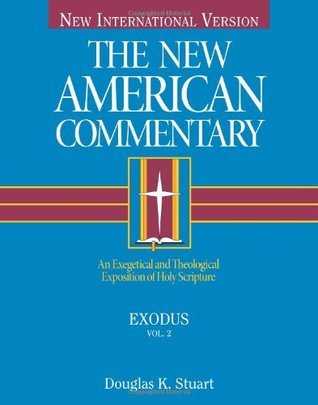
New American Bible Commentary, Old Testament Set #2
Exodus: An Exegetical and Theological Exposition of Holy Scripture (Volume 2)
THE NEW AMERICAN COMMENTARY is for the minister or Bible student who wants to understand and expound the Scriptures. Notable features include:* commentary based on THE NEW INTERNATIONAL VERSION;* the NIV text printed in the body of the commentary; * sound scholarly methodology that reflects capable research in the original languages; * interpretation that emphasizes the theological unity of each book and of Scripture as a whole; * readable and applicable exposition.
827 pages, Hardcover
First published June 15, 2006
About the author
Douglas K. Stuart
27 books27 followersDouglas Stuart is a professor of Old Testament at Gordon-Conwell Theological Seminary in South Hamilton, Massachusetts.
Ratings & Reviews
Friends & Following
Create a free account to discover what your friends think of this book!
Community Reviews
Displaying 1 - 14 of 14 reviews

February 7, 2016
Stuart's Exodus Commentary is a good example of the strengths and weaknesses of the NAC series as a whole. It's well studied, well written, and deeply evangelical in its outlook. The strengths of this are obvious for those who have similar leanings--Stuart will always seek the option that retains the most stringent positions on things like the good character of Moses, Mosaic authorship of difficult texts, etc., and defend it thoughtfully and well. But sometimes this apologetic leaning creates significant problems. For example, he bends over backwards to argue that "maybe the Midwives weren't _exactly_ lying" or "Maybe Moses wasn't a problem here," when the text provides simpler solutions in and of itself.
Furthermore, there are a number of times when his simple reading of the text at times lacks literary or theological depth because it's so focus on apologetic concerns. For example, Stuart is often so concerned at papering over distinctions in the text in the name of defending Mosaic authorship, that he misses opportunities to discuss what these tensions--which are present, even if not from non-Mosaic authorship--indicate, both literarily and theologically.
It's also uneven. The last half of the text is decidedly less beneficial than the first half! For that reason, it gets a 3*. Still, if you're looking for a solid, readable, well laid-out commentary on Exodus from an evangelical perspective to use in Church of Class preparation, this is pretty solid.
Furthermore, there are a number of times when his simple reading of the text at times lacks literary or theological depth because it's so focus on apologetic concerns. For example, Stuart is often so concerned at papering over distinctions in the text in the name of defending Mosaic authorship, that he misses opportunities to discuss what these tensions--which are present, even if not from non-Mosaic authorship--indicate, both literarily and theologically.
It's also uneven. The last half of the text is decidedly less beneficial than the first half! For that reason, it gets a 3*. Still, if you're looking for a solid, readable, well laid-out commentary on Exodus from an evangelical perspective to use in Church of Class preparation, this is pretty solid.

March 28, 2021
One of my primary sources for a class I've been teaching on Exodus at my church. Helpful. I especially appreciated his many excursuses covering difficult topics along the way. For an 800 page book, very readable.
December 26, 2017
The book of Exodus is one of the most fascinating yet under preached on books of the Bible. I say that it is under preached on due to most preachers fear of preaching a long-drawn-out exegetical series on the entire book rather than just preaching on the most well-known parts. Due to this need to preach on the book of Exodus exegetically, a exegetical commentary is needed. One of the best exegetical commentaries is that of the new American commentary produced by B&H publishing. This Commentary series is respected in both hire scholarship as well as in popular understanding. For this series combines the best of scholarship with practical applications. It is therefore easy to understand why B & H selected Douglas K Stuart to be the author of such an important volume.
This volume begins with a 50 page introductory section which is the envy of most commentaries. It is also important to note that Stuart does not focus his entire introductory section on the authorship or sources of Exodus. In the first few pages need to Claire with certainty that Moses was the author and that it was his sources that this book of the Bible was transferred from oral tradition into physical writing.
Furthermore in this introductory section Stuart gives a great detailed outline of the book of Exodus, which an exegetical preacher can use as a outline to preach from as well as a great excursus on the seams shown in the book of Exodus. With regard to the commentary proper, Stuart deals with each verse in turn. He make sure that the student of scripture will be able to understand the book of Exodus and its original context as well as it’s interconnections to the rest of scripture as a whole. Furthermore there are invaluable application insights scattered throughout this work.
There are a few sections I am a little disappointed with, the first deals with the commentary on the Ten Commandments. It is not that the commentary is not phenomenal rather I found it much too brief to be a great detailed Health if one would preach more than one sermon on the Ten Commandments. On the flip side the commentary on the other was given on Mount Sinai are described and exited in great detail. Furthermore due to the more recent liter of this publication Stuart interacts with modern critical scholarship as well as modern of angelical scholarship to produce a volume that will Aid the preacher immensely in however they shall choose to use it. I therefore recommend this commentary highly amongst a packed field of worthy exegetical commentaries.
These books was provided to me free of charge from B&H Academic Press in exchange for an unbiased, honest review.
This volume begins with a 50 page introductory section which is the envy of most commentaries. It is also important to note that Stuart does not focus his entire introductory section on the authorship or sources of Exodus. In the first few pages need to Claire with certainty that Moses was the author and that it was his sources that this book of the Bible was transferred from oral tradition into physical writing.
Furthermore in this introductory section Stuart gives a great detailed outline of the book of Exodus, which an exegetical preacher can use as a outline to preach from as well as a great excursus on the seams shown in the book of Exodus. With regard to the commentary proper, Stuart deals with each verse in turn. He make sure that the student of scripture will be able to understand the book of Exodus and its original context as well as it’s interconnections to the rest of scripture as a whole. Furthermore there are invaluable application insights scattered throughout this work.
There are a few sections I am a little disappointed with, the first deals with the commentary on the Ten Commandments. It is not that the commentary is not phenomenal rather I found it much too brief to be a great detailed Health if one would preach more than one sermon on the Ten Commandments. On the flip side the commentary on the other was given on Mount Sinai are described and exited in great detail. Furthermore due to the more recent liter of this publication Stuart interacts with modern critical scholarship as well as modern of angelical scholarship to produce a volume that will Aid the preacher immensely in however they shall choose to use it. I therefore recommend this commentary highly amongst a packed field of worthy exegetical commentaries.
These books was provided to me free of charge from B&H Academic Press in exchange for an unbiased, honest review.

July 23, 2020
Stuart offers an academically serious commentary that likewise takes the miraculous signs and wonders of the Exodus seriously. Refusing to jump on the JDEP Theory scholastic bandwagon, Stuart holds strongly and convincingly to Mosaic authorship by appealing to the books intrinsic unity (among other arguments). But what I appreciate most in this commentary is Stuart's respect for the text, and how he uses the text to interpret itself. He doesn't get lost in the academic weeds, so to speak. That said, among OT scholars, he seemed at times unwilling to see or engage with potential intentionality and patterns of design in certain texts, while I myself am more inclined to see the literary genius of the biblical authors come out in deep patterns in such texts like Ch. 15:25-27.

May 30, 2023
Great commentary on Exodus. Thicc boi that’s for sure. Like any commentary, it has various strengths and weaknesses. It was hard but accessible for me as an above averagely interested lay person. Some uses of Hebrew but usually well explained. Footnotes are excellent. My favorite part were the Excursuses throughout that would deep dive into a debated topic or something that just needed a more thorough treatment. For the scope of the commentary it does all it sets out to do. I wish it would make more interpretative leaps at application and NT connections, but if he did that I’m sure people would complain that it wasn’t just an exegetical and theological breakdown. That’s just what would have made it a perfect commentary for me, personally.

May 22, 2018
An in-depth and detailed commentary on Exodus. I can tell Stuart has spent a long time researching and diving into the culture, background, and history that surrounds this book. Though near the end of his commentary he seems to be fatigued. Overall great treatment of the Hebrew and helpful understanding of the plagues. When he compares them to natural disasters I was amazed at how we think we have an answer for everything but sometimes as Stuart points out it is just God doing wonderful things! After reading this book I feel I have a grasp of one of the biggest and most fundamental stories of the OT.

April 6, 2021
A very thorough, dependable and conservative approach to Exodus. What Stuart is able to do is critique the NIV translation where needed, as he is a superior ancient languages scholar, and, at times, he is also able to debunk the Documentary Hypothesis where it appears weakest. Stuart's excursuses are a significant contribution on their own - apart from the commentary.
October 26, 2024
This is a great commentary. I only have one other NAC, but I think this holds up. Stuart does a great job of covering the obvious, pointing out the important, and on occasion as necessary digging into things a little deeper. I would not consider this a real technical commentary, but it is worthwhile for what I used it for as a reference for my Sunday School class.

April 2, 2020
Helpful, detailed commentary on Exodus. Did a really good job explaining the text, but I docked a star because it isn't really pastoral at all in tone, so the value is more for acquisition of knowledge than spiritual exhortation.
4/5
4/5
January 14, 2022
This is an excellent commentary on the book of Exodus. It gives detailed and comprehensive coverage of the book and is full of wonderful insights into the meaning and applications of the text.

December 16, 2022
Not very good.

October 6, 2025
Outstanding work of scholarship and spirituality

May 4, 2015
You can read my full review here: spoiledmilks.wordpress.com/2015/05/04...
According to Douglas Stuart, Exodus is split into two parts:
1. In Egypt, Israel was the servant of pharaoh.
2. At Sinai, they became God’s servants (20).
Stuart covers the Structure, Historical Issues, Text, Authorship, and the Theology of Exodus.
There are many excursuses thrown into the mix that are both helpful and interesting:
▪ The Angel of the Lord
▪ The Nile as a God
▪ The Hardening of Pharaoh’s Heart
▪ Moses’ Staff
▪ Was Moses Divorced From Zipporah?
▪ Israelite Holy War
Stuart writes, keenly aware of misinterpretations in the scriptures from the many internet forums out there. He explains YHWH’s “harshness,” slavery, and paying the bridal price (along with all of the other laws). This book is thick (that’s especially seen where Stuart explains the items in the tabernacle. He gets quite detailed there).
Unfortunately there weren’t as many ANE insights as I thought would be helpful, but what Stuart does see will help the pastor see the meaning of the text and how to bring it to the congregation.
At 826 pages there’s more than enough to read and glean here. Exodus is near impossible to read and understand on your own. Yes, while we are filled with the Spirit of the Lord, that doesn’t mean he’ll reveal to you the cultural mindset of a 15th century Egyptian people while you read is word. But what we can do is rely on others who have put in the time to study God’s word, and who equally rely on him to reveal the intended meaning as they study.
[Special thanks to Chris at B&H for allowing me to review this book! I was not obligated to provide a positive review in exchange for this book.]
According to Douglas Stuart, Exodus is split into two parts:
1. In Egypt, Israel was the servant of pharaoh.
2. At Sinai, they became God’s servants (20).
Stuart covers the Structure, Historical Issues, Text, Authorship, and the Theology of Exodus.
There are many excursuses thrown into the mix that are both helpful and interesting:
▪ The Angel of the Lord
▪ The Nile as a God
▪ The Hardening of Pharaoh’s Heart
▪ Moses’ Staff
▪ Was Moses Divorced From Zipporah?
▪ Israelite Holy War
Stuart writes, keenly aware of misinterpretations in the scriptures from the many internet forums out there. He explains YHWH’s “harshness,” slavery, and paying the bridal price (along with all of the other laws). This book is thick (that’s especially seen where Stuart explains the items in the tabernacle. He gets quite detailed there).
Unfortunately there weren’t as many ANE insights as I thought would be helpful, but what Stuart does see will help the pastor see the meaning of the text and how to bring it to the congregation.
At 826 pages there’s more than enough to read and glean here. Exodus is near impossible to read and understand on your own. Yes, while we are filled with the Spirit of the Lord, that doesn’t mean he’ll reveal to you the cultural mindset of a 15th century Egyptian people while you read is word. But what we can do is rely on others who have put in the time to study God’s word, and who equally rely on him to reveal the intended meaning as they study.
[Special thanks to Chris at B&H for allowing me to review this book! I was not obligated to provide a positive review in exchange for this book.]

April 20, 2013
Exodus is a gas but impossible to read without a good guide. I'm doing a series on reading it straight through, to boot, so I've got a lot of secondary material.
This one fills the bill pretty well as a general in-depth discussion, with a lot of asides about particular subjects.
It gets weaker towards the end, when Stuart lapses into theological and/or rhetorical jargon, without a lot of discussion of the Mosaic law or its implications. He also makes a lot of conclusions without any citation or support, some of which are questionable.
This one fills the bill pretty well as a general in-depth discussion, with a lot of asides about particular subjects.
It gets weaker towards the end, when Stuart lapses into theological and/or rhetorical jargon, without a lot of discussion of the Mosaic law or its implications. He also makes a lot of conclusions without any citation or support, some of which are questionable.
Displaying 1 - 14 of 14 reviews