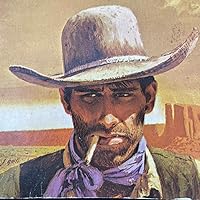
Raisin' Hell is a profitable crop!” said the man with the shotgun‚ and Templar was beginning to believe him. The sheriff offered Templar $50 a week; the saloon owner offered him $75. Templar had gotten drunk‚ and laid out almost every able–bodied man in town. But there was one more offer to come. A very rich man would pay him $5‚000 for one month's service as a bodyguard. When Templar gasped at the price‚ the rich man looked at him earnestly and said‚ “I live in constant fear of murder.”
Frederick Schiller Faust (see also Frederick Faust), aka Frank Austin, George Owen Baxter, Walter C. Butler, George Challis, Evin Evan, Evan Evans, Frederick Faust, John Frederick, Frederick Frost, David Manning, Peter Henry Morland, Lee Bolt, Peter Dawson, Martin Dexter, Dennis Lawson, M.B., Hugh Owen, Nicholas Silver
Max Brand, one of America's most popular and prolific novelists and author of such enduring works as Destry Rides Again and the Doctor Kildare stories, died on the Italian front in 1944.
"The old man begins to give me a chill," confided Templar. "Old men always do," replied O'Shay. "It's either what they know or what they don't know that gives folks a terrible shock."
A 1928 entry from "the King of Action Westerns" Max Brand, "Mystery Ranch" begins with our protagonist John Templar raising heck and beating up everybody in Last Luck's three saloons. He finds himself waking up in jail and being offered a bouncer position by the town sheriff and the saloon owners who figure this monster brawler might be a good peacekeeper in their establishments. Instead, he decides to work as a bodyguard for a rich man who lives on the outskirts of town because the guy thinks he's going to be murdered.
The setting is early-1900's instead of the usual "old west" so Last Luck and the rich guy's mansion are generational mashups where there are cars, street lights, office buildings and other more modern sensibilities but also its old cowboys, whisky drinkers, Chinese cooks and trouble-makers living in the past.
This one is actually more of a psychological mystery than an action western. We only see the mystery through the eyes of the protagonist Templar as he tries to figure out which of the characters in his charge's orbit might be threats to him, while also puzzling over the mysterious behavior of the rich man himself. The back half turns into a manhunt and there's a surprise at the end.
One important thing I have to note for "Mystery Ranch" is that it has two specific racial terms that today are considered quite offensive and are used very often in the book; they are mostly used in appropriate context for its writing date of 1928, meaning, via dialogue that ignorant rubes are saying to each other, so Brand isn't making use of them beyond showing his characters' opinions, but they are used so often that even I was a little queasy. A Chinese character is referred to as a ch--- so many times it just kills the read.
Verdict: A ho-hum mystery set in the post-civilized old west but I'm not kidding when I say the sheer volume of use of the Chinese slur just made me feel bad and wish I hadn't picked it up. Back in 1928 it might have been an okay adventure but today I find it a victim of its time and not a worthwhile read. If you would like a good Max Brand novel, please find "Ronicky Doone's Treasure" (review #295).
Jeff's Rating: 1 / 5 (Bad) movie rating if made into a movie: PG-13
Mystery Ranch was written in 1928. The words spellings and meanings have changed since then. The manner of speech has changed. All these contribute to making the reading slower than normal for me. I did enjoy the book, and found it fascinating how the insights to human nature is portrayed. I did not guess the villain.