Book of insightful black-and-white sketches and illustrations of London by Scharf that fill the time gap between Hogarth, Rowlandson, and their contemporaries, and the era for photography and pictorial journalism. Scharf’s realistic portrayal of London brings to life one of the most fascinating periods of the Capital’s history. Hard cover published by John Murray Publishers Ltd., 1987, 154 pages 8" x 10 ½”; First Edition, First Printing.
I discovered George Scharf through @D_Profundis (Dr Greg Roberts) who tweets Scharf's delightful drawings and watercolours on Twitter. As a result, I have already this year bought 6 (six) copies of this book to spread the love among my friends, family & foes.
I've been trying to find contemporary Regency sources that will take me behind the sanitised version of London that Heyer purveyed, and to illustrate the details Jane Austen takes for granted and omits. From a purely research point of view, Scharf is invaluable and Peter Jackson's book supplements the sketches (mainly in b&w) with useful background information both on the period and on Scharf himself.
Scharf, a Bavarian artist who accidentally joined the British army as a baggage lieutenant in time for Waterloo, came to London in 1816 and established hinself a niche as an illustrator of ordinary life. Most of his sketches are of London streets: he was fascinated by the varied forms of street architecture, and the quirkiness of life at street level. Scharf captures the colour and arrogance of gentlemen waiting for a stagecoach, and the misery of a street musician dragging his children round in the rain. He responds to the majesty of the new British Museum by focusing on stone masons clustered with their mallets round a column, or the surrealism of giraffes sneering at visitors mounting the grand staircase. He enjoys the packed life of Covent Garden market, and draws studies of removal wagons heavy laden with the teetering mass of assorted household furniture. The street he lived in (St Martin's Lane) he drew frequently–at least, until it was demolished to make way for Trafalgar Square. Then he sketched the process of demolition.
Here are a couple of Scharf's enchanting drawings so you can see why I'm so smitten.
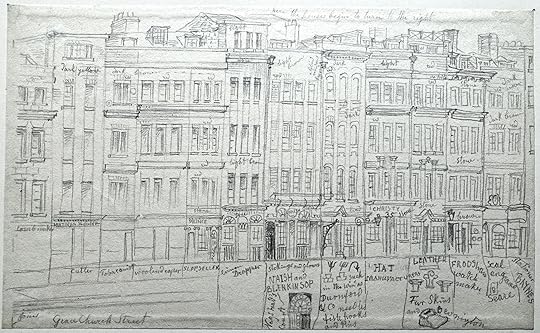
The first is of Gracechurch Street–where the Gardiners live, in Pride & Prejudice. (Larger scale version here.) Look at the height of the buildings (and their variation), and the range of shops underneath: a watchmaker, leather goods, a slop seller. Mr Bingley's sisters visited Jane in Gracechurch St and were, you may remember, not amused.
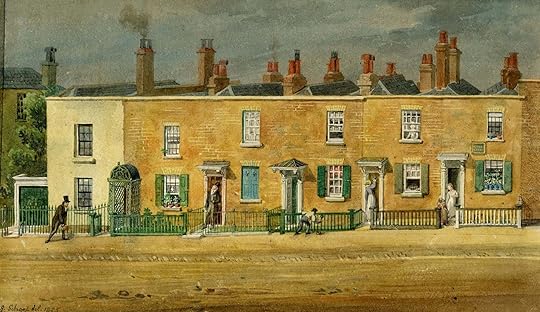
The second is of an undistinguished row of houses in Woolwich. (Larger scale version here.) Look, though, at how Scharf makes the most of the little differences in the porches and brings the whole scene to life from pot plants, to the gentleman worrying whether it's going to rain, and the poor chap with sore feet schlepping up the street.