

What do you think?
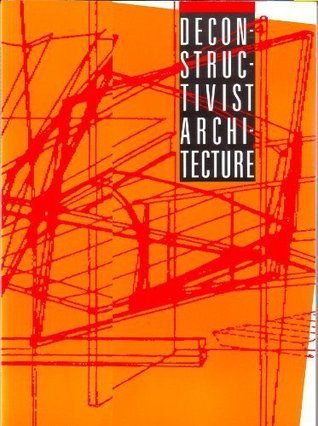
Deconstructivist Architecture
Rear cover "This book presents a radical architecture, exemplified by the recent work of seven architects. Illustrated are projects for Santa Monica, Berlin, Rotterdam, Frankfurt, Hong Kong, Paris, Hamburg, and Vienna, by Frank O. Gehry, Daniel Libeskind, Rem Koolhaas, Peter Eisenman, Zaha M. Hadid, Bernard Tschumi, and the firm of Coop Himmelblau. 104 pages, 153 illustrations."
- GenresArchitecture
Paperback
First published November 1, 1988
About the author
Philip Johnson
225 books7 followersPhilip Cortelyou Johnson (July 8, 1906 – January 25, 2005) was an influential American architect.
In 1930, he founded the Department of Architecture and Design at the Museum of Modern Art in New York City. In 1978 he was awarded an American Institute of Architects Gold Medal and in 1979 the first Pritzker Architecture Prize. He was a student at the Harvard Graduate School of Design. Johnson was gay, and has been called "the best-known openly gay architect in America." In 1961 he was elected into the National Academy of Design as an Associate member and became a full Academician in 1963.
In 1930, he founded the Department of Architecture and Design at the Museum of Modern Art in New York City. In 1978 he was awarded an American Institute of Architects Gold Medal and in 1979 the first Pritzker Architecture Prize. He was a student at the Harvard Graduate School of Design. Johnson was gay, and has been called "the best-known openly gay architect in America." In 1961 he was elected into the National Academy of Design as an Associate member and became a full Academician in 1963.
Ratings & Reviews
Friends & Following
Create a free account to discover what your friends think of this book!
Community Reviews
Displaying 1 - 5 of 5 reviews
December 4, 2022
I found the discourse about ball-bearing and Spring House very interesting. From my point of view, self-aligning ball bearings did not seem that innovative to me. Yet, this is because we have normalized it and from today’s point of view it is not something unique, although it was very astonishing back then. The spring house on the other hand was stunning because of its mediocrity. I found it absolutely beautiful just because vernacular architecture respects the local landscape and materials in a way that doesn’t disrupt the environment. Furthermore, I believe that the spring house really challenges the idea of form and proves that anything can be architecture and anyone can build a house. I loved the way Johnson described the relationship between the two: “The sphere is pure; jagged planks make up a deformed space. The contrast is between perfection and violated perfection.” (Johnson, 8). I especially loved the term “Violated perfection”. It does seem like deconstructivism is escaping perfection, in a way, it is in fear of perfection. For deconstructivists, perfection is a failure.
I do agree that deconstructivism rarely prioritizes function over anything else, Frank House (House VI) by Eisenman is an example of it. Yet, I do think that this is the beauty of deconstructivism: It brings architecture much closer to art than anything before. The form, shape, and aesthetics are prioritized and then there is function. I found Wigley’s comment very interesting: “Instead of form following function, function follows deformation.” (Wigley, 19) Once there is a shape, only then they can mold function into it, which takes a huge trust and understanding of the complexity of a building.
An amazing work, written by Philip Johnson himself, offering a great insight into deconstructionist Architecture! Here are some quotes that I bookmarked:
“The projects in this exhibition mark a different sensibility, one in which the dream of pure form has been disturbed. Form has become contaminated. The dream has become a kind of nightmare.” (10)
“Rather, the instability of the pre-revolutionary work had never been proposed as a structural possibility.” (15)
“Instead, deconstructivist architecture disturbs figures from within.” (16)
“It is as if some kind of parasite has infected the form and distorted it from the inside” (17)
I do agree that deconstructivism rarely prioritizes function over anything else, Frank House (House VI) by Eisenman is an example of it. Yet, I do think that this is the beauty of deconstructivism: It brings architecture much closer to art than anything before. The form, shape, and aesthetics are prioritized and then there is function. I found Wigley’s comment very interesting: “Instead of form following function, function follows deformation.” (Wigley, 19) Once there is a shape, only then they can mold function into it, which takes a huge trust and understanding of the complexity of a building.
An amazing work, written by Philip Johnson himself, offering a great insight into deconstructionist Architecture! Here are some quotes that I bookmarked:
“The projects in this exhibition mark a different sensibility, one in which the dream of pure form has been disturbed. Form has become contaminated. The dream has become a kind of nightmare.” (10)
“Rather, the instability of the pre-revolutionary work had never been proposed as a structural possibility.” (15)
“Instead, deconstructivist architecture disturbs figures from within.” (16)
“It is as if some kind of parasite has infected the form and distorted it from the inside” (17)

June 2, 2022
Although a bit repetitive at times and essentially a single-perspective-reading, Mark Wigley (the predominant author of this work and co-curator of the exhibition this book catalogues) gives a clear overview of his interpretation of the 'style' and the seven architects and their projects. Particularly evocative are his descriptions of Gehry's house in California and Coop Himmelblau's 'parasitic' extension to a Vienna roofline.

September 29, 2025
"Los modernos argumentan que la forma seguía a la función; en la arquitectura deconstructivista, las formas son alteradas primero y solo entonces dotadas de un programa funcional"
La forma no sigue a la función sino que la función a la deformación.
La forma no sigue a la función sino que la función a la deformación.

May 22, 2022
challenging architecture

Read
July 9, 2025now I just need to write the 20-page research work on this.
Displaying 1 - 5 of 5 reviews