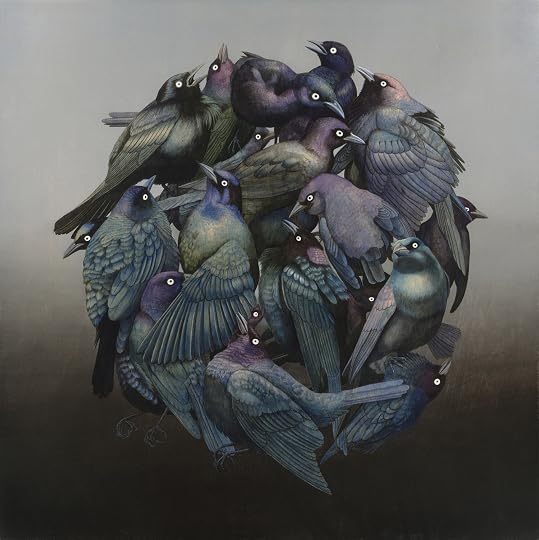
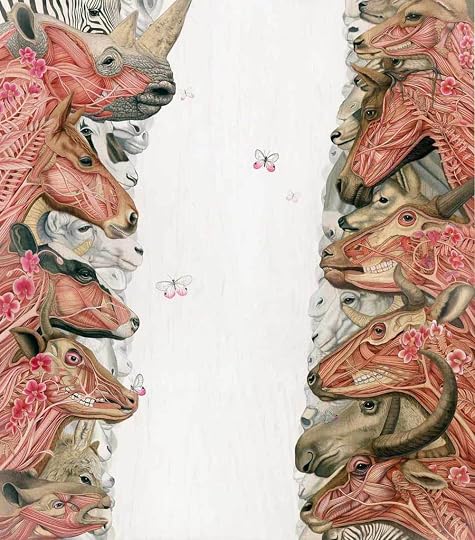
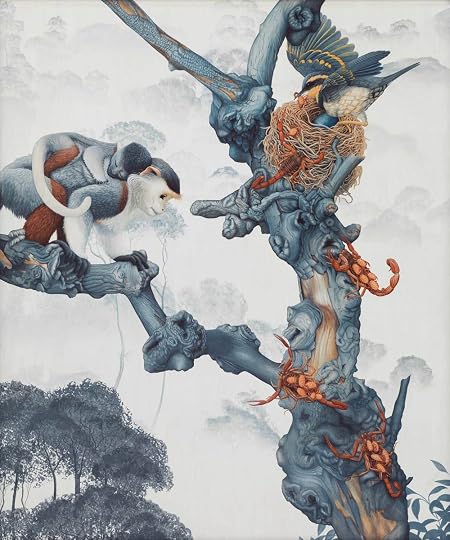
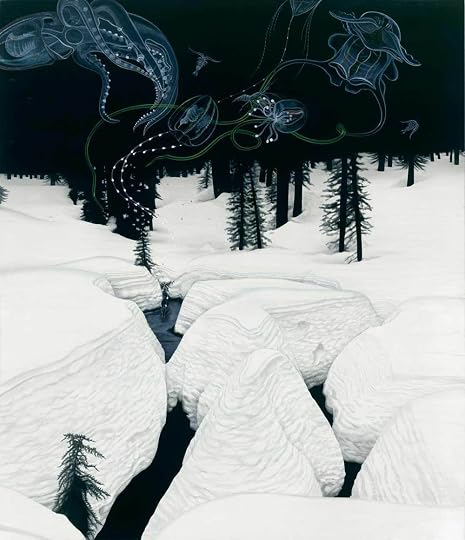
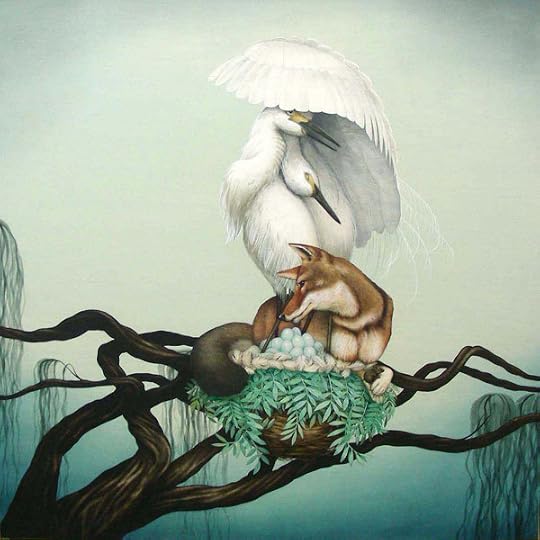
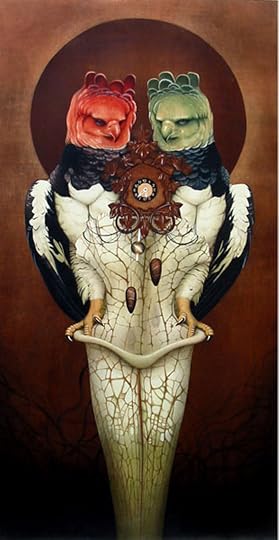
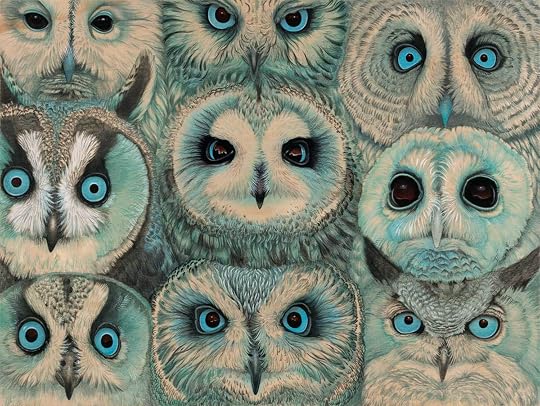
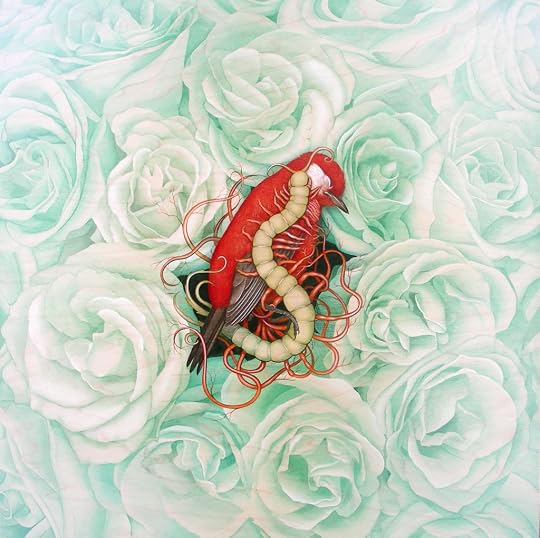
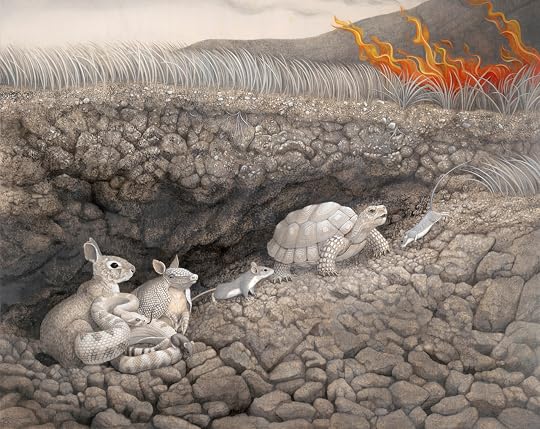
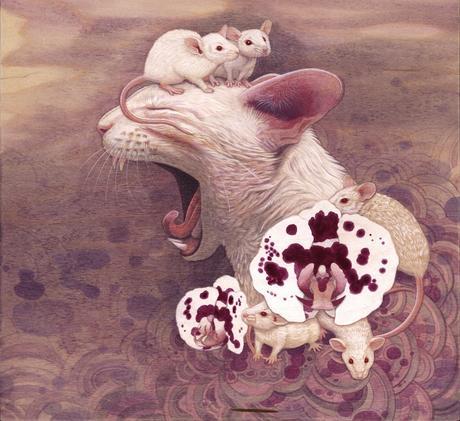
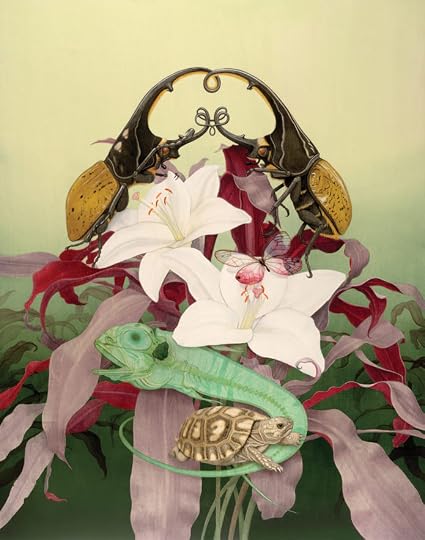
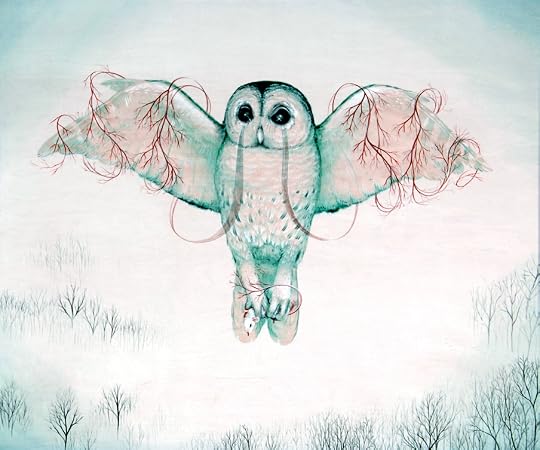
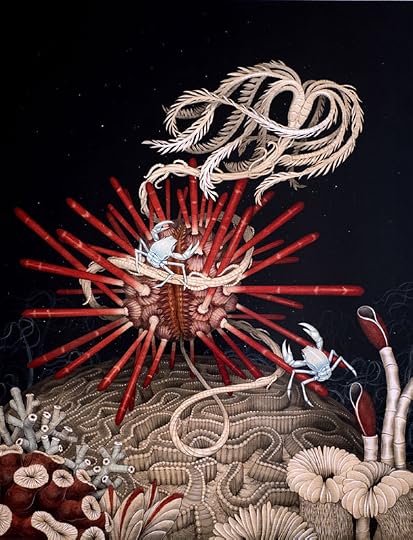
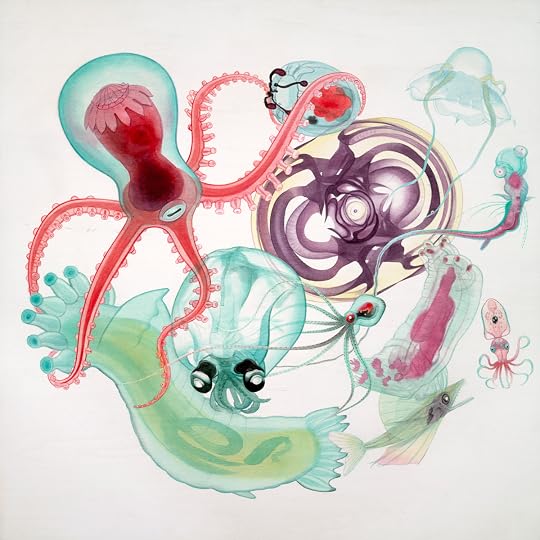
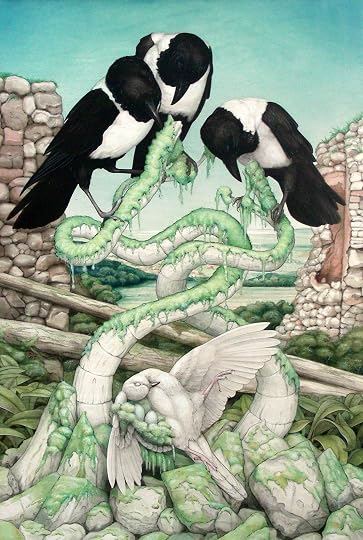
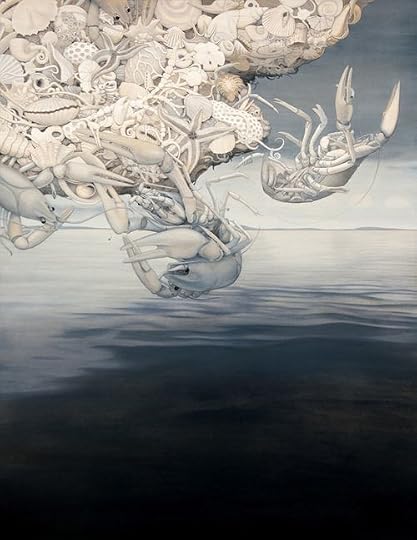
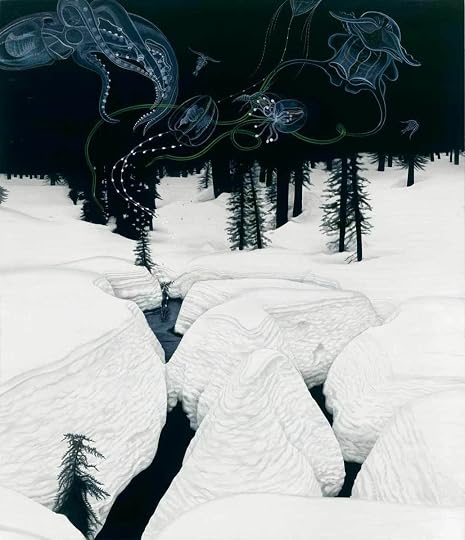
Coming off her highly anticipated show at the Joshua Liner Gallery in New York City, we are proud to announce a long overdue monograph on this highly gifted artist. As a result of her rural upbringing in Arkansas, she inherited a closeness to the natural world, a lifelong imprint that informs her work. Her patron saints, John James Audubon and Ernst Haeckel, provide the artistic inspiration and painstaking attention to details of morphology whether real, or imagined. There are fascinating discoveries to be made in her work, from new species of nudibranchs to unexpected life forms that blur the lines of flora and fauna. We also discern flashpoints through unlikely pairings, perceptions of danger in tranquil settings a commentary on the fragility of life? Whatever the intent, there is a mesmerizing dialogue at work, encompassing both inner and outer worlds. Questions are posed and meticulously explored, and perhaps in the process, we get a little closer to the answers. Take a glimpse into hidden worlds where the mysteries of life still abound!
Everyone wants something from an artist, even if they don't give a shit about art. When they examine a painting, they're looking for something they want to see -- in whole or in part -- or even something to provide reasons for hating and dismissing it. They wouldn't know how to describe this something, and most are hoping to be shown the beautiful new something they'll instantly recognize as what they've been waiting for, the transcendental mystery always just beyond the periphery. For me, it's simple. I want the artist to: [A] break open their sleeping head and spill their dreams onto the canvas, or to [B] consciously recreate on canvas something amazing that only they can see. I don't need a photo-realistic landscape. I have a digital camera for that shit. The world transformed by human imagination, in ways that can't be replicated in other media, is as reliable a way of understanding the human mystery as any I know of. As Denis Johnson expressed it (all my quotes are eco-friendly -- I recycle):
“And therefore I looked down into the great pity of a person’s life on this earth. I don’t mean that we all end up dead, that’s not the great pity. I mean that he couldn’t tell me what he was dreaming, and I couldn’t tell him what was real.”
I'm looking for fragments of dream and nightmare, and painting has long proven to be one of the artforms best-suited for this ephemeral genus of psychological translation. From Bosch and Bruegel and Arcimboldo, to the Symbolists and Neue Sachlichkeit and Surrealism, dreams have been the creative engine of oil-on-canvas artistry. Tiffany Bozic has shown us the fantastical menagerie housed in her mind, and it's better than any zoo, or circus, or safari expedition.
Accompanying her biologist husband on his trips to study exotic creatures in their natural habitat, Bozic has developed a fascination with flora and fauna. These are the creatures that inhabit the menagerie of her subconscious, moving from memory to canvas with the graceful draughtsmanship and scrupulous detail of early pioneers like Arthur Bartholomew. Like Walton Ford and her closest peer, Josh Keyes, these faithful representations become something more. Ford incorporates unreal depictions, but his art isn't surreal... he uses a symbolic lexicon of his own devising to tell stories that profoundly resonate. Unlike Ford, Bozic does use elements of dream and nightmare, surrealist and symbolist compositions that possess a cool acceptance of the grim realities of the natural world. As unlikely and fantastic scenarios converge, we see through her clear-eyed windows the beauty in predation and decay. While in Ford's work Audubon is the primary Naturalist source, Bozic is obviously drawn to the work of Ernst Haeckel, whose engraved and lithographic prints are unlike anything that came before them.
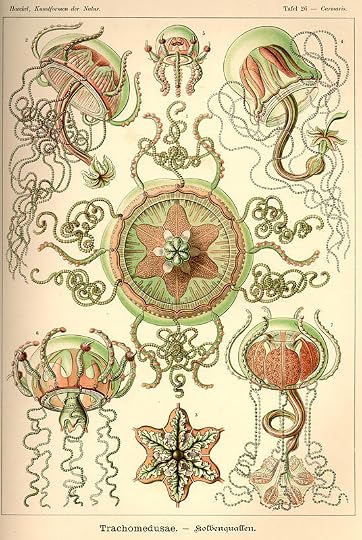
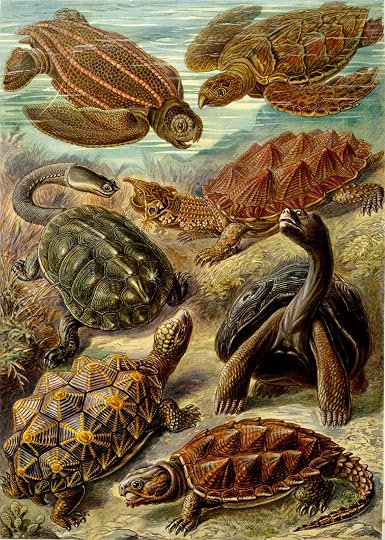
Prints by Ernst Haeckel; Bozic shows a deep admiration for Haeckel's work. Using fictional groupings to help illustrate evolutionary similarities and variations was not scientifically valid; but it helped Haeckel -- one of Darwin's earlier allies -- to get attention, by appealing to the same faulty and over-rated agency that Darwin's detractors did -- 'common sense'.
A 19th Century polymath, Haeckel's studies on sea life and groundbreaking papers on evolutionary biology were the results of an accomplished scientist, and not a passionate amateur. But it was his approach to scientific artwork that he's best remembered for, using symmetrical and geometric compositions to more clearly illustrate morphological commonalities. His artistic gifts may have been applied as scientific tools first and foremost, but his influence on art history is beyond reckoning; as unlikely as it may seen, he was integral to the development of Art Nouveau, which borrowed his symmetry, intricacy, and even specific subjects like medusa jellyfish. Tiffany Bozic has borrowed these innovations for herself, to great effect.
Tiffany doesn't seem to be working within the guidelines of Andre Masson's Surrealist manifesto, but I'm not gonna call her Art teacher and rat her off about it. Has there ever been a manifesto that wouldn't have served the human race immeasurably better as toilet paper? And I can't think of anything that requires a fucking mission-statement-rule-book less than an art 'movement' based on capturing spontaneous creativity, straight from the subconscious tap.
The Surrealist manifesto didn't originate because Dali and Ernst were running around in circles like headless chickens, beseeching the Lord of contradictions to slap numbers on a bunch of bullshit laws, so they might have something to chain themselves to. Masson created it as a publicity stunt. At that time and place, the public perception of 'manifesto' was associated with dangerous and cool radicalism, socialism being the big one. It gave Surrealism a pseudo-political connection, a feel of historical inevitability. This was no doubt based on Masson's admiration for the Futurist poets and painters of pre-WWI Italy, despite the unfortunate connections to fascism that would come later.
But Masson was selling Surrealism short. It goes beyond the transitory nature of politics, and speaks to our most ancient wants and fears. Tiffany Bozic has been claimed by the artistic subculture known by several unsatisfying titles, 'Pop Surrealism' being the most common. Freed from the formal associations of Surrealism, Bozic combines a dream-inspired approach with the calculated scientific eye of the Natural History tradition. Her art has much in common with other contemporary artists Alexis Rockman and Gilles Aillaud.
Tiffany Bozic's 'Drawn by Instinct' is flawlessly designed and produced, and as a young artist's midcareer retrospective, her prolific output is all the more impressive for her perfectionist tendencies and attention to detail.