Jump to ratings and reviews
Rate this book

REI: 50 Years of Climbing Together

Rate this book
Founded in 1938, this is the complete history of the first 50 years of REI, Recreational Equipment, Inc. Known worldwide for its quality sporting goods, this company actually was catapulted into existence by the birth of recreational climbing into mainstream society. Filled with company history, as well as a history of climbing and other sports, this book is an extremely interesting read for any sports enthusiast or REI member.

Written by Harvey Manning, a noted author of hiking guides and climbing textbooks, as well as an early member of the community that gestated REI.

200 pages, Paperback

First published January 1, 1988

1 person is currently reading
6 people want to read

About the author

Harvey Manning

66 books1 follower
Harvey Manning was a noted author of hiking guides and climbing textbooks, and a tireless hiking advocate. Manning lived on Cougar Mountain, within the city limits of Bellevue, Washington, calling his home the "200 meter hut". His book Walking the Beach to Bellingham is an autobiography and manifesto fleshing out his journal of a hike along the shore of Puget Sound over a two year span.


-Wikipedia

Ratings & Reviews

What do you think?
Rate this book

Friends & Following

Create a free account to discover what your friends think of this book!

Community Reviews

5 stars
1 (12%)
4 stars
3 (37%)
3 stars
4 (50%)
2 stars
0 (0%)
1 star
0 (0%)
Displaying 1 of 1 review
Profile Image for Richard.
1,189 reviews1,147 followers
September 11, 2022
Recreational Equipment, Incorporated (better known as “R-E-I” to many, although I’ve heard plenty pronounce it as “ree-ah”) is the U.S.A.’s biggest purveyor of… well, that’s a bit difficult.

I’ve been a backpacker for a very, very long time, and I always though it was the biggest retailer of outdoor stuff. Then I learned that if you toss in sports (golf, tennis, baseball) or hunting, or the use of a backyard barbecue, or just clothes that look outdoorsy, there are plenty of contenders for the top spot.

But trust me on this: REI has a unique place in the hearts of those who like to peaceably go into the wilderness. I know that it, as well as the generic category of ‘hardware store’ were the only businesses I sincerely enjoyed wandering through, just browsing.

I think there are two big reasons for that.

First, they’re in the business of getting their customers outdoors, and if you haven’t discovered all the scientific evidence that tells us that’s good for our bodies, minds, and souls, then you haven’t been paying attention. Shopping in most places has a bitter edge: it’s too easy to be persuaded to spend money on something that is not really good for you (at best).

Second, being a consumer in this age can make a person queasy. Which mega-billionaire or gang of self-centered corporate suits are we handing money over too? Doesn’t it always feel like they’re just going to use our spending to further entrench their power? Well, REI is a co-op, owned by its customers. So very few worries about toxic capitalism. (See more on this here: California Center for Cooperative Development. Most of the company’s profits go back to those customers who become owners (“members”, going back to the era where it really was more of a social clique). Much of the rest goes to the kind of socially benevolent non-profits that the typical REI member-owner would approve of. Yeah, it trends distinctly liberal in political valence.

REI came into being in 1938 when a bunch of mountain climbers in Seattle wanted to buy a bunch of tools — ice axes being the crucial instrument — and banded together to make on big purchase. That turned out to be a good idea, and the co-op slowly but steadily gathered steam.

Here are some pictures of the kind of early devices the co-op sold (from The Mountaineers archive):

An alpenstock was the less-expensive cousin of the ice axe. Easier to make, not as capable. Kind of like a hiking staff with a sharp, heavy spike to blast into the ice.

159cm, wood, octagonal shaft, fragile leather strap
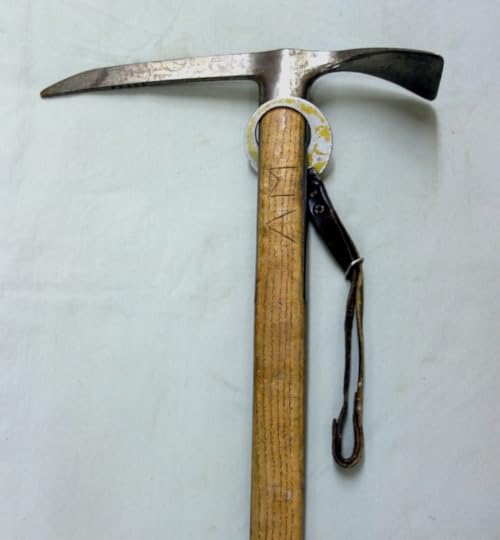
The ice axe is still used in roughly the same shape today. The pointy spike is known as the pick, with the chisel-like adze on the back side. There’s a leash so the user doesn’t accidentally let go when things suddenly become scary.

90cm, wood shaft, Fritsch brand (Zurich), “AM” inscribed on shaft, glide ring with leather strap.
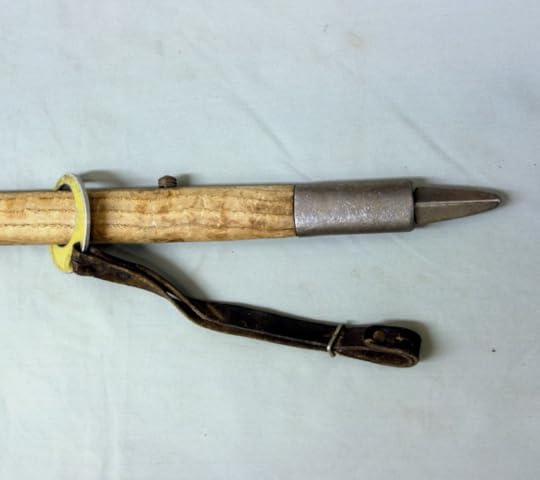
At the other end is the spike, which let’s the tool be used as a walking stick (albeit a short one) on less dangerous slopes.

Ice axe, 90cm, wood shaft, Fritsch brand (Zurich), spike has diamond cross-section.


REI started mostly with ice and rock climbing. The vast majority of this book tells the story of those years, when the co-op was still small and mostly confined to the northwest corner of Washington state. (Although once they did mail-order sales, surprising pockets of fanatics sprung up elsewhere, much to the surprise of the parochial locals.)

After World War II ended, Americans quickly had more money and time, and camping and skiing got bigger. I’ve got pictures of my parents wearing the ski gear of the 1950s, and I quickly recognized what the author was referring to when he notes that those tight black lycra ski pants were often considered scandalous.

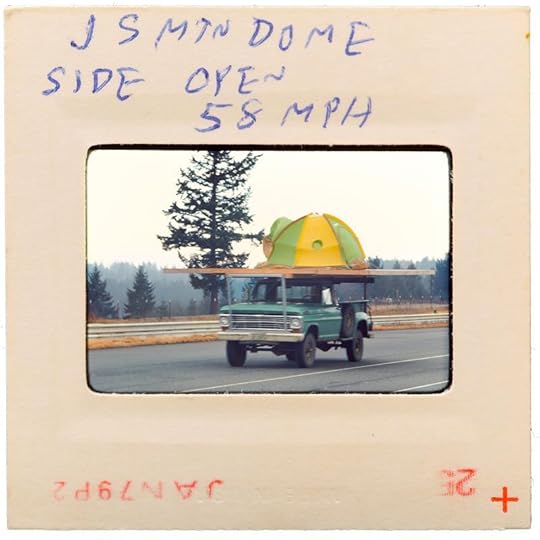
Backpacking exploded in the 1970s, and REI was on top of it. I started backpacking about then, although I wasn’t buying my own gear until later. I remember a lot of what the illustrations show. I’m astonished at how bulky, heavy, and primitive my gear was back then. How did we survive? Here’s a photo of a new-fangled JanSport Mountain Dome tent being wind-tested. I remember when that style was revolutionary!


This book was published at REI’s 50th anniversary, almost three dozen years ago. That does somewhat limit its appeal, although I suspect things haven’t been quite as exciting for that time.

It’s also pretty hard to find a copy. I can imagine dedicated REI customers enjoying knowing the history of their favorite store — even more so for REI employees.

But I think most of the fun as a history book, explaining how these forms of recreation evolved from the retail side, and that’s how I’d recommend it, especially for those curious about the heritage of mountain climbing. Coincidentally I read not too long ago a quite different book that came at that from a different angle, and I think that’s the better book to read first.

Of Men and Mountains is by William O. Douglas and tells of the incredible adventures he had as a young man in the mountains of Washington, although he was roughly a generation older than the protagonists of this REI saga. Oh, you don’t recognize the name? Douglas remains the longest-serving Justice of the United States Supreme Court. He really was a mountain man and photo-environmentalist, writing a famous dissent in Sierra Club v. Morton that natural resources should have standing before the law to protect themselves.

It’s fascinating to see how the wild west of the Washington mountains was gestating these effects simultaneously.
Displaying 1 of 1 review

Can't find what you're looking for?

Get help and learn more about the design.