The Italian Renaissance was an unparalleled era of creativity, particularly in the field of painting. Building on the achievements of artists such as Giotto in the fourteenth century and Masacio and Donatello in the fifteenth centuries, and culminating in the careers of the undisputed geniuses Leonardo de Vinci, Michelangelo, Raphael and Titian, the period witnessed the rediscovery of naturalistic techniques in art and new interest in portraiture, landscapes and themes from classical mythology. This imaginative richness produced some of the most enduring images in all art history, many of which are reproduced here in a perfect introduction to a unique age.
Art historian Sara Elliott has produced a lively and wide-ranging account of this great era of Western civilization, including extensive captions to each colour plate and many invaluable comparative illustrations.
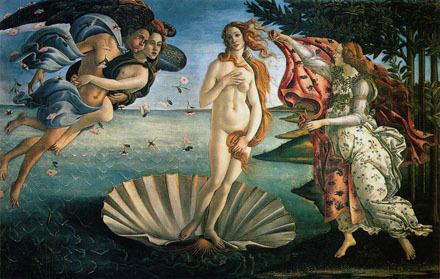
Slight -- the comments are not uninteresting (albeit very brief), but the scholarship cannot be trusted. In commenting on Botticelli's Birth of Venus, e.g., the author gives an account of what Hesiod had 'said' about this event that is a complete invention (cp. Hes. Theog. 188-206). It would not have been so hard to look it up.
The sine qua non of publishing sound scholarly work is that EVERYTHING be checked, every reference, every dot... not once, but thrice.
Et flot udvalg af den italienske renæssances store maleres væsentligste værker er her gengivet i helsidesfarvefremstillinger, der giver rig mulighed for at studere både detaljer og komposition hos Michelangelo, Bellini, Botticelli, Rafael, Leonardo mv. Billederne er fint grupperet efter tid og motiv,
De ledsagende tekster er til gengæld ufuldkomne og bidrager sjældent med nogle givende analyser. Især en af dem er iøvrigt grotesk tykfobisk. Derudover er det sindsygt fucking irriterende at de ledsagende tekster til værkerne er samlet i starten af bogen, fordi det kræver af læseren, at denne konstant bladrer frem og tilbage mellem værket og introduktionen til dette???
When talking about the Renaissance, looking at art is important but finding a book without nudity is impossible as the painters in the Renaissance were fascinated with the human body. This book has very little nudity and each page is devoted to one full page painting with text on the opposing page explaining the picture. The Mona Lisa is included in this book. Good for home schoolers discussion of the time period. The Phaidon book I looked at was by Sara Elliot with a publication date that matches the one I selected on Goodreads.
Italian Renaissance Painting: Colour Library by Sara Elliott (Phaidon Press 1993)(759+/-). This is a beautiful coffee-table sized collection of color plates of the works of the Italian masters of the Renaissance. My rating: 7.5, finished 7/14.