

What do you think?
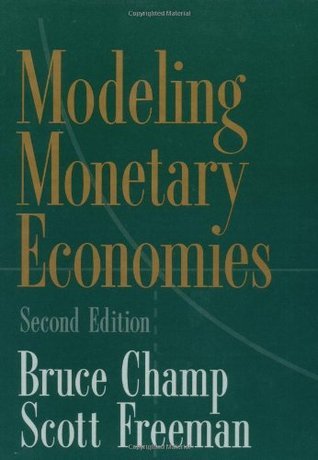
Modeling Monetary Economies
The approach of this text for upper-level undergraduates is to teach monetary economics using the classical paradigm of rational agents in a market setting. By teaching from first principles, the authors aim to instruct students not only in the monetary policies and institutions that exist today in the United States but also in what policies and institutions may or should exist tomorrow and elsewhere. The text builds on a simple, clear monetary model and applies this framework consistently to a wide variety of monetary questions. The authors have added in this second edition new material on speculative attacks on currencies, social security, currency boards, central banking alternatives, the payments system, and the Lucas model of price surprises. Discussions of many topics have been extended, presentations of data greatly expanded, and new exercises added.
344 pages, Paperback
First published January 1, 1993
Ratings & Reviews
Friends & Following
Create a free account to discover what your friends think of this book!
Community Reviews
Displaying 1 - 3 of 3 reviews
April 7, 2013
Dry read but very clear explanation of macroeconomics concepts

July 23, 2023
I read this book as a source for an Advanced Macroeconomics lecture.
First half, clearly explains the OLG model an different scenarios resulting to inflation & deflation, including population, monetary base, etc.
First half, clearly explains the OLG model an different scenarios resulting to inflation & deflation, including population, monetary base, etc.

February 6, 2016
Reasonable treatment of monetary economics in a textbook way that could be used to accompany a course. Each chapter develops an idea about monetary economics and presents a model that can illustrate the point. The core model, however, is an overlapping generations model which is no longer the state-of-the-art nowadays. In fact, there is now a general perception that it is not overlapping generations that explain the need for money, with models of double-coincidence-of-wants taking the lead.
Generally, I would say this is an interesting book for an undergraduate level, but if you want to understand more about monetary economics, you will have to proceed to other kinds of models. Specifically, I would advise you to read about the Fiscal Theory of the Price Level which for me is really the most coherent theory around.
Generally, I would say this is an interesting book for an undergraduate level, but if you want to understand more about monetary economics, you will have to proceed to other kinds of models. Specifically, I would advise you to read about the Fiscal Theory of the Price Level which for me is really the most coherent theory around.
Displaying 1 - 3 of 3 reviews