

What do you think?

Yang Wan-li
Book by Schmidt, J.D.
Hardcover
First published December 31, 1976
Ratings & Reviews
Friends & Following
Create a free account to discover what your friends think of this book!
Community Reviews
Displaying 1 - 1 of 1 review

Read
December 13, 2015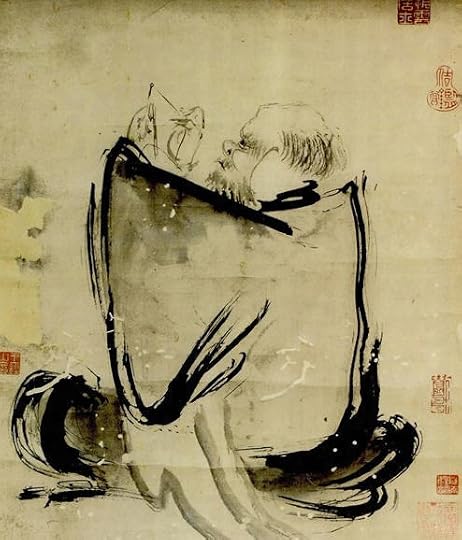
- Liang Kai (c. 1140 - c. 1210)
Light Rain
Lonely, depressed, speechless, I lean against my door;
Plum flowers, light rain, it's almost dusk.
What a shame the eaves' raindrops aren't open-minded;
Drip, drip, when did they ever leave their old rut?
Within a span of two years, just when the Jurchen Tartars were excising the northern heartland out of the Chinese nation, was born a trio of infants who were to become good friends and the finest poets of the early Southern Sung dynasty. Unlike Lu Yu (Lu You) and Fan Ch'eng-ta (Fan Chengda), Yang Wan-li (1127–1206) came into the world just south of the frontier between the Chinese and Jurchen that emerged from their initial three-year conflict. So his family didn't need to flee further south, but great battles were fought close to his home and the aftereffects were long sensed in the Yang family home.
Yang's family was counted among the scholar/literati class, but unlike his future friends, Yang's forebears were impoverished and working at the lowest levels of local government. Nonetheless, his family made the necessary sacrifices and he, too, passed the necessary exams to begin a career as scholar and official. Though Yang rose at times to more important positions, he, like the others, acquired a bad odor at the Sung court because he was openly critical of various emperors' poor decisions, and so he spent most of his career as an official in lower level posts.
He didn't seem to mind it much, probably because he came under the influence of Ch'an (Zen) Buddhism, which increasingly engaged his time and thought and which doesn't give a damn about worldly success. It also significantly influenced his poetics, not so much by determining the topics of his poems as by subtler means. Ch'an Buddhism is, among other things, iconoclastic and deeply distrustful of authorities and words. One could well think such a position is ill suited for a poet, but Yang wrote
Then what is poetry? Some say: "It is words and nothing else." I say that one who is good at poetry does away with words. "But then it is meaning and nothing else." I say that one who is good at poetry does away with meaning.
Like Ch'an Buddhism vis-à-vis the mysteries of the universe, Yang located his poetry beyond words and meaning in a realm of seldom subtlety. And he did so while using the simplest of language, even employing colloquialisms that shocked the arbiters of taste. But these were just one aspect of Yang's iconoclasm.
Until rather late in life Yang studied and copied prior masters, but early in 1178 that came to an end. Though there does not seem to be a report of the sudden religious enlightenment that is the goal of the practice of Ch'an, Yang did experience a similar moment of sudden insight in his poetics:
On New Year's Day of 1178, I started to write poetry, because I was on vacation and had no official business. Suddenly, I was as if enlightened (wu), and at that moment I took leave of the T'ang poets, of Wang An-shih and Ch'en Shih-tao, and of all the gentlemen of Kiangsi, no longer daring to imitate any of them. I was so overjoyed, I tried having my son hold the writing brush while I orally composed several poems, and they came gushing forth without any of the earlier grinding.
Henceforth, Yang's poems acquired a new style and ease, and they flowed forth at a rate...Well, in 1178 he wrote more poems than he had done in the previous eight years. This mature poetry employed paradox and surprise, focused on illusion and transformation, and turned the meanings of famous lines by the old masters on their heads. At least some of these poems have an effect on the reader that is not dissimilar from that of a koan.(*)
On the Night of the Twelfth of the Eighth Month I Gaze at the Moon From Sincere Study
Nearing mid-autumn, the moon is already pure;
A circle of ice, it hangs on a raven black curtain.
Suddenly I discover that tonight the moon
Isn't really glued to the sky; it moves entirely on its own!
It's impossible to give here a fully balanced discussion of the work of such a productive and wide-ranging poet, but surprise, incongruity and humor play an important role in Yang's post-epiphany poetry, and the next poem illustrates these well.
Spending the Night at the River-Port Pool Rock
At the third watch, no moon, the sky's really black;
A flash of lightning is followed by the roar of thunder.
Rain pierces the sky, falling on my boat-hut's roof;
A driving wind blows across, crooked, then straight.
The loose matting leaks, soaking my bedding;
The sound of waves beats my pillow, a paper's width away.
In the middle of dreams, I am startled awake and can't sleep.
Grabbing my clothes, I sit up straight and sigh over and over.
I have experienced every difficulty and hardship during my travels,
But in my whole life there's been nothing like tonight!
Lord Heaven scares me with his nasty jokes;
Without informing me, he gave me this surprise.
He may not be able to suddenly gather his wind or tidy his rain;
Yet can I now ask him for the east to get light?
I hang my head, draw in my legs, how narrow and confined!
When suddenly once more, on my head - drrippp !!!
In Yang Wan-li (1976) J.D. Schmidt has once again(**) brought the life, times and poetics of a major Sung dynasty poet within reach of the modern reader with empathy and insight and has provided sensitive and very effective translations of a fair number of poems. Would that there were more! But at least there are a few more books of this type from his hand for me to read.
(*) A few paradoxical lines used by Ch'an masters to throw their disciples' thinking out of its usual tracks in order to give them at least the possibility of seeing beyond the realm of habit. Please note that Sincere Study was the name of Fan's library.
(**) I've recently discussed his Stone Lake: The Poetry of Fan Chengda 1126 1193.
Displaying 1 - 1 of 1 review