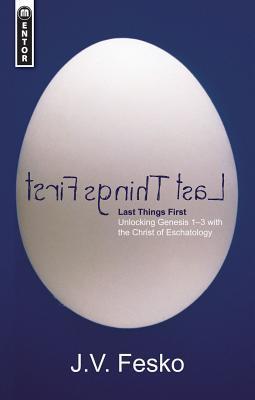
We think that we know the first three chapters of the Bible well - Creation and the Fall, we say, knowingly. But have we ever stopped to consider that Jesus in the book of Revelation is called 'the last Adam' and the 'Alpha & Omega'? Should this make a difference to how we look at the first three chapters of Genesis? Dr. John Fesko says that it does and that without seeing Christ and the end days, we cannot understand the first days. Over the controversies that surround these first three chapters he says 'there are many theologians who represent different schools of thought. Is there a better way to approach the opening chapters of Genesis in spite of the debate? The answer to that question is an unqualified, 'Yes'... The way through the impasse is to interpret Genesis in the manner presented in the New Testament. More specifically, one must interpret Genesis 1-3 in the light of Christ and Eschatology.' By doing this, John is able to explain this important portion of scripture from a holistic Christological viewpoint, one that is consistent throughout scripture. If you are tangled up on origins in Genesis then this may be your way through the maze.
J. V. Fesko graduated from the University of Aberdeen in Scotland, UK, with an earned Ph.D. in theology. Dr. Fesko's interests include systematic theology, applied soteriology (union with Christ, justification and sanctification, and the ordo salutis), sixteenth- and seventeenth-century Reformed dogmatics, as well as the integration of biblical and systematic theology. He was the pastor of Geneva Orthodox Presbyterian church from 1998 to 2009. He is now presently the Academic Dean and Professor of Systematic and Historical Theology at Westminster Seminary California. He is also an ordained minister in the Orthodox Presbyterian Church.
This is a refreshing and rewarding study of the opening three chapters of the Bible, which start threads weaving their way through the entire canon. Modern evangelicals can get so caught up in controversies about Genesis 1-3 that they can miss some of the most important features of the text, including key data about anthropology, christology, and especially eschatology. Though I think Fesko can be somewhat dismissive about modern concerns, he does point to an important reality about the stunted theological vision which plagues many churches today. This book is an important corrective to that in many respects, and is a good place to start for those interested in the biblical framework in which we can better understand Christ the Redeemer, the Second Adam. Moreover, it starts the conversation about eschatology in the very beginning, which is where it should begin, contrary to the "panmillennial" approach so common today. This is not so that we begin with a heated discussion about the various "isms", but so that we can center our framework about the end of man and the person and work of Christ. For, as Vos has taught us, eschatology precedes soteriology.
Probably the weakest part of the book was the discussion about the dominion mandate and Christ's work in fulfilling it. I thought Fesko dismissed Gentry's position too hastily and I believe that their positions are very similar if not identical. Moreover, there seemed to be a nature-grace dualism imposed on the doctrine.
In sum, a very important book to read, especially for those who want to further understand how Christ relates to Adam in a–if not thorough–close to full treatment.
This book has really good information concerning God's temple, the first and last Adam, God's redemptive plan beginning in the garden, and the consummation of that plan with the gospel of Jesus Christ. Fesko's work on Genesis was absolutely worth the price of the book. He also did a fantastic job comparing Eden, the tabernacle, and the temple. The only issue I had with the book is Fesko's treatment of the New Covenant (the covenant of grace). As a 1689 Baptist, I believe the covenant of works had different administrations (Noah, Abraham, Moses, and David), not the covenant of grace.
This is a fascinating examination of how the themes contained in Genesis 1-3 do not fall away as the redemptive story progresses, but actually continually show up and are ultimately fulfilled in the coming of Christ and our final eschatological hope of the new earth. The driving force behind Fesko’s thesis is that readers since the enlightenment have been thinking through the early chapters of the Bible as if they are scientific in nature. This has led many interpreters to completely miss the point:
“The reason for Genesis 1-3 was not to refute Charles Darwin and scientific evolutionary theory. On the contrary, it was intended to show the work of the first Adam, which is foundational to comprehending properly the work of the second Adam.” (p. 201).
By understanding more about how Adam, Eve, the garden, the covenant of works, the imago dei, and the Sabbath are all types of fuller Gospel meanings to come later in redemptive history, I was left again with the impression that such rich, comprehensive and harmonious detail could only have come about by the superintending work of the Spirit of God.
I greatly enjoyed interacting with this book. While there were many points of disagreement between me and the author, his major points were all on target and really helped to illuminate the relationship of Genesis 1-3 to the rest of Scripture, particularly to Christ as the second Adam. The section on the garden of Eden as the first temple was also very enlightening.
Eschatology has its roots in protology, which isn't really about science but rather the second Adam. The gospel must be spread in order to fulfill the dominion mandate, not by reproduction. Though ultimately acting as types and shadows of the second Adam, all of the agreements somehow allude to the first Adam's creation and labor. The creation story should be interpreted as the authors of the New Testament did.