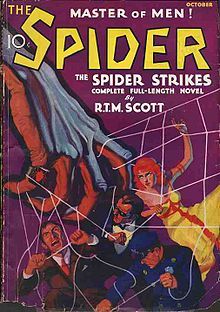
The Spider Strikes The issue that started it all 75 years ago! In this epic adventure, join Richard Wentworth III alias the Spider, along with his finace Nita van Sloan and his faithful servants, as they struggle to save the nation from a criminal genius. Introduced here is the secret of the Spider's seal, his many tricks and devices that serve in the stories to come! Satan's Workshop Was it science or sorcery that turned a healthy ordinary man overnight into... a leper of 10 years? Who is kidnapping the city's wealthy men and beautiful women, and extorting money from both? While police close in on the Spider's secret identity, the villainous 'DOC' seems immune from police prosecution... but not from the Spider!
Form of name used independently by two Canadian writers, father and son, both christened Reginald Thomas Maitland Scott, though the son was usually called Robert and sometimes wrote simply as Maitland Scott. Scott Senior (1882-1966) had been a much-travelled marine engineer and subsequent soldier during World War One, with the Canadian Expeditionary Force, before settling in the USA and turning to writing. His first story, "Such Bluff as Dreams Are Made Of" (April 1920 Adventure) introduced the character of Aurelius Smith, known as Secret Service Smith, who became Scott's best known character, appearing in many stories and novels, and served partly as the basis for the later creation of Richard Wentworth, the man behind the vigilante hero the Spider in a long series of novel-length stories published in The Spider pulp magazine. The first two Spider novels, "The Spider Strikes" (October 1933 Spider; 1969) and "The Wheel of Death" (November 1933 Spider; 1969) were credited to R T M Scott and have usually been assumed to have been written by the father. However there is sufficient difference between the two that it has been suggested by Will Murray and others that Scott Junior (1909-1945) might have written one of them, probably the second. Scott Senior was not a prolific writer and would have found it difficult to sustain the pace of a novel a month so his son, who had become an editor at Popular Publications which published The Spider, may have helped with the second novel before the character was handed over to pulpsmith Norvell W Page who wrote the novels under the House Name Grant Stockbridge. Whilst the first two novels create the character of Richard Wentworth and his ruthless crime-fighting alter-ego the Spider, neither revel in any of the more fantastic and eccentric plots that Page later created.
The Spider Strikes is the first pulp novel starring the Spider, whom I've long liked in the comic book medium (the recent IDW series, but also the crazy Tim Truman project in the 90s). Having gotten my hands on the Girasol "Pulp Doubles" reprint of the original 1933 story, I was keen to see how the R.T.M. Scott novel made out. As far as prose goes, the pulp style takes a few chapters to get used to. Scott seems to have an aversion to pronouns, so there's a fair bit of repetition, and either Girasol reproduced the story complete with typos, or they introduced new ones of their own. Nothing major though. The reproduction does have the original drawings, which aren't bad, and interestingly, an editor's note that mentions the publication asked the author to describe the Spider's CPR technique in full in case it might save lives some day. I don't think it replaces an actual CPR course, but it's a fun period detail. Once you get into it, the story moves at pretty fast clip, with lots of twists and turns and chances for the Spider - not yet a masked man, more like a suave Bruce Wayne who doesn't mind killing - to do detective work, get into fights, cleverly escape jail cells, and so on. I was struck at how well that all worked and that the 80 years separating me from the publication date didn't give me a sense of déjà vu throughout. The Spider's battle of wits with disguise artist Mr. X was full of surprises and I didn't feel like I'd seen it all before. My favorite character is very much Nita Van Sloan, an extremely competent "Girl Friday" who could have spun off into her own stories right then and there. I'm ready for more action of the kind!
While I'm glad Girasol has reprinted the old Spider stories (in this case, complete with illustrations), I do have questions about how they've been packaged as "doubles". In Pulp Doubles #9, we find the first ever story and then the 42nd, Satan's Workshop! The leap to that second story is kind of like watching Buckaroo Banzai for the first time - there's lots of continuity and the Spider keeps recruiting people as agents, creating more. Big serial vibes. As with the original story, my favorite character is Nita van Sloane who is ALSO recruiting her own agents (money talks in Spider stories) even if her role is to eventually become a damsel in distress, no matter how competent she initially appears. The pulpy threat of a "crime doctor" who uses his skills for evil deeds (juggling a lot of balls) provides an interesting mystery and some lurid chills.
Finished reading THE SPIDER STRIKES, the first of two Spider novels included in this pulp reprint. Spider Strikes was originally published in the first issue of the Spider magazine in October 1933.
The Spider, alias Richard Wentworth, is a vigilante who fights crime and takes vengeance on those deserving it. He appears to be independently wealthy and has a socialite girlfriend, Nita Van Sloan, who is aware of his secrets. Ram Singh, a Hindi, is Wentworth's loyal manservant and is a deadly knife thrower and usually carries several knives with him. In Spider Strikes, Wentworth is after a master criminal who is planning a super crime that is not revealed until late in the story. The criminal is also a master of disguise and is able to escape from Wentworth on several occasions. But in the end, the Spider triumphs as usually happens in pulp stories.
The story seemed a lot more violent that some other pulp novels I have read such as Doc Savage and The Shadow. Early in the story Wentworth kills a card shark who may have been a bad guy but not necessarily one worthy of killing! R.T.M. Scott wrote the first two Spider novels and then Norvell W. Page continued to write most of the subsequent stories under the house name Grant Stockbridge. I will probably read the second story, Satan's Workshop, by Page in this compilation at a later date but overall, I would only mildly recommend this.