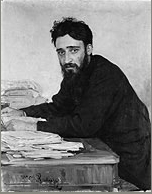
Eshleman is an American poet, translator, and editor.
Eshleman has been translating since the early 1960s. He and José Rubia Barcia jointly prepared The Complete Posthumous Poetry of César Vallejo (1978) and won the U.S. National Book Awardin category Translation. He has also translated books by Aimé Césaire (with Annette Smith), Pablo Neruda, Antonin Artaud, Vladimir Holan, Michel Deguy and Bernard Bador.
Eshleman founded and edited two of the most seminal and highly-regarded literary magazines of the period, Caterpillar and Sulfur.
Sometimes he is mentioned in the company of the "ethno-poeticists" associated with Jerome Rothenberg, including: Armand Schwerner, Rochelle Owens, Kenneth Irby, Robert Kelly, Jed Rasula, Gustaf Sobin, and John Taggart. He is now Professor Emeritus at Eastern Michigan University.
For Eshleman the neolithic cave paintings of southern France present a crucial moment--a fracture-- in the creation of our human consciousness :
"I envision a crisis that slowly came to a head over thousands of years in which hominid animality eroded, and at around 30,000 BC was separated out of the to-be-human heads and daubed, smeared, chipped, in nearly total dark, at times close to a mile underground, onto cave walls."
While reading this book, I also got hold of the documentary "Lascaux Revisited" directed by Jacques Willemont. Having only ever seen a few art history plates of these paintings, i was astonished by the MOVING(!) images of this art. As in this passage, Eshleman reminds us of the physical experience of viewing the caves:
" if one were to film one's postures through this entire process it might look like a St. Vitus dance of the stages of life of man, birth channel expulsion to old age, but without chronoligical order, a jumble of exaggerated and strained positions that correspondingly increase the image pressure in one's mind--
while in Le Tuc D'Audoubert i felt the broken horse rear in agony in the cave like stable of Picasso's Guernica, at times I wanted to leave my feet behind, or to continue headless in the dark, my stomach desired prawn-like legs with grippers, my organs were in the way, something inside of me wanted to be an armored worm, one feeler extending out of its head
I never thought I would say it: I found a Clayton Eshleman book that really didn't do much for me.
As usual, when Eshleman is on his game, he is very very on his game. Every once in a while, the book kicks out one of those poems that just makes you sit back and say "whoa." (Interestingly, these are far more common in the book's later poems.) The majority, however, do not do this; Eshleman seems to have temporarily forgotten that "show, don't tell" is not only a phrase, but a way of life.
Having read and enjoyed material from both before and after this book, I have to wonder whether this is simply an anomaly. For the Eshleman completist only. ** ½