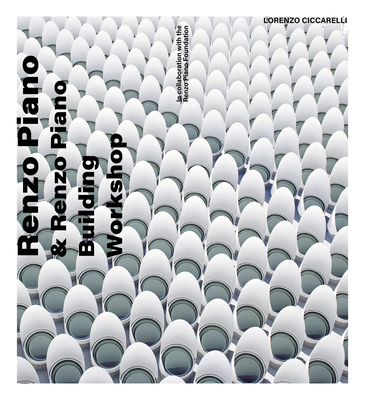
Renzo Piano is one of the world’s greatest living architects and creator of a host of iconic modern buildings, including the Pompidou in Paris, the Menil Collection in Texas, Kansai Airport in Japan, the Shard in London and the new Whitney Museum of American Art in New York.
Written and created in collaboration with the Piano Foundation in Genoa, this richly illustrated volume covers the early work as well as the most recent designs, making a complete survey of his career to date. Starting with his beginnings with the Pompidou Centre in the 1970s (in collaboration with Richard Rogers) the story continues up to construction of one of his latest works, a spectacular new bridge in Genoa in 2020.
The book explores all of the studio’s main the public spaces and museums, airports, theatres, and libraries. As well as giving unique insights into the creative process of Piano himself, the book includes numerous unpublished designs and photographs. In the process the book reveals Piano’s unique way of handling light and space, as well as his particular attention to the social implications of the profession of architect and the relationship of buildings to their urban environment and landscape.
Renzo Piano, Italian architect and winner of the Pritzker Prize, has designed The Shard in London, Paris' Centre Georges Pompidou, and a legion of other amazing works over his lifetime. This book is more than a coffee table book, and at times reads more like a textbook. The book includes some older pretty grainy pictures, as well as some stunning pictures, blueprints, line drawings, as well as a timeline of his works. Very informative.
Renzo Piano, by Lorenzo Ciccarelli, is both an attractive coffee table book as well as a deeply researched assessment of Piano's career. Don't let the quality of either one keep you from appreciating both aspects.
What came through for me was the way that architecture is very much a collaborative and community art form. Even when one person's vision is dominant, it still requires the input from other principals as well as the work of other craftspeople. I found Ciccarelli's decision to use a few of Piano's commissions to highlight the stages/phases of his career to be very useful. It can be distracting, when looking back at long illustrious careers, when every work is given space. This approach allows a deeper dive into a few key projects which emphasize the different periods of his work.
This will also be a nostalgic book for those who have visited some of these buildings. It took me back to the first time I saw the Pompidou Centre, I was visiting friends and we were going to see the Dali exhibit (1979, I think). The building was still fairly new and while I didn't know about the construction my friend was as excited to show me the building as he was to take in the exhibit. That was my introduction to Piano and the Rogers'.
Highly recommended for those with an interest in architecture as well as architectural/art history. As I mentioned, this is also a very attractive coffee table book that just happens to also reward a close reading.
Reviewed from a copy made available by the publisher via NetGalley.
This is a beautiful book filled with drawings and photos of the amazing buildings (and a car!) that Renzo Piano designed. From the Georges Pompidou center in Paris which I absolutely love in the middle of the Marais district with its whimsical fountains out front, to the Whitney in NYC - I could not get enough of these photos. I will definitely appreciate seeing these buildings again the next time I visit these cities. In the meantime, I have the Modern Wing at the Art Institute of Chicago which I go to a lot and enjoy the beauty of the light and space in his incredible design. I loved learning more about his story and the stories of the creation of many of his famous sites.
Thank you to Netgalley and Quarto Publishing Group – White Lion, for an ARC and I left this review voluntarily.
Lorenzo Ciccarelli offers a brilliantly told story starting from Renzo Piano’s “Prehistory” to the architect’s large-scale collaborations.
Chapter by chapter, we learn about the evolution of Piano and his practices. This book is a text that both architects and any enjoyer of art will find encapsulating.
Ciccarelli masterfully balances giving us an in-depth look at the artist at hand as well as the collage of collaborators on each project. A personal highlight has to be the author’s chapter on the Menil Collection. The text here is a worthy match to the museum.