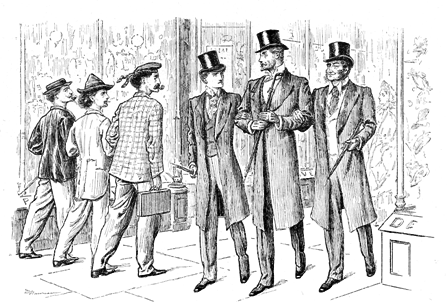
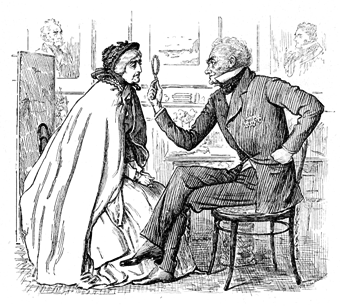
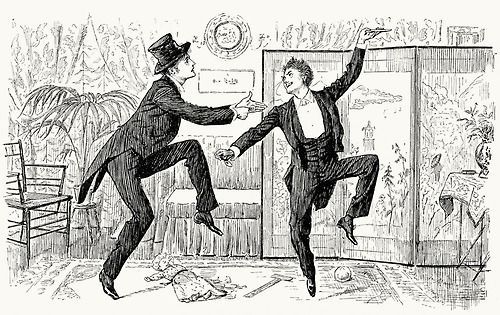
George Du Maurier's classic The Martian: A Novel, originally published in 1897, was one of the earlier science-fiction works. George Du Maurier, the grandfather of Daphne Du Maurier, was a celebrated novelist and illustrator whose work ran regularly in Punch. He's best recalled today for his famous novel Trilby, which introduced the evil manipulator Svengali to the world. This is a later novel, brilliantly embellished with dozens of Du Maurier's illustrations. H.G. Wells aside, this is perhaps the first work to feature a Martian, and came just before Wells enjoyed his success with the War of the Worlds (originally published in 1898).
Please do open this up and look at du Maurier's exuberant illustrations. They are The Martian's saving grace for, really, I can't imagine anyone could now read this with the seriousness du Maurier hoped for.
The story of a Victorian gentleman who is possessed by / can communicate with a female extra-terrestrial is...not very convincing, and it is NOT helped by the structure of the book - the story is told from the PoV of the hero's French school-friend, who admires him extravagantly (to say the very least):- So much for Barty Josselin's school life and mine. I fear I may have dwelt on them at too great a length. No period of time has ever been for me so bright and happy as those seven years I spent at the Institution F. Brossard—especially the four years I spent there with Barty Josselin. The older I get, the more I love to recall the trivial little incidents that made for us both the sum of existence in those happy days. La chasse aux souvenirs d'enfance! what better sport can there be, or more bloodless, at my time of life? And all the lonely pathetic pains and pleasures of it, now that he is gone!
The book's also notable for its focus on the comparatively new subject of eugenics. As Wikipedia notes, "It is implied that Barty's and his wife Leah's moral, intellectual and physical perfection will be passed on to evolve into even more perfect children to build a more perfect race of beings in the future." And we all know what that leads to.
This is (not to put too fine a point on it) an awful book. But (scant comfort) aren't the illustrations great–although they all now look like caption competition drawings.
Crikey, they changed a lot for the film! Where’s the wisecracking botanist stranded on Mars? Where’s all the cool science-stuff? Where are the potatoes?
Oh. Oh, I see, it’s not that The Martian.
Sorry. Couldn’t resist it. Did I read a whole book just to make a feeble joke? No.
Likewise, it isn’t that du Maurier. It’s Daphne’s grandfather we’re looking at here, the chap who wrote Trilby and drew all those cartoons for Punch. And that’s why I gave this thing a whirl.
There. Having got that out of my system…
The Martian isn’t a very good book. In fact it’s something like half a very bad book, and about half a decent read. It’s really a teaspoonful of science-fiction dissolved in a tablespoon of metempsychosis, dissolved in a wineglass of pseudo-biography tending to hagiography, dissolved in a pint glass of semi-autobiographical reminiscence and given a title that, in eighteen-something-or-other, probably wasn’t as misleading as it is now. Not, I think, one of the world’s great cocktail recipes and in each case, for my money, the solvent is more interesting than the solute. If you’re really going to read the thing (admit it, you’re not really going to read the thing), and your taste is remotely like mine (which, to be fair, it may well not be), you’d be best advised to read the first half or so then bail. Of course if your character is remotely like mine then you’ll do no such thing. The first half starts out in a French boarding school then wanders via Belgium into Germany, which means quite a lot of the dialogue is in French, so…
Parlais vous Francais mon ami? Non? I only had a couple of years of it myself…
so it might be a good idea to flip to the back, where, in the Gutenberg edition, there’s a handy glossary. And no, I didn’t notice that until the end of the book, so I sort of puzzled it out for myself.
The rest of the book… Let’s call it historical interest only, shall we...? Looks a bit like this:
Which, unless it’s done really, really well, isn’t my thing, and as du Maurier wrote it was about as welcome as a dose of cholera. Sorry.
Picture Achilles from the ILLIAD, or Perseus battling medusa. In Ancient Greece, heroes represented the ideal men of the era despite their clear flaws and tragic weaknesses. What happens when the prototypical hero is transported to an era when wit, charisma, and intelligence matter more than brawn? When the ideal man changes as they age or join different social classes? Enter THE MARTIAN, a supernatural tale of the otherworldly incarnate in 19th century Europe.
THE MARTIAN recounts the lives of two childhood friends, Bartholomew "Barty" Josselin and Robert Maurice, from the moment they first met as school boys to the day of Barty's death. Presented to the reader as a lengthy obituary from Maurice, THE MARTIAN a man who embodies perfection itself with the help of a reincarnated alien spirit. Or at the very least, a man connected to a supernatural power which convinces everyone else he's perfect, anyway.
The book, supposedly, is a semi-autobiography on part of author George du Maurier. The narrator's hazy recollections certainly feel more genuine than his attempts to wax poetic about the greatest man who ever lived. Du Maurier frequently dips into social commentary, unafraid to call out yesteryear's conventions from behind rose-tinted memories. The story discusses other friends’ and relatives’ tragic fortunes as much as it does the main character's friendship.
In stark contrast, everything Barty does, even his mistakes, are beautiful, breathtaking, or bewildering. Faults are twisted into odd strengths, and Maurice can't help but drown his friend in praise during their physical fights or decades long arguments over a girl. When the story deviates from this narrative, the story, such as when Barty loses his eyesight, the narrative drastically improves. Alas, such moments are too brief and buried under too many anecdotes.
THE MARTIAN's greatest problem is a lack of conflict. Whenever a possible disagreement emerges from Barty's behavior, the narrator is quick to inform the readers, no, really, Barty was in the right! Or, it all turned out for the best! It takes over two hundred pages to develop any sort of conflict with the introduction of the alien spirit, Martia. Despite her overpowered abilities, the intellectual differences between her and Barty salvage an otherwise tedious novel.
The bulk of the story, however, presents Barty as a living god and Maurice his unwavering devotee. Had the horror of enthrallment been intentional, the book could have been an interesting proto-Lovecraftian twist on the sci-fi genre or a cutting look at the nature of faith. However, the book is far too mundane to make much of its subject matter. Du Maurier prattles about his favorite music and pastimes for hundreds of paragraphs, wasting the potential of conflating 19th century mediumship with extraterrestrial spirits. The text is too literal to be a commentary on the nature of faith in an unfair world, too unassuming to be a bildungsroman satire.
The promotion of eugenics is, unfortunately, a major theme of the novel. While du Maurier doesn't outright promote the science behind it, he spends a great portion of his time praising the beautiful and talented, rewarding them with even more beautiful and talented children and implying Maurice didn't have children to avoid passing on his ugly nose. Vulgar and crass family are distained in no uncertain terms, and whiteness is explicitly smiled upon. Equating beauty to goodness was standard for the time, yes, but knowing the context doesn't make the topic any more palpable.
Note: while the book is in English, almost all the dialogue is in untranslated French. Du Maurier’s gorgeous sketches, which the book is most noteworthy for, are not included in the free Kindle edition.
I started skimming when I realized this probably wasn’t going to be a sci-fi.
And it isn’t. I think gothic romance would maybe be the best genre heading for this story, with a lot of semi-autobiographical filler about the “good old days” of mid-19th century Europe as the author waxes rhapsodic about idyllic school days and post-grad art studios and bohemian parties.
I would hesitate to call this pure fantasy, since all the “Martia” stuff reads now, to me at least, as a misunderstood case of mental illness. I mean, come on, a guy tells you a disembodied alien is residing in his brain, telling him how to write bestselling novels that Ayn Rand would enjoy and he’s having arguments with the voice in his head over who he should marry? I’m going to recommend medical intervention, stat.
This book accidently becomes an interesting primary source for how 19th century Europeans viewed themselves as issues such as nationalism and eugenics started to be on the rise (leading, as we now know, to a wee bit of conflict in the 20th century), but as a source of entertainment – hard pass.
This starts in 1847 and was written as though it’s a biography of a dead famous author and all round golden boy. The “ biography” is written by his lifetime friend and about whom we learn a lot. It is very different for its time is that … SPOILER…. Barty eventually confides in his wife/ friend that his success as a. Author, and in deed generally, is down to being possessed by a Martian. Interesting book but for me spoilt by too much French, particularly in the earlier chapters. Some parts were slow but others fast moving. The ending almost seemed rushed.
This entire review has been hidden because of spoilers.
Having just read Andy Weir's "The Martian," I figured it would be a good time to read other book in my library with the title "The Martian." They are as different as two books with the same title could be. Published in 1896, this "The Martian" has very little to do with Mars. What few references to Mars make no effort for scientific accuracy, and are pure fantasy. However, this fantasy Mars, while still reliant on "an ancient culture on a dying planet" concept common to much of early science fiction, has elements unique to any other science fiction tale I've read involving Mars.
Unfortunately, the book is over 450 pages long, and it takes around 350 pages before any details of the titular Martian are provided. The writing is overwrought and very wordy. There is no conflict outside of what little internal conflict is suffered by Barty Josselin, the main character, who really doesn't suffer much because he is great at whatever he does. The book is laid out as a biography of the late, famous author Barty Josselin, and it is narrated by his life long friend Bob Maurice. The story begins with their school days in Paris and relates about 50 years of their friendship, following their ups and downs in their personal and professional lives, and of course ends with revealing how The Martian's unique relationship with Barty saved his life at his lowest point and aided his literary success.
It is a tedious read, and is something I would recommend only for those who are seriously interested in early or prototypical science fiction.
This book is largely a fictional biography of one Barty Josselin. Written in English, a great deal of the text is additionally in a great deal French, along with Latin phrases, some German and other languages as well. The author is aware of this, as he defines in the text passages where it is felt necessary to the story. There is a significant amount of the text that is indistinct to readers who are not familiar with the several languages in the book. It's not overall important that the reader understand these passages, as it's clear the author did not feel the definition was as important to the reader in many instances as it is that the text reflects a different language; whether or not the reader is fluent in said language.
Being a biography, there is only a smattering of action. As a science fiction novel, the issue of not revealing anything significantly out of the ordinary until around 260 pages in, and not a direct description of the titular character, The Martian, until another hundred pages. The biography itself is fairly engaging, though if a reader is looking for something in the action-oriented science fiction vein, it might not be satisfying.
Though I enjoyed reading it, a recommendation is not so easily given. The lack of action makes the book a bit dry, and the switching between languages by the author, with interpretations and explanatons oftne not given until the glossary at the end of the book.
Unreadable, tedious, pretentious tripe. A quarter of the way in, and all that's happened is the author telling me what an amazing chap the protagonist is: best at everything, perfect in every way, and so much superior to everyone else. After 120 pages of non-stop adulation, I'm bored. And we haven't even got past his school days yet.