
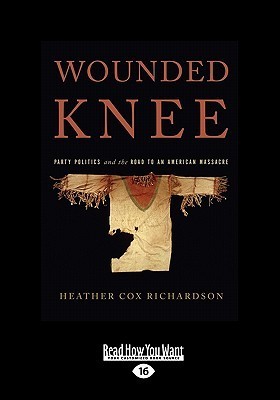
More on this book


Kindle Notes & Highlights

“It is no longer a government of the people, by the people, and for the people, but a government of Wall Street, by Wall Street, and for Wall Street.”
Their call for legislation was based in the widespread idea that hardworking Americans should be able to rise, but horrified Republican politicians and businessmen didn’t see it that way.
93

Footnote missing.
100
Footnote missing.
“By the peculiarities of his personal character, his petty selfishness, his unworthy nepotism, his dull conceit, and ungraciousness . . . with others, he made himself as thoroughly disliked as any President we have ever had.”
Theodore Roosevelt gave American navy promoters a boost when his book The Naval War of 1812
Alfred T. Mahan, produced his own classic work, The Influence of Sea Power Upon History, 1660-1783,
In 1892, following the show’s last performance in Glasgow, Kicking Bear lingered on the stage after the show was over. Speaking in Lakota, he told the uncomprehending crowd his own version of his life story. Sadly, that speech, like almost all Indian versions of history, was lost as soon as he spoke the words.
Like tears in rain.
Harrison lost the 1892 election to Grover Cleveland, who promised lower tariffs and civil service reform. Harrison fell into an oblivion from which he has never recovered, but which is a kinder historical fate than he deserved.
But Republicans had come to use the rhetoric of individualism to defend the very sort of economic oligarchy the party had organized in the 1850s to oppose. By the 1890s, the Republicans were the party of big business, hated by those trying to rise in American society.
The late nineteenth-century Republican approach to American government left a lasting legacy. The Harrison Republicans were consummate party politicians, willing to ignore reality, manipulate government machinery to stay in power, and destroy those in the way of their plans. Harrison’s men convinced themselves that the protection of big business through the tariff was crucial to the survival of the nation. They refused to recognize the artificial bubble of western growth or the growing gap between rich and poor in America, problems their own policies exacerbated. They saw protests as an attack
...more
“history must be true, otherwise it is not history.”
In 1927, American poet Stephen Vincent Benét wrote of his love for American places, noting the strength in their very names. He suggested that when he died: I shall not rest quiet in Montparnasse. I shall not lie easy at Winchelsea. You may bury my body in Sussex grass, You bury my tongue at Champmedy. I shall not be there. I shall rise and pass. Bury my heart at Wounded Knee.
“Why do we find so much evil and wickedness practiced by the nations composed of professedly ‘Christian’ individuals?”
